


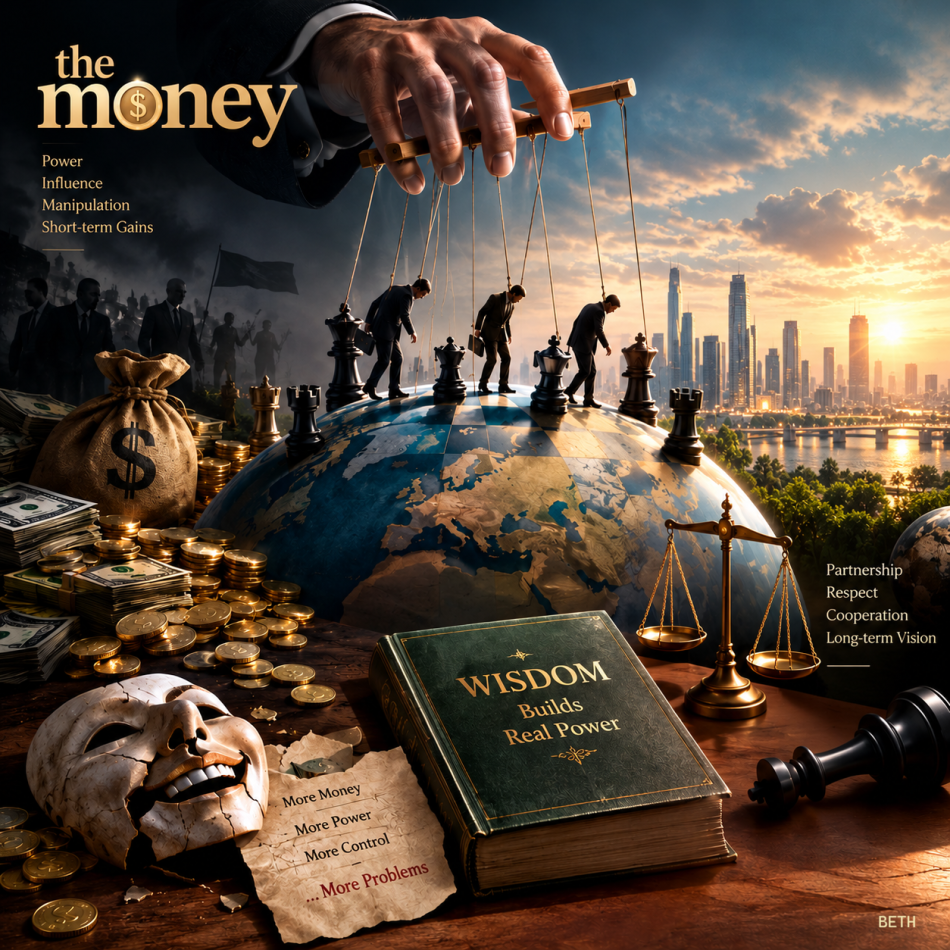
Who Shapes the World's Mind?

Who Shapes Global Public Opinion?
And Who Writes the Narrative Before the World Reads It?
Prepared & Interpreted by | Strategic Media Department – BETH Press
Supervised by: Abdullah Al-Omairah
Introduction
Every day, people read dozens of news stories.
They see hundreds of images.
They scroll past thousands of posts.
Yet few ever stop to ask the most important question:
Who decided that I should see this?
Is what I see truly the world as it is?
Or is it only a carefully selected part of reality—chosen, organized, and presented as if it were the whole picture?
This question goes far beyond politics.
It goes beyond journalism itself.
It concerns the way our awareness is formed, our beliefs are shaped, and our decisions are made.
That is why it is no longer enough to know what happened.
We also need to understand:
How did this story reach us in the first place?
The Media No Longer Works Alone
A few decades ago, it was reasonable to believe that newspapers, radio stations, and television networks shaped public opinion.
Today, however...
The picture has become far broader.
The media remains a central player.
But it is no longer the only one.
Today's information ecosystem includes:
- Digital platforms
- Technology companies
- Search engines
- Artificial intelligence
- Think tanks
- Public opinion research firms
- Public relations agencies
- The entertainment industry
- Social media influencers
Even universities—institutions that rarely produce news—often produce the ideas that later become news, policies, and public debates.
This leads to one of the most important questions of our time:
Who shapes the way people see the world?
At first glance, the answer may seem obvious.
A newspaper.
A television network.
A digital platform.
But the reality is far broader than that.
What reaches people each day is not created by a single medium, a single institution, or even a single country.
It is the product of an interconnected ecosystem in which news organizations, digital platforms, technology companies, search engines, artificial intelligence, think tanks, universities, public relations firms, the entertainment industry, and many other actors all contribute—each in different ways—to shaping public perception.
The real question, therefore, is no longer:
Who owns the biggest media outlet?
Rather:
Who has the greatest ability to shape the way people see the world?
Do Journalists Really Shape Public Opinion?
This is one of the most common questions in media.
It is also one of the most misleading.
Journalists do not work in isolation.
Editors do not make decisions in isolation.
Media organizations do not operate in isolation.
Every story passes through an entire ecosystem before it reaches the public:
Editorial priorities.
Institutional policies.
Legal frameworks.
Economic interests.
Target audiences.
Political environments.
And an intensely competitive media marketplace where thousands of platforms compete for the same human attention.
Journalists shape part of the story.
But the story itself is shaped by a much larger system.
Who Shapes the World's Mind?
The question may sound philosophical.
In reality, it is remarkably practical.
Those who influence what we read also influence what we think about.
And those who influence what we never read shape our understanding as well—often in ways that are far less visible.
This is why the most powerful tool of influence is not always misinformation.
Sometimes
It is selection.
Choosing one story over another.
One event instead of another.
One image instead of another.
One angle instead of another.
People build their understanding of the world from the information they receive—
Not from the information they never had the opportunity to see.
That is why awareness should not begin with the question:
What did I read today?
It should begin with another:
What didn't I read today?
Selection Is More Powerful Than Publication
Influence is not created only by what gets published.
It is also created by what never gets published at all.
That observation immediately raises two important questions:
Who decides what gets published?
And who decides what is left out?
Here we arrive at one of the most fundamental principles of modern media.
The key question is not:
Who publishes the news?
The real question is:
Who decides that this particular story should be published?
Publishing is an execution.
Selection is where the narrative begins.
Perhaps the more important question is not:
Who wrote the story?
But rather:
Who decided that the world should see it?
Who decides that one story deserves the headlines?
And who decides that another remains buried in the margins?
Is it the journalist?
The editor?
The media organization?
Editorial policy?
Audience demand?
Algorithms?
Commercial interests?
Or is it ultimately the result of all these forces interacting together?
A Principle That Changes the Way We Read the Media
The reality is simple:
Not everything that happens is published.
And not everything that is published represents everything that happened.
This is not an invitation to distrust journalism.
It is an invitation to understand how media narratives are constructed.
Understanding the media does not begin by reading what was published—or watching what was broadcast.
It begins by asking:
Why was this published?
And why wasn't something else?