


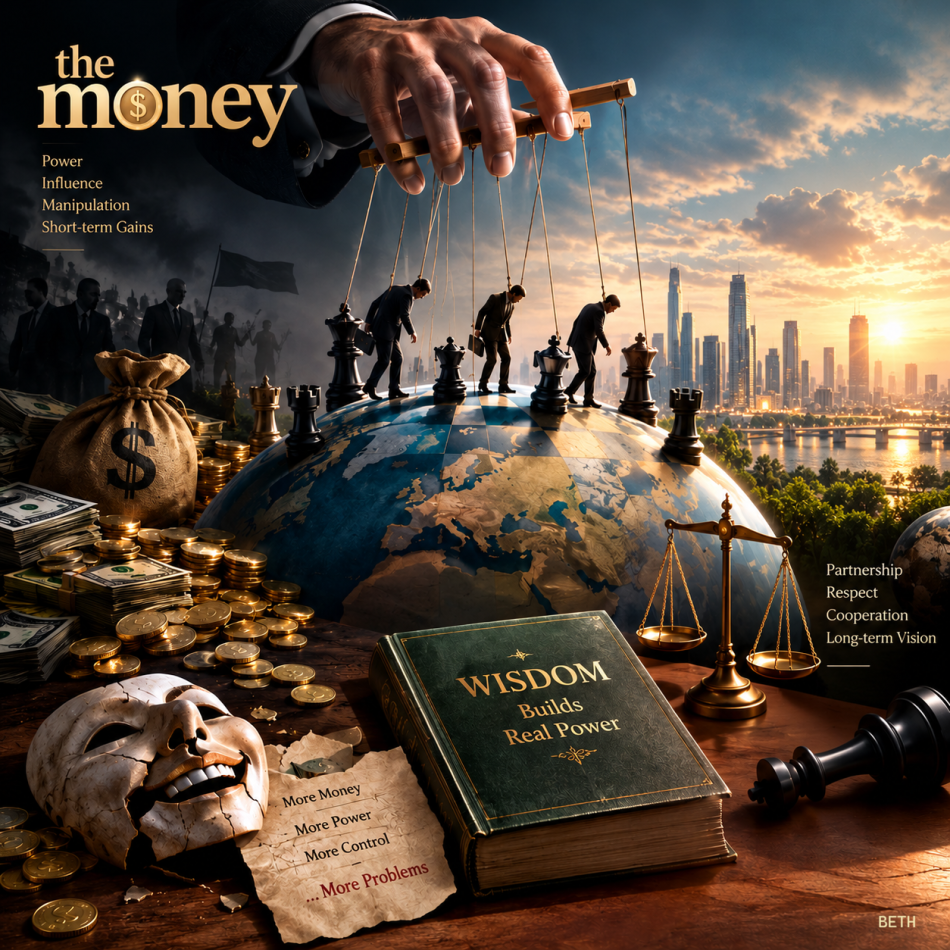
When the Revolution Turned Back
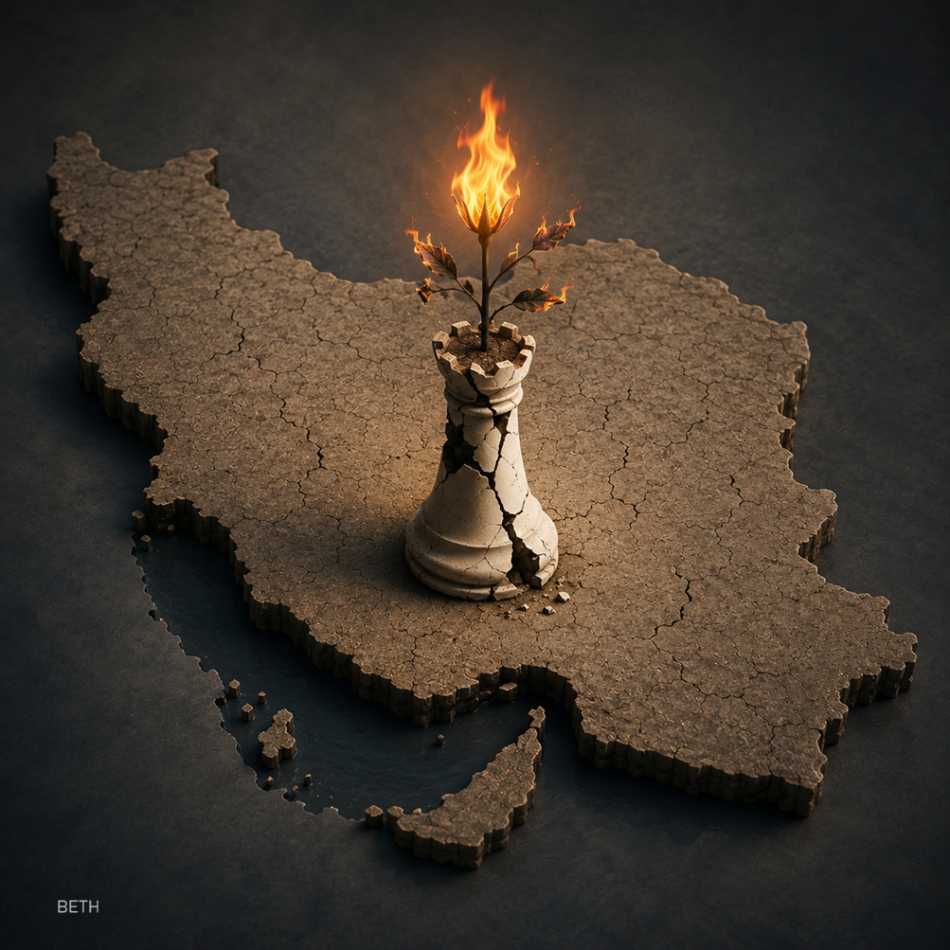
Forty-Seven Years of Exporting Crises .. Have the Flames Reached Their Source?
Prepared and Analyzed by | Strategic Media Department – BETH Agency
Supervised by: Abdullah Al-Omairah
Since the Iranian Revolution of 1979, the new regime has never treated the revolution as an event that ended with the establishment of the state.
Instead, it transformed it into a permanent project.
In the regime's vision, Iran ceased to be merely a nation defined by its borders and national interests. It became the base of an ideological and political project extending beyond its frontiers, seeking to shape the balance of power across other states.
From that vision emerged the most consequential doctrine:
Exporting the Revolution.
The objective was never to export a successful cultural or economic model. Rather, it was to build cross-border influence through armed groups, ideological loyalties, and parallel structures operating alongside—or beyond—the institutions of the state.
Over the past forty-seven years, the consequences of this strategy have become evident in Lebanon, Iraq, Yemen, and Syria, although in different forms and to varying degrees. In other countries, Iranian influence did not necessarily take a military form; instead, it appeared through political, media, or sectarian channels designed to establish networks of influence adapted to the social and political realities of each society.
Nor were the Iranian regime's efforts to build circles of influence confined to traditional conflict zones. They expanded, to varying degrees, into other societies through intellectual, sectarian, and media instruments tailored to the characteristics of each local environment.
Should this circle of influence continue to expand, its long-term impact could exceed that of armed extremist organizations. Its objective is not merely to control territory, but to shape ideas, redefine loyalties, and establish enduring influence from within those societies. In that sense, its effects could prove deeper and more lasting than those of organizations such as Al-Qaeda or ISIS, or even the influence exercised by militias and armed groups that have emerged across parts of the region.
In Lebanon, Hezbollah evolved into a military and political force whose influence, in some respects, extends beyond the authority of the state itself.
In Iraq, Iranian-aligned factions benefited from the vacuum created after the 2003 U.S.-led invasion and the fall of Saddam Hussein, eventually consolidating armed groups with significant political and security influence outside the traditional framework of the state.
In Yemen, the Houthis transformed from a local movement into an armed force capable of threatening neighboring countries and international maritime navigation.
In Syria, Iran intervened both militarily and politically, helping establish armed networks to protect its regional influence and preserve its strategic geographic connection with its allies.
These are not isolated events.
Nor are they disconnected episodes.
They are components of a single long-term strategy.
A strategy whose greatest price has been paid by the societies forced to live under the shadow of these groups, where conflict, division, and instability displaced development, while the rest of the world continued its march toward progress and prosperity.
In essence, the strategy sought to move the Iranian regime's defensive lines onto the territory of others.
What Does the United States Want?
The United States does not necessarily seek the same outcomes as the Gulf states or Israel.
Washington's primary objectives are to prevent Iran from acquiring nuclear weapons, protect American forces and allies, safeguard freedom of navigation and global energy flows, and reduce the ability of the Islamic Revolutionary Guard Corps (IRGC) and its affiliated groups to threaten U.S. interests.
At the same time, the United States also weighs the cost of regime collapse.
The American experience in Iraq demonstrated that removing a government can be far easier than building a stable state in its aftermath.
For that reason, Washington may, under certain circumstances, prefer a weakened, constrained, and deterrable Iranian regime over a comprehensive collapse that could trigger widespread instability or jeopardize the security of nuclear facilities, weapons, and state institutions inside a large and complex country.
This is the central dilemma:
Does the United States seek to eliminate the source of the threat?
Or does it seek only to manage that threat at a level compatible with its strategic interests?
If changing Iranian behavior is considered sufficient, Washington may accept the continuation of the current regime in exchange for agreements, guarantees, and concessions.
But if it concludes that the regime repeatedly uses every agreement to regain strength and ultimately resume the same policies, then behavioral change alone will no longer be enough.
What Does Israel Want?
Israel views Iran through a different strategic lens.
It sees Iran's nuclear program, ballistic missiles, Hezbollah, and Iranian-backed armed groups operating near its borders as components of a single integrated threat rather than separate security files.
For that reason, freezing uranium enrichment alone is insufficient if missile capabilities remain intact.
Likewise, reducing attacks by one proxy group means little if the broader network of proxies remains operational.
Nor does Israel regard a temporary agreement that suspends today's threat while allowing it to be rebuilt tomorrow as a durable solution.
Its objective is to dismantle Iran's capacity to encircle and threaten Israel, eliminate the risk posed by a potential nuclear weapons capability, and reduce the regional influence of the IRGC to a level from which its network cannot easily be reconstructed.
Yet Israel, like the United States, ultimately confronts the same fundamental question:
Who governs Iran if the current regime falls?
And would regime collapse produce a more stable state—or create a dangerous vacuum inside a large country possessing advanced military institutions, strategic infrastructure, and extensive nuclear expertise?
What Do the Gulf States Want?
The Gulf states do not seek a destroyed Iran.
Nor do they seek a fragmented Iran.
They have no strategic interest in instability within a large neighboring country located directly across the Gulf.
What they seek is a normal Iran.
A state that protects its interests from within its own borders.
A state that treats its neighbors as sovereign countries rather than arenas for influence.
A state that abandons armed groups as instruments of foreign policy.
A state that respects maritime security and chooses economic development, cooperation, and regional stability over missiles, militias, and the export of crises.
From the Gulf perspective, the concern is not the existence of a prosperous or economically strong Iran.
The concern lies in a political system that links its own strength to the weakening of neighboring states and treats regional instability as a legitimate instrument for expanding influence.
That is why reopening the Strait of Hormuz alone would not constitute a sufficient peace.
Nor would an agreement restricting Iran's nuclear program alone resolve the broader challenge.
The real measure of success is far more fundamental:
Will the political and military structures that generated the threat actually change?
Will the state's monopoly over the use of force be restored?
Will support for armed groups come to an end?
Will Arab societies cease to be treated as strategic arenas for defending the Iranian regime?
Who Has Benefited?
After forty-seven years, it is difficult to argue that the Iranian people have been the primary beneficiaries.
Generations of Iranians have paid the price for a project from which their daily lives gained far less than the institutions of power within the regime.
Nor have the peoples of Iraq, Lebanon, Yemen, and Syria emerged as beneficiaries, having endured years of conflict, armed groups, internal divisions, and external interventions.
Even the regional influence the regime succeeded in building came at a considerable cost.
It consumed financial resources, drained national capabilities, expanded the circle of adversaries, and transformed Iran from a country with the potential to become a major economic and civilizational power into one whose international image has become closely associated with terrorism, regional crises, sanctions, and missiles.
The greatest beneficiary was the regime itself.
The existence of a permanent external enemy provided justification for tightening control at home.
Exporting conflict reinforced the regime's image as the guardian of the Revolution.
Its network of armed groups supplied bargaining chips that conventional diplomacy alone could never provide.
Yet those very advantages also contain the seeds of their own danger.
A regime that depends on crisis to justify its existence will inevitably struggle to build genuine peace, because peace threatens not only its military instruments, but also the narrative upon which its legitimacy rests.
When Does the Strategy End?
The Iranian regime is unlikely to abandon this strategy simply because its costs become heavier for the state or for its citizens.
The state and the regime do not calculate costs in the same way.
What may appear to be an economic disaster from the perspective of the nation may be regarded by the regime as an acceptable price for survival.
What ordinary citizens experience as exhaustion and decline may be viewed by the Islamic Revolutionary Guard Corps as an investment in influence and security.
For that reason, a genuine transformation is unlikely to occur until the cost of sustaining the project becomes greater than its value to the regime itself.
When external armed networks can no longer shield Tehran.
When regional influence becomes a source of direct vulnerability rather than strategic protection.
When spending beyond Iran's borders fuels domestic anger that threatens the cohesion of the governing system.
And when the leadership finally recognizes that the Revolution it sought to export has begun importing war back into Iran itself.
Will the Regime Endure?
The regime may survive for years to come.
Or it may enter a period of instability sooner than many expect.
History shows that regimes do not collapse simply because they make mistakes, impoverish their societies, or even lose wars.
They collapse when external setbacks converge with internal divisions, economic deterioration, and a declining ability of the security apparatus to preserve the center of power.
The Iranian regime still possesses extensive security, military, and organizational institutions, together with decades of experience in suppressing dissent, managing crises, and using external threats to consolidate domestic authority.
Yet survival through coercion is not the same as long-term stability.
The regime may succeed in preventing its immediate collapse while gradually failing to govern a state capable of sustainable development and national progress.
This ultimately leads to the most fundamental question:
What value is there in preserving the regime if Iran itself continues to erode?
Conclusion
Forty-seven years ago, the Iranian regime sought to make the Revolution greater than Iran itself.
It built armed groups, opened multiple fronts, exported its conflicts beyond its borders, and invested in the weakness of neighboring states and the divisions within their societies.
But the Revolution that once searched for distant arenas has now returned home in a different form.
It has returned as sanctions.
As isolation.
As military strikes.
As growing concern over the survival of the regime.
And as mounting pressure on the Iranian state itself.
The central question is therefore no longer simply:
When will the Iranian regime abandon its strategy of exporting instability?
The deeper question is:
Can it abandon that strategy without abandoning the very idea upon which its legitimacy and survival have been built?
If the Revolution remains the backbone of the regime, and exporting it remains the principal mechanism for protecting it, then lasting peace requires more than another agreement.
For the first time in forty-seven years, Tehran faces a fundamental choice:
Should it continue protecting the Revolution for the sake of the regime—or begin protecting Iran for the sake of the nation?
States may postpone confronting their own crises.
They may export them beyond their borders and even gain influence or strategic advantage in doing so.
But history never erases the bill. It merely postpones the date of payment. And when that day finally arrives, the cost is often greater than all the gains their architects once believed they had achieved.