


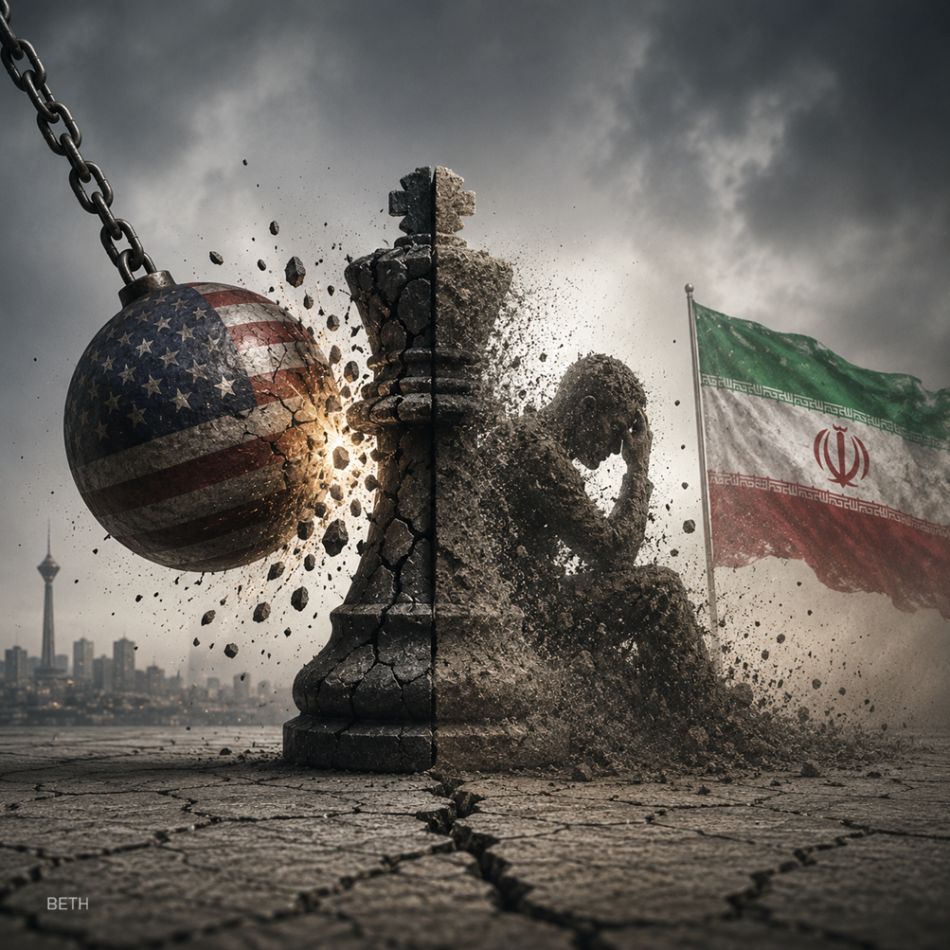
Day 134 🇺🇸⚔️🇮🇷: From Breaking Power .. to Breaking Will
BETH | B
The United States expanded its military operations inside Iran on Thursday, extending its strikes to northern parts of the country for the first time since the current confrontation began. The attacks targeted sites near Tehran and Semnan Province, as well as locations in Hamadan, Lorestan, Markazi, Khuzestan, Hormozgan, and Sistan and Baluchestan, marking an escalation that reflects the expansion of military operations to new objectives while fighting around the Strait of Hormuz continues.
In a related development, the U.S. military announced that it had intercepted and disabled an oil tanker bound for Kharg Island, Iran's largest oil export terminal, accusing it of attempting to breach the maritime blockade that Washington recently reimposed on Iran.
In response, Tehran launched missiles and drones toward Bahrain, Jordan, and Kuwait, while warning that any continued U.S. attacks on Iranian infrastructure would trigger a broader expansion of military operations. Iranian officials also reaffirmed that the Strait of Hormuz remains a "red line."
Politically, U.S. Vice President J.D. Vance said that tensions between the "hardline" and "pragmatic" factions inside Iran had contributed to the renewed confrontation, describing the administration's approach as "a delicate diplomatic dance" and stressing that opportunities for a political solution still exist despite the recent military escalation.
Meanwhile, U.S. Secretary of Defense Pete Hegseth and Israeli Defense Minister Israel Katz discussed the latest developments in the military campaign and agreed to maintain close coordination in response to the rapidly evolving regional situation.
Analysis
What is unfolding today goes beyond the geographical expansion of military strikes inside Iran.
The United States no longer appears focused solely on weakening Iran's military capabilities. It now seems to be moving gradually toward reshaping the calculations of the Iranian leadership itself.
The expansion of strikes into new regions, the targeting of infrastructure linked to Iran's missile program, and the tightening of pressure on Iranian oil exports all suggest that Washington is seeking to narrow Tehran's strategic options and increase the cost of continuing the confrontation, rather than merely achieving immediate battlefield gains.
Iran, in turn, is attempting to broaden the scope of its response—not only to demonstrate its military capabilities, but also to convince its adversaries that sustained pressure will inevitably lead to a wider regional escalation, raising the cost of war for everyone involved.
Equally significant is that the U.S. Vice President's remarks focused less on the strikes themselves than on the decision-making dynamics inside Iran. His reference to divisions within the Iranian leadership reflects growing attention to how decisions are made in Tehran, rather than merely to the consequences of those decisions.
This suggests that the conflict may be entering a different phase.
If the early stages of the war were aimed at breaking military power, the current phase appears increasingly focused on breaking political will—pressuring decision-makers to conclude that the cost of continuing the confrontation has become greater than the cost of changing course.
BETH Perspective
In major wars, victory is not always achieved by destroying what the adversary possesses.
More often, it is achieved by changing what the adversary believes it must do.
Military strikes, economic pressure, political signaling, and close observation of divisions within the opposing leadership can all become instruments serving the same strategic objective: narrowing the leadership's available choices until changing course becomes less costly than maintaining it.
The central question today, therefore, is not:
How far will the strikes go?
Rather, it is:
What decision are these strikes ultimately intended to change?