



Day 164: The Passage Blocks Peace
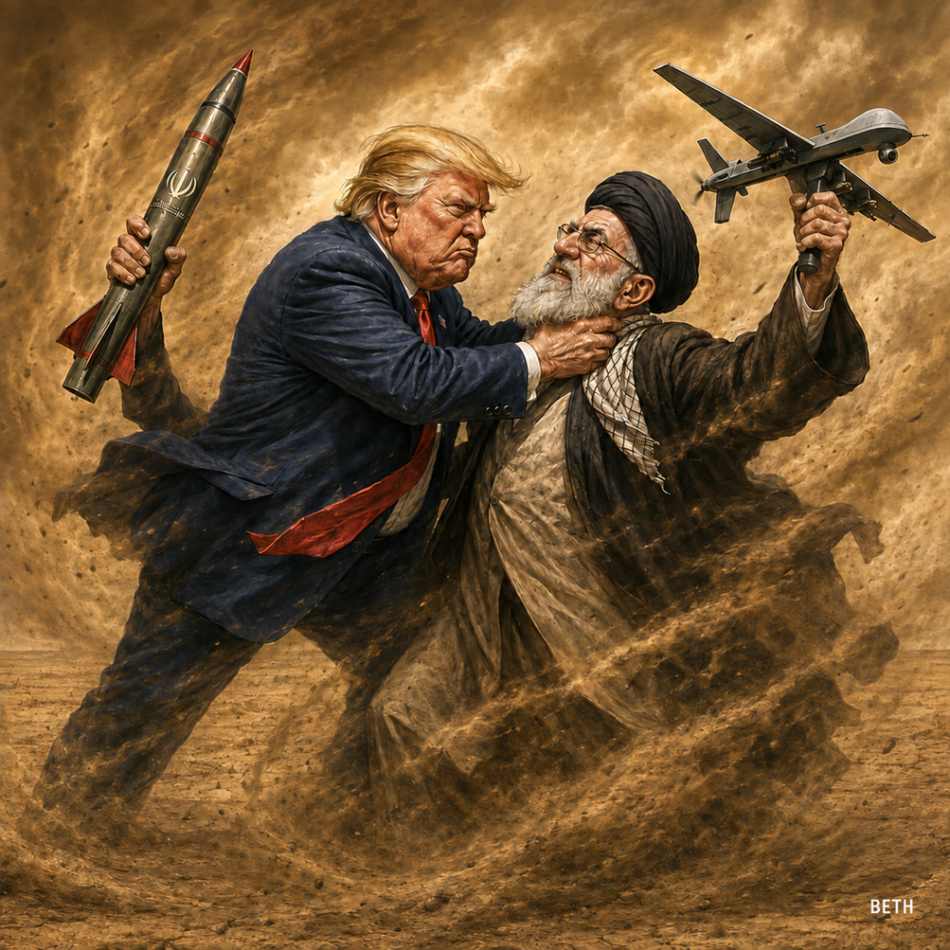
Iran separates maritime arrangements from political negotiations, while Washington shifts from military threats to economic strangulation, as attacks on vessels reveal that an Oman-brokered agreement may regulate passage without ending the war
Follow-up and Analysis | Strategic Media Department – BETH Agency
The US-Israeli war with Iran entered its 164th day without new large-scale strikes inside Iranian territory, yet it has not entered the path toward peace either.
The relative military calm does not indicate that a settlement is approaching. Instead, it reveals that the confrontation has moved into a more complex phase, in which the Strait of Hormuz, sanctions, shipping movements, and energy prices are being used as instruments of mutual pressure.
In Iran’s latest position, Foreign Minister Abbas Araghchi said the United States must meet Iran’s conditions before full shipping traffic through the Strait of Hormuz can resume, stressing that Tehran has not decided to return to negotiations with Washington.
He explained that messages exchanged through Qatar and Pakistan do not constitute negotiations, while separate talks with Oman are focused on defining a maritime route through the strait.
This reveals the most significant aspect of Iran’s new position:
Tehran is separating the regulation of traffic through Hormuz from the full reopening of the strait and the resumption of negotiations with the United States.
This means that a potential agreement with Oman, even if finalized, may not be an agreement to end the crisis. Instead, it could be a technical and security arrangement allowing limited passage under rules and guarantees acceptable to Iran.
Attacks Disrupt the Process
Iran’s statements coincided with continuing attacks on vessels transiting the strait. ADNOC announced that one of its vessels had come under a new attack—the third targeting its ships within a week—with no injuries reported. Another cargo vessel was struck by an unidentified projectile.
Traffic through the strait remains extremely limited compared with the more than 130 vessels that crossed it daily before the war.
These attacks do not appear separate from the political process. They send a practical message that Iran intends to retain the authority to determine which vessels may pass, even while negotiations continue over the maritime route proposed with Oman.
The dispute has therefore become larger than the reopening of a shipping lane. It now revolves around a question of sovereignty:
Who sets the rules of passage through Hormuz: Iran, the United States through its naval power, or a regional arrangement brokered by Oman?
Washington Changes Its Instrument
Meanwhile, the administration of President Donald Trump is moving toward intensifying economic pressure rather than immediately returning to a large-scale air campaign.
US officials have confirmed that the blockade of Iranian ports will continue, alongside preparations for tougher financial sanctions. Trump has also linked the cost of the war and the effort to prevent Iran from acquiring a nuclear weapon to control over navigation through the strait.
This shift does not mean that the military option has been ruled out. It indicates, however, that Washington wants to turn time into a burden on the Iranian economy without bearing the cost of another prolonged round of strikes.
Tehran, for its part, is attempting to reverse the same equation. Every day the strait remains nearly closed increases the cost of the war for energy markets and importing nations, adding pressure on the United States to accept a settlement.
Each side is trying to make time work against the other.
Israel Expands the Pressure
On the Israeli front, there are no indications that a large-scale air campaign inside Iran is about to resume. Israel, however, continues to operate against forces and fronts associated with Tehran.
Seven people were killed and three wounded in an Israeli strike on southern Lebanon, in one of the deadliest attacks since the June 20 ceasefire between Israel and Hezbollah. The strike underscores the fragility of the truce and the possibility that the Lebanese front could return to escalation.
At this stage, Israel appears to prefer maintaining pressure on Iran’s regional proxies and influence, while leaving the direct maritime and economic confrontation with Tehran to the United States.
The War Pollutes the Sea
The crisis has begun to leave consequences extending beyond security and energy.
Satellite images have revealed oil slicks near Qeshm Island, one of which is believed to be linked to a vessel damaged in an earlier attack. Regional tensions are also obstructing salvage and containment efforts.
The closure of the strait therefore no longer threatens trade alone; it also endangers the marine environment and the coastlines of the Gulf.
Why Does Iran Refuse to Call the Messages Negotiations?
Araghchi deliberately rejected describing the messages exchanged through Qatar and Pakistan as “negotiations,” because acknowledging that talks are taking place could be interpreted domestically and internationally as a retreat under US pressure.
Tehran is therefore maintaining three distinct levels:
- Indirect messages that do not politically bind Iran.
- Maritime arrangements with Oman that do not amount to reopening the strait.
- Political negotiations that will not begin until Washington responds to Iran’s conditions.
This formula gives Iran room to maneuver. It can facilitate the passage of some vessels to ease international pressure without surrendering the Hormuz card or formally announcing a return to the negotiating table.
What Does Tehran Want?
Iran wants to convert its effective control over maritime passage into political gains, including an end to the war, the easing or lifting of sanctions, the termination of the blockade on its ports, the release of frozen assets, and guarantees against renewed strikes.
The United States wants the opposite: the reopening of the strait first, followed by discussions on the remaining issues, while retaining the blockade and sanctions as instruments of pressure.
Between these two positions lies the central deadlock:
Washington wants the passage before the settlement; Tehran wants the settlement as the price of reopening the passage.
Expected Outcomes
Most Likely: Limited Passage Without Peace
The most likely scenario is an Omani arrangement allowing a larger number of vessels to pass through a designated route, supported by a notification or security coordination mechanism, without announcing the full reopening of the strait.
Such an arrangement would provide markets with a degree of reassurance, but it would neither end the US blockade nor automatically restore political negotiations.
Most Dangerous: An Incident That Triggers a Strike
Fatalities resulting from an attack on a vessel, serious damage to a major tanker, or the targeting of a US naval asset could trigger a swift and limited response against maritime installations or Islamic Revolutionary Guard Corps positions.
This would not necessarily signal the return of a comprehensive air campaign, but it could destroy the progress achieved through Omani mediation and lead to an even tighter closure of the strait.
Most Distant: A Comprehensive Deal
A major settlement does not appear imminent. The dispute is no longer confined to Iran’s nuclear program; it now includes the blockade, sanctions, compensation, freedom of navigation, the definition of sovereignty over the strait, and guarantees against the resumption of war.
Any comprehensive agreement would require these issues to be resolved through a gradual and synchronized arrangement—something for which neither side has yet demonstrated sufficient political will.
Assessment
Day 164 does not mark the beginning of negotiations. It marks an attempt to define the conditions required to reach them.
Iran does not want to reopen Hormuz without receiving something in return, while the United States does not want to reward Tehran for closing it. Between them, Oman is attempting to build a narrow maritime passage through a much larger political crisis.
An agreement on the shipping route may be possible, but opening a route for vessels does not necessarily open a path to peace.
This is no longer merely a war over control of the strait; it is a war over who will pay the price of reopening it.