



Day 162: Wrestling in the Hormuz Arena
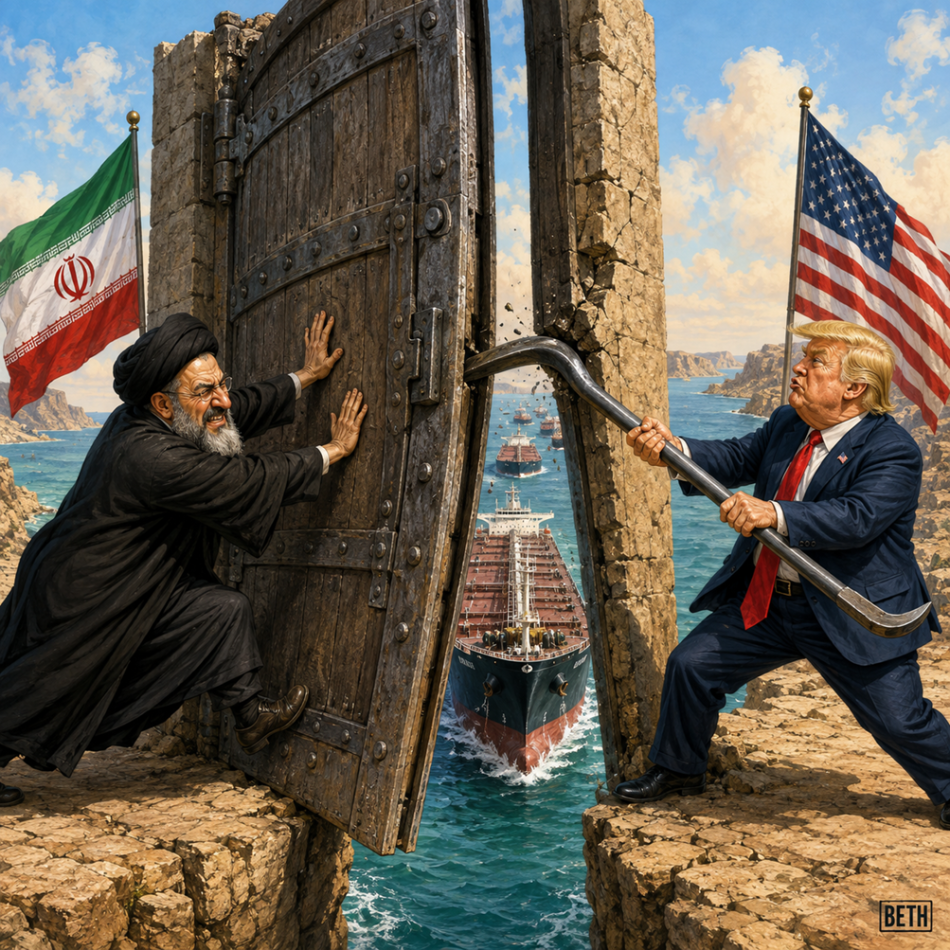
Washington declares full control over the Strait of Hormuz, while Tehran insists that it alone holds the authority to open it. Meanwhile, vessel traffic indicates that the passage has not returned to normal and that the war has shifted from broad exchanges of strikes to a struggle over who controls passage and sets its terms.
Monitoring and Analysis | Strategic Media Department – BETH Agency
Supervised by: Abdullah Al-Omairah
The Current Scene
The U.S.-Iran war entered its 162nd day without a return to broad airstrikes, but the military calm has not translated into a political settlement.
U.S. President Donald Trump declared that the United States has “total control” over the Strait of Hormuz, describing the U.S. naval deployment as a wall preventing Iran from imposing its will on the passage.
Tehran, however, rejected the American narrative and affirmed that the strait would not reopen normally until Washington responded to its conditions, foremost among them lifting the blockade on Iranian ports, releasing frozen assets, and establishing enforceable U.S. commitments.
The dispute is therefore no longer merely about reopening the strait, but about the more difficult question:
Who has the authority to define an open strait: American naval power, or Iranian geography and sovereignty?
No Extension of the Understanding
Iranian sources denied that negotiations were underway to extend the June agreement, saying the deal had collapsed after the United States failed to fulfill its obligations and that current contacts were taking place indirectly through mediators.
Tehran is demanding a return to the previous agreement before moving to new negotiations, while Washington maintains that Iran must first reopen the strait and stop threatening vessels.
This means the two sides are divided not only over the details, but over the starting point:
Washington says: Open the strait, then we negotiate.
Tehran says: Fulfill your commitments, then we open it.
So far, no formula has emerged that can break this reversed sequence.
Control Does Not Mean Reopening
The United States presents figures indicating that nearly nine million barrels per day are passing through Hormuz and that the region’s total exports through the strait and alternative routes amount to approximately 15 million barrels.
Ship-tracking data, however, paints a different picture. It estimates actual flows through the strait at between 1.74 million and 6.98 million barrels per day, while regional exports before the war were close to 18.7 million barrels.
Part of the discrepancy may result from vessels switching off their tracking systems or from the use of alternative pipelines and routes. Nevertheless, the scale of the gap makes the U.S. statements appear closer to a political narrative of control than definitive evidence that normal navigation has resumed.
Naval power can protect a vessel during its passage, but it cannot by itself restore confidence among shipping companies, insurers, and crews.
The first ship may pass under military protection, but normal navigation will not return until the market is confident that the next ship can pass without it.
The Battle Moves to the Ships
On August 11, U.S. forces opened fire on the Panama-flagged cargo ship Vela Nova, saying the vessel had attempted to break the blockade imposed on Iran and that a U.S. helicopter had targeted its engine room.
The incident shows that Washington has moved from attempting to open the passage in the face of Iranian restrictions to imposing its own restrictions on ships heading to Iran.
Here, the central paradox of the war emerges:
Each side claims to be protecting freedom of navigation, while using navigation itself to pressure the other.
The incident also increases the risk that a war between two states could become an international crisis involving vessels, crews, companies, and flag states that are not directly involved in the conflict.
What Does Trump Want?
The U.S. president has clearly outlined three possible courses:
- Continue military and naval pressure.
- Carry out stronger strikes if Iran rejects the conditions.
- Intensify the economic strangulation until Iran’s internal situation becomes unsustainable.
Trump’s conduct in recent weeks, however, suggests that he uses the threat of strikes to compel mediators to extract an Iranian concession, then postpones action whenever the possibility of an agreement emerges.
His claim of “total control” therefore does not necessarily mean that a broad strike is imminent. It may instead be an attempt to convince Iran that the Hormuz card has lost its value and push Tehran toward negotiations before Washington is forced to prove that claim militarily.
What Does Iran Want?
Tehran understands that it cannot match American power in an open confrontation. It also knows, however, that Washington has so far been unable to translate its military superiority into a political end to the war.
Iran therefore continues to hold on to Hormuz because it remains its most important source of leverage:
- It raises the cost of the war for the global economy.
- It gives Iran influence in any negotiations.
- It prevents Washington from declaring a complete victory.
- It links energy security to lifting the blockade on Iranian ports.
Yet the continued closure also places pressure on Iran itself and threatens to isolate it from countries that may understand its political demands but will not accept the disruption of their trade and global energy supplies.
Hormuz gives Iran negotiating leverage, but over time it could become an economic and political burden.
What Comes Next?
The most likely scenario in the coming days is neither a comprehensive peace nor an immediate return to broad bombing, but rather calibrated escalation at sea:
A Protected Trial Passage
Mediators may push for a limited number of vessels to pass through agreed routes, without Iran declaring the strait fully open and without the United States immediately lifting its blockade.
Separating Hormuz from the War
Washington will seek a separate maritime agreement preventing attacks on vessels, while postponing the nuclear file, sanctions, and compensation to later negotiations. Iran, however, will resist such a separation until it receives a clear economic concession.
Selective Escalation
If mediation fails, the United States may strike specific Iranian coastal or naval capabilities instead of immediately returning to a prolonged air campaign inside Iran.
Testing the U.S. Blockade
Tehran may send additional vessels toward its ports or use non-Iranian ships and more complex transport networks to test Washington’s ability to enforce its blockade without provoking a confrontation with third countries.
The Flashpoint
The most dangerous aspect of the current phase is that the decision to restart the war is no longer confined to the White House or Iran’s leadership.
A vessel straying off course, an unidentified drone, a field commander misjudging the approach of a naval vessel, or an attack on an energy facility in the Gulf or the Red Sea could ignite the confrontation.
This makes the present calm more fragile than it appears, because the number of forces, weapons, and threatened passageways increases the possibility that an incident could precede the political decision.
Assessment
The United States does not control Hormuz in the full political sense, nor does Iran control it in the absolute military sense.
Washington possesses the power to enforce passage, while Tehran retains the ability to keep that passage dangerous and costly.
Each side is therefore attempting to declare victory before reaching an agreement.
Trump wants the strait to reopen as a result of American power.
Iran wants it to reopen as a result of American concessions.
Between the two narratives, the markets are waiting for the first vessels to pass regularly, not the first statements to emerge from Washington or Tehran.
The war has not moved closer to peace, but it has entered a battle over who will write the terms of passage. If mediators fail to find a formula that allows both sides to save face, Hormuz may become the place from which the next strike begins, rather than the route through which the war ends.