


BETH Eyes in the Capitals of Decision
The World Guards Its Gateways
From Hormuz and Bab al-Mandab to Taiwan, the Arctic, and Europe’s borders, the global press observes a world searching for alternative routes and new security guarantees
World Capitals | BETH
The global press no longer views wars merely as confrontations unfolding within national borders, but as threats transmitted through maritime passages, supply chains, energy markets, borders, and technology networks.
From Washington and London to Beijing and Tokyo, and from New Delhi to the capitals of the Middle East, one common thread emerged across today’s newspaper coverage:
The world is no longer concerned only with who wins wars, but with who can protect the routes through which everyday life passes.
Energy needs a strait, trade needs a canal, microchips need secure factories, nations need protected borders, and markets need confidence to prevent fear from turning into an economic crisis.
First: What Is Preoccupying the World
The War over Passages
Developments in the Strait of Hormuz and Bab al-Mandab featured prominently in international coverage after daily vessel traffic through Hormuz fell to between eight and 11 ships, compared with approximately 130 to 140 before the war.
Newspapers linked U.S. President Donald Trump’s declaration of “complete control” over Hormuz and the continuing decline in shipping traffic with the Houthi attack on the Tihamah in Bab al-Mandab, which killed six people: three Pakistanis, one Indonesian, and two members of Yemeni rescue teams.
In Western coverage, the issue is no longer merely a U.S.–Iranian dispute. It has become a test of the international system’s ability to protect its vital passages.
The United States is preventing vessels from reaching Iranian ports, Iran is linking the reopening of Hormuz to the lifting of the blockade, and the Houthis are threatening the alternative route through the Red Sea.
The world therefore faces the gradual closure of the primary passage and a simultaneous threat to the alternative route.
Oil Returns to the Forefront
Brent crude approached $90 a barrel amid maritime attacks and diminishing prospects for an agreement between Washington and Tehran.
The economic press focused on the effects of higher energy prices on inflation, transportation, aviation, and industry, particularly as markets awaited U.S. inflation data and central bank decisions.
The striking paradox, however, was that stock markets did not display the same degree of fear. European and U.S. indices remained relatively stable, while some Asian markets advanced.
Interpretations were divided:
- One view holds that investors expect a political agreement before the damage spreads.
- Another warns that markets have become accustomed to risk and may be underestimating the scale of the crisis.
Oil sees the war, while stocks behave as though peace is closer than it appears.
A New Route in the North
Disruption in Hormuz and Bab al-Mandab coincided with Chinese and European economic interest in the launch of a commercial shipping service along the Northern Sea Route in the Arctic.
The new Chinese route aims to reduce travel time between Asia and Europe while bypassing traditional passages threatened by conflict in the Middle East.
The Arctic route, however, is seasonal and costly, requires arrangements with Russia, and cannot yet accommodate the volume of trade moving through Suez and Bab al-Mandab.
Its importance nevertheless lies not in its present capacity, but in the message it carries:
The world has already begun searching for a geography that cannot be held hostage by a single war.
Tensions Shift to Asia
Asian and Western newspapers focused on the forthcoming naval exercises between China and Indonesia in waters east of Taiwan, as well as Taipei’s criticism of the drills as a Chinese attempt to project influence around the island.
The exercises coincided with Taiwanese defense drills and growing Chinese military activity, making the issue appear to be another extension of the struggle over strategic passages.
Taiwan is not merely a disputed island. It sits at the heart of global trade routes and is closely linked to the semiconductor industry on which the technology, defense, and artificial intelligence sectors depend.
If Hormuz tests energy security, Taiwan tests technology security.
The Ukraine War Turns Toward the Economy
European newspapers continued to follow Ukraine’s attacks on oil facilities inside Russia and Moscow’s use of North Korean missiles in strikes against Ukrainian cities.
The significant shift is that both sides are increasingly focusing on the economic capacity of their adversary.
Ukraine is striking refineries and energy facilities, while Russia targets infrastructure, cities, and electricity networks. Each side is attempting to make the continuation of the war more costly for the other.
This reflects the same principle now visible in the Middle East:
When a decisive military victory becomes difficult, war moves toward the economy, strategic passages, and the sources of life.
Weather Becomes a Security Story
Heatwaves, drought, and wildfires imposed themselves on European newspaper coverage, with Britain expected to record its hottest summer in history amid falling water reserves and rising demand for electricity and gas.
In China, the remnants of Typhoon Dolphin forced the evacuation of thousands of people from areas threatened by flooding and landslides, with massive rainfall forecast for Beijing.
Such stories are no longer presented as isolated natural phenomena, but as threats to energy, food, water, and infrastructure security.
Second: Domestic Priorities
United States: The War Comes Home
The U.S. press is focused on three interconnected issues:
Trump’s management of the war with Iran, rising fuel prices, and inflation data.
Analysts are asking whether the U.S. president has a strategy for ending the war or is simply replacing one objective with another: from the nuclear program to reopening Hormuz, from reopening Hormuz to blockading Iranian ports, and from military pressure to demanding complete surrender.
The disclosure of a secret flight to remove Trump from Türkiye during an Iranian threat also sparked debate over the gap between rhetoric of strength and the calculations of personal security.
Concerns over U.S. missile stockpiles and the rising cost of the war also remain prominent. What began as a military discussion has become a domestic question about the United States’ ability to sustain operations on multiple fronts.
Britain: A Crisis Behind Walls
The British press focused on prison overcrowding and the possibility of releasing inmates early to ease the pressure, amid fears that people convicted of serious crimes could be freed.
The issue appeared to reflect a deeper problem involving insufficient capacity, weak probation and rehabilitation services, and accumulated court cases.
The second crisis is record heat, drought, and wildfires, and the pressure they are placing on water, energy, and agricultural systems.
Britain is not confronting one major crisis, but several domestic systems that have simultaneously reached the limits of their capacity.
Europe: Borders Return
Migration and borders featured prominently in several European newspapers amid disagreements between EU states over inspection procedures and growing concern that temporary controls could become permanent borders within the Schengen Area.
In Hungary, the election of former judge András Baka as president attracted particular attention. It was seen as another step away from Viktor Orbán’s political legacy and a signal of efforts to rebuild more independent institutions.
The common thread is that Europe, which was founded on removing borders, is gradually rebuilding them because of migration, security, war, and internal political disputes.
China: Climate, Memory, and Power
The priorities of the Chinese and Asian press were divided among three areas:
- Evacuations caused by heavy rain and flooding.
- Naval exercises and relations with Southeast Asian nations.
- Preparations to mark the centenary of former Chinese President Jiang Zemin’s birth.
The revival of Jiang’s era carries a domestic message. His leadership was associated with China’s economic opening and rise within global trade, while Beijing today confronts a more divided international environment and escalating trade and technology conflicts.
Attention also focused on preparations for the Chinese-made COMAC passenger aircraft’s first international flight, a step that goes beyond civil aviation to challenge the dominance of Boeing and Airbus.
China is commemorating the era of its opening while preparing for a world that is becoming more closed.
Japan and Korea: Security First
Japanese newspapers focused on growing friction with China, while the Korean press followed North Korea’s launch of a ballistic missile as preparations continued for U.S.–South Korean military exercises.
Semiconductors and technology shares also remained at the forefront of economic coverage, with the Seoul market rising on gains by chip manufacturers.
Two inseparable issues therefore come together in East Asia:
Missiles guard the borders, while microchips guard the economy.
India: Jobs Confront Artificial Intelligence
The future of India’s information technology industry appeared among the leading Asian economic analyses, amid growing concern that artificial intelligence could reduce demand for the traditional jobs on which India built its digital services sector.
The danger is not limited to the loss of a small number of jobs. It involves reshaping an entire economic model based on exporting software services and operating support centers for global companies.
At the same time, New Delhi is monitoring energy security and maritime passages. India is one of the largest importers of Gulf oil, and any prolonged disruption in Hormuz would place pressure on the rupee, inflation, and transportation costs.
Middle East: Negotiations under Fire
The Iran war retained clear priority, but the focus shifted from airstrikes to three central questions:
- Who controls Hormuz?
- Can Pakistani and Omani mediation produce an agreement?
- Could Houthi escalation in Bab al-Mandab expand the maritime war?
In Lebanon, Israeli attacks on the south continued despite the truce. A vehicle was targeted, and an ambulance was subsequently damaged during the rescue operation.
Gaza, southern Lebanon, and Syria also remained sources of concern amid continuing disagreements between Trump and Israeli Prime Minister Benjamin Netanyahu over withdrawal and disarmament plans.
The region negotiates along one track while fire reshapes realities along another.
Third: What Matters to Saudi Arabia
Two Passages under Pressure
The most consequential issue for the Kingdom today is not a single event, but the connection between developments at two gateways:
- Hormuz is placing pressure on Gulf exports and energy markets.
- Bab al-Mandab is threatening Saudi Arabia’s alternative route through the Red Sea.
The attack on the Tihamah in Bab al-Mandab cannot be viewed solely within the context of Yemen. It came as larger volumes of oil and trade were being directed toward the Red Sea to reduce dependence on Hormuz.
The escalation is therefore attempting to encircle the alternative after disrupting the original route.
This increases the importance of the East–West Pipeline and the port of Yanbu. It also reveals the need to secure the entire Red Sea rather than merely protect an individual facility or vessel.
The Maritime Coalition Becomes a Necessity
When the Kingdom announced a maritime coalition attended by dozens of countries and publicly supported by 14 states, the initiative initially appeared preventive. Following the attack on the Tihamah, it has become a response to an existing threat.
The challenge is not merely to assemble warships, but to build a comprehensive system that includes:
- Early intelligence sharing.
- Protection of commercial vessels.
- Monitoring of drones and missiles.
- Coordination with shipping and insurance companies.
- Keeping ports and energy routes operating reliably.
The coalition’s success will not be measured by the number of naval vessels, but by the number of commercial ships that return to sea with confidence.
The Mecca Agreement Advances in Global Assessments
The international press continued to analyze the defense agreement between Saudi Arabia, Türkiye, and Pakistan, with two principal interpretations emerging.
The first views it as an attempt to build regional deterrence and reduce dependence on a single security guarantor.
The second considers it an additional layer of security rather than an alternative to existing relations with the United States and NATO.
The deaths of three Pakistanis in the Houthi attack nevertheless present the agreement with an early test—not necessarily through direct military intervention, but through political, intelligence, and maritime coordination among the three countries.
The broader significance is that Pakistan is no longer a mediator removed from the consequences of the war. The danger has reached its citizens, while threats in the Red Sea directly affect Saudi interests. Türkiye, meanwhile, possesses military expertise and a defense industry that could be employed in maritime protection.
Saudi Oil Faces Two Equations
Higher prices increase the value of Saudi oil exports, but they do not represent a pure gain for the Kingdom.
Prices driven by fear may be accompanied by:
- Higher insurance and transportation costs.
- Disruption to delivery schedules.
- A slowdown in the global economy.
- Higher costs for projects and imported materials.
- Faster efforts by consuming nations to find alternatives to oil.
Saudi Arabia’s interest therefore remains in stable prices and open passages, not a temporary surge created by war.
Markets See Resilience
Saudi Arabia’s benchmark index recorded a modest rise of approximately 0.1 percent, with slight gains for Aramco and Ma’aden shares despite heightened maritime tensions.
This movement does not mean markets are ignoring the danger. Rather, it indicates that they distinguish between political noise and the Saudi economy’s ability to manage crises and diversify its export and financing routes.
Continued pressure on Hormuz and Bab al-Mandab, however, will make shipping and insurance costs increasingly important in assessments of companies and sectors.
The Kingdom at the Center of the Solution
In contrast to the threatening rhetoric exchanged between Washington and Tehran, Saudi Arabia has maintained its emphasis on de-escalation and diplomatic solutions while simultaneously building instruments of deterrence and protection.
This dual approach distinguishes Saudi action:
Diplomacy to prevent war, and alliances to prevent its consequences from being imposed on the Kingdom.
Saudi Arabia cannot choose a geographic location far from strategic straits and crises, but it can prevent geography from becoming a source of weakness by diversifying routes, expanding partnerships, building maritime power, and linking energy security to the security of global trade.
Beyond the Headlines
The world’s newspapers are not preoccupied with a single war today, even though wars dominate their front pages.
At a deeper level, their concern is the fear of losing the route:
The oil route through Hormuz, the trade route through Bab al-Mandab, the container passage through the Panama Canal, the semiconductor route around Taiwan, transit routes within Europe, and the new maritime passage through the Arctic.
Strategic passages have become part of national power, alongside the military, the economy, and technology. A country dependent on a single route does not possess a supply chain; it possesses a vulnerable chokepoint.
The world that once built globalization around the shortest routes has begun rebuilding its security around multiple ones.
The Saudi BETH Perspective
Global press coverage reveals that the Mecca Agreement, the maritime coalition, the East–West Pipeline, and the Red Sea ports are not separate Saudi files. They are parts of a single answer to the question of the future:
How can the Kingdom protect its sovereign decisions and economy when strategic passages become instruments of war?
The answer taking shape in Riyadh is not based on replacing one alliance with another, nor one route with another single route. It is based on distributing both power and risk.
In a world where every nation guards its own gateway, Saudi Arabia is building a network that no single key can lock.
Another Perspective
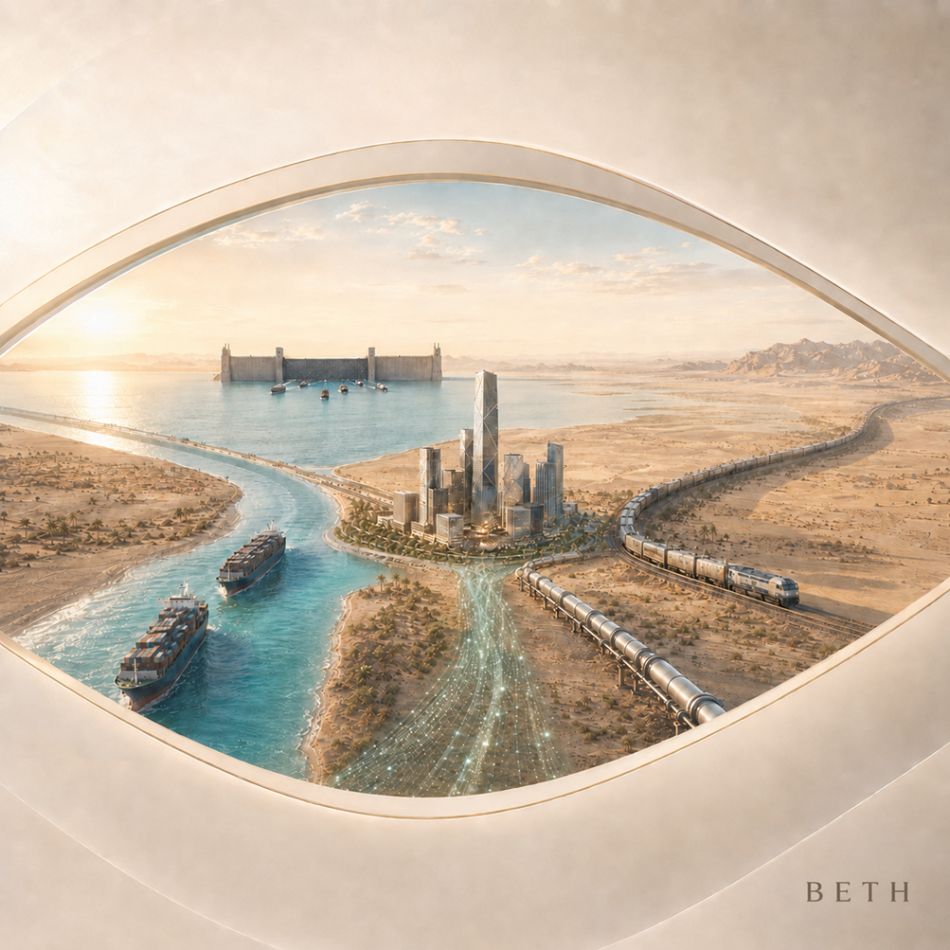
The image is symbolic rather than a realistic geographical map. It presents an artistic vision of the world’s routes and strategic passages, placing the Kingdom at its center as a point of connection among them rather than offering a precise representation of their locations and distances.