



Day 162: Control Does Not Open Hormuz
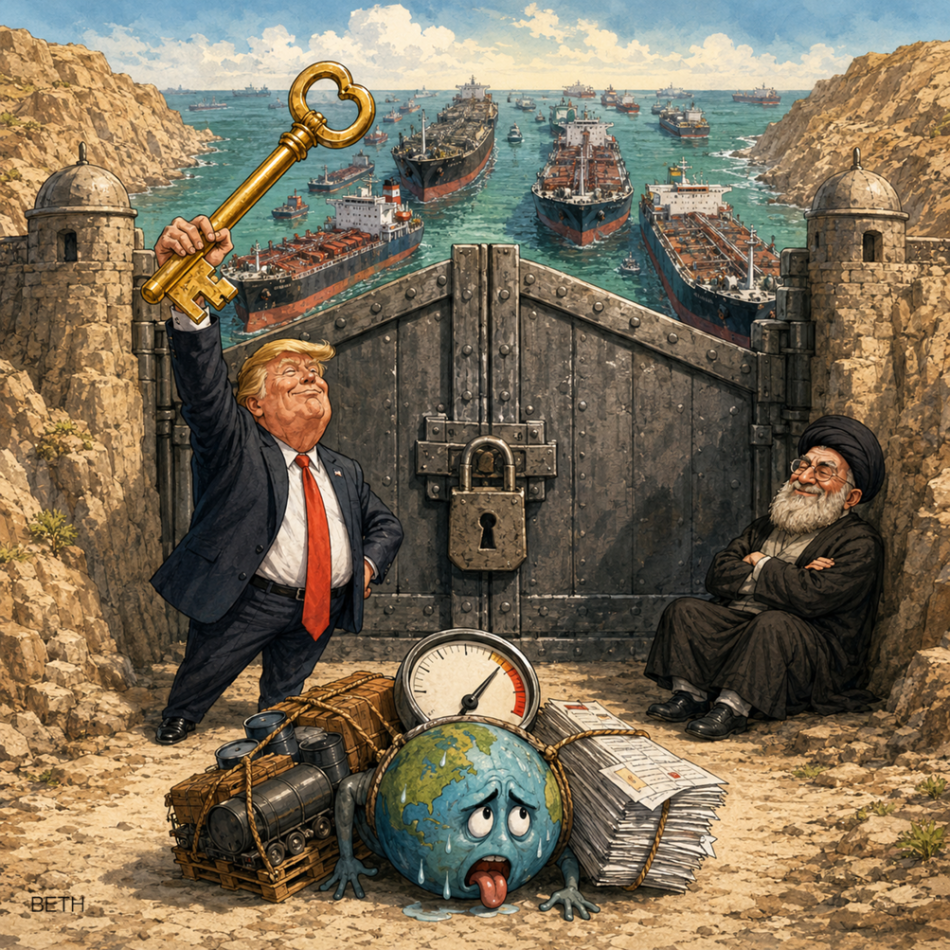
Washington declares that it controls Hormuz, while Tehran clings to the key to navigation. The war extends to Bab al-Mandab and strikes one of the peace mediators
BETH Follow-up and Analysis
U.S. President Donald Trump announced that the United States now exercises “complete control” over the Strait of Hormuz, stressing that Iran no longer controls it.
Shipping traffic, however, presented a different picture. The number of vessels that crossed the strait on Tuesday fell to between eight and 11, compared with approximately 130 to 140 vessels a day before the war. Only one vessel exited the strait that day, while the remaining ships entered through Iranian waters.
This reveals the greatest contradiction of Day 162: If the United States controls the strait, why is it unable to open it?
Military, Not Commercial, Control
The United States has the ability to monitor the strait, strike Iranian naval assets, intercept ships, and prevent them from reaching Iranian ports. But it cannot order shipping and insurance companies to return to a passage that remains exposed to mines, missiles, drones, and attack boats.
Military control means having the ability to strike the adversary. Opening the strait, however, means guaranteeing the safety of hundreds of vessels every day, clearing mines, continuously securing the passage, and convincing insurance companies that the danger has ended.
Washington, therefore, appears to control the battlefield around Hormuz, while Tehran remains capable of controlling the level of fear within it.
Evidence of this came when U.S. forces fired missiles from a helicopter at the Vela Nova in the Gulf of Oman, disabling the vessel after accusing it of attempting to breach the blockade imposed on Iranian ports. It was the third ship forcibly stopped by the United States since the blockade was reimposed in July.
In other words, U.S. power is currently being used in two seemingly contradictory directions:
- Preventing ships from reaching Iran.
- Demanding freedom of passage for other ships through Hormuz.
This gives Tehran its political argument: International navigation will not resume as long as the U.S. blockade keeps Iranian ports closed.
Will Trump Carry Out His Threat?
Trump outlined three options for dealing with Iran: maintaining the current pressure, launching powerful strikes, or economically strangling Tehran.
In practice, he has already begun implementing the third option. The naval blockade, sanctions, frozen Iranian assets, and prevention of vessels from entering Iranian ports represent an attempt to weaken the economy without immediately returning to a large-scale air war.
The threat to “hit Iran hard” remains a means of negotiating pressure. It could, however, turn into action if Iran or its allies targets a U.S. vessel, a Gulf energy facility, or a military base.
Tehran’s response was swift and clear: the strait will remain closed until the United States ends the war, lifts the blockade, releases frozen Iranian assets, and accepts other conditions conveyed through mediators.
The two sides now hold opposing blockades:
Washington is blockading Iran’s ports, while Tehran is blockading global trade.
What Happened to the Nuclear Issue?
A U.S. military intelligence assessment revealed that Iran’s priority has shifted from its nuclear program to controlling Hormuz because Tehran now views the strait as a faster and more powerful source of leverage.
This assessment does not mean that the nuclear program never existed. Iran is known to have possessed enrichment facilities and quantities of enriched uranium. Parts of the stockpile and some centrifuge sites are no longer subject to full verification following the suspension of inspections.
The different question is: Did Iran possess a nuclear bomb, or had it made a final decision to build one?
To date, there is no conclusive public evidence proving that Iran built a bomb or operated an integrated program to produce a deployable nuclear weapon. This legitimately recalls the experience of Iraq, but the two cases are not identical.
In Iraq, unconfirmed intelligence assessments were transformed into political certainty and used to justify war. The alleged weapons were never found. In Iran, the nuclear program, its facilities, and enriched material are documented facts. What remains unproven is whether those capabilities were converted into an actual weapon.
The new assessment may therefore mean one of two things:
First, the strikes may have genuinely weakened Iran’s nuclear capabilities, prompting Tehran to turn to its remaining geographic weapon: Hormuz.
Second, Washington may be reframing the justification for the war. As the nuclear issue recedes, “liberating the strait” becomes the new justification for sustaining military pressure.
The nuclear issue represented a potential threat. Hormuz, however, has become a daily source of damage visible in oil prices and shipping movements.
The Mediator Is Hit
In Bab al-Mandab, the cargo ship Tihamah was attacked with three Houthi ballistic missiles, killing four crew members—three Pakistanis and one Indonesian—as well as two Yemeni personnel involved in the rescue operation. Ten others were injured.
The gravity of the incident increased with reports from Yemeni authorities that another missile was fired while the dead and wounded were being evacuated.
The Houthis said they had targeted a vessel carrying Saudi military supplies but provided no evidence to support the claim. Tracking data, meanwhile, indicates that it was an Egyptian-owned commercial vessel.
There is no evidence that the Pakistani nationals were deliberately targeted because of their nationality. The political outcome, however, is painful: The country attempting to bring Washington and Tehran closer together has lost three of its citizens to fire from an Iranian ally.
The timing may carry three possible messages:
- Shifting pressure from Hormuz to Bab al-Mandab to demonstrate that resolving the crisis in one strait will not end the maritime war.
- Threatening alternative oil and trade routes that have shifted toward the Red Sea.
- Raising the cost of negotiations and demonstrating that Tehran is not the only actor capable of disrupting navigation.
The Houthis may have acted according to their own calculations, but the attack places Iran in an awkward position with Pakistan. Tehran needs Islamabad as a mediator, while its ally is killing Pakistani citizens in the Red Sea.
Other Developments
Oil prices rose again, with Brent crude approaching $90 a barrel amid diminishing hopes for a swift agreement and the continued decline in shipping traffic.
Despite the escalation, Pakistan said the United States and Iran were moving closer to a “peace arrangement or a deal.” The continuation of both blockades and maritime attacks, however, suggests that mediation may have brought the parties closer to a political formula, but not to an enforceable agreement.
Traffic through Bab al-Mandab also rose to approximately 30 vessels, compared with an average of around 25 over the preceding days, indicating that some ships may be attempting to use the Red Sea as an alternative to Hormuz. The Houthi attack now signals that the alternative route is not secure either.
BETH Analysis
Trump’s declaration of control over Hormuz is not merely a description of reality. It is also an attempt to strip Iran of its most important negotiating card. Tehran, meanwhile, does not need complete control of the strait. It only needs to keep the level of risk high enough to discourage ships and insurance companies from returning.
The shift in U.S. intelligence discourse from the nuclear issue to Hormuz reveals a broader transition in the war—from the question, “What might Iran build in the future?” to the more urgent question, “What can Iran disrupt today?”
The Bab al-Mandab attack also means that the confrontation is no longer centered on a single strait, but on an entire network of maritime passages. Every time the world attempts to bypass Hormuz, a new threat emerges at another gateway.
On Day 162, the central question is not who controls the sea, but who can give ships the confidence to cross it. So far, Washington has failed to open the passage, while Iran’s claim of controlling Hormuz has brought it no victory.
By Trump’s own logic, declaring that the United States exercises complete control over the strait means that Washington holds the power to open or close it. It therefore bears responsibility for its continued closure—not Iran alone.
The struggle for control has thus become a political farce: one side claims to possess the key, the other boasts of closing the gate, while the world pays the price for it remaining shut.