



Day 161: Who Controls Hormuz?
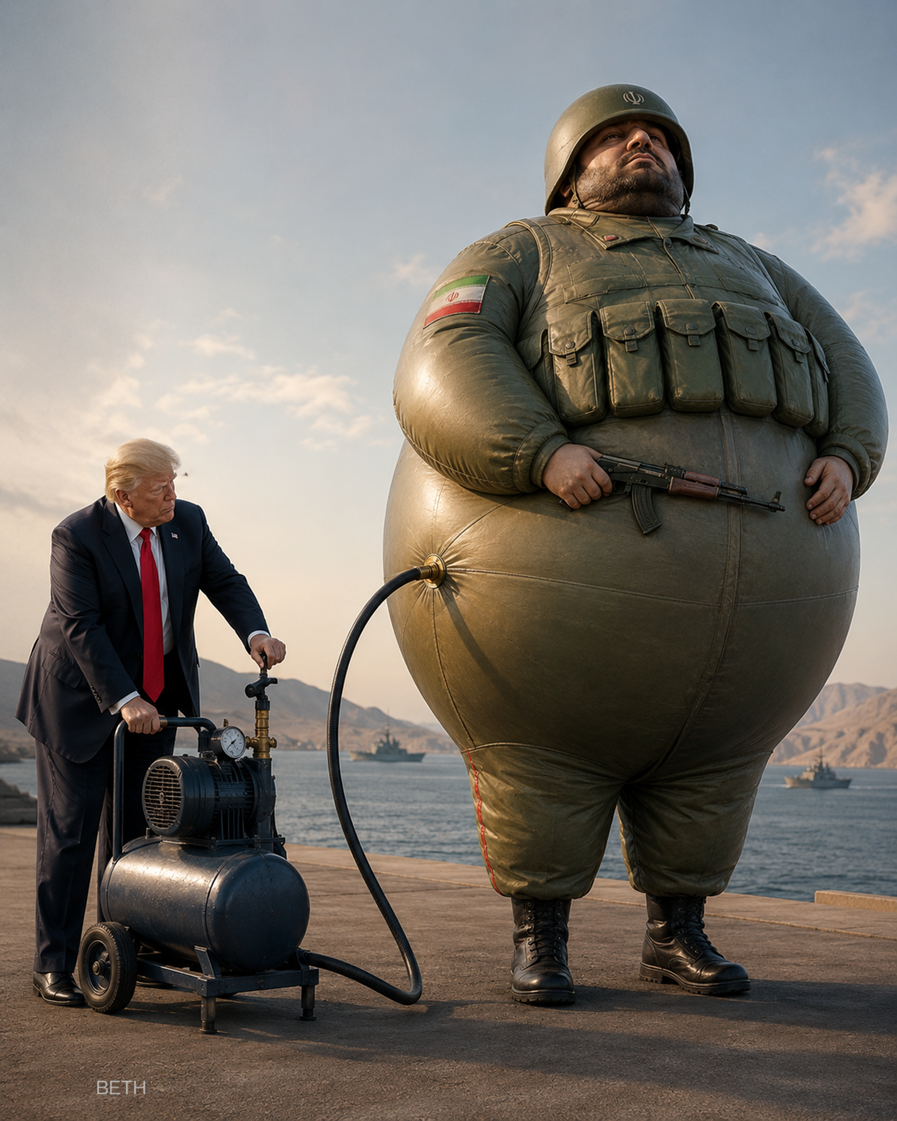
Trump declares U.S. Navy control of the strait, Iran holds to its conditions, while commercial traffic remains evidence that power has yet to become a solution
Follow-up and Analysis | BETH
Riyadh | BETH
The U.S.-Israeli war with Iran entered its 161st day as the confrontation shifted from intensive airstrikes to a more complex battle over the Strait of Hormuz, the economic blockade, the terms of a settlement, and who possesses the actual ability to impose an end to the war.
In his latest remarks, U.S. President Donald Trump said Iran was in a state of economic chaos and revealed three strategies his country was pursuing in dealing with it: monitoring the extent of its weakness, striking it hard, and maintaining economic pressure on it.
Trump had also declared that the U.S. Navy was the only force currently controlling the Strait of Hormuz and that it had cleared the entire waterway of Iranian mines. He also responded to Tehran’s demands for compensation for war damage by announcing that the United States would, in turn, demand compensation from Iran for the deaths, injuries, and damage it attributes to the country.
Yet, for all their force, these statements raise more questions than they answer. If the United States controls the strait and has cleared it of mines, why has maritime traffic not returned to normal levels? And who holds the real decision-making power in Hormuz: the force that controls it militarily, or the party still capable of undermining confidence in safe passage?
Three Strategies
The three strategies announced by Trump represent the clearest U.S. description yet of how the current phase is being managed.
The first is based on monitoring Iran’s condition to determine the extent to which the war, sanctions, and blockade have damaged its military capabilities, economy, and internal cohesion.
The second is to keep the option of powerful strikes available, whether to prevent the reconstruction of military sites, respond to another attempt to close the strait, or retaliate for attacks on U.S. forces and their allies.
The third is to maintain economic and financial pressure and push Tehran to negotiate from a weaker position without bearing the cost of a prolonged air war or a ground intervention.
This strategy suggests that the suspension of strikes does not mean the war is over. Rather, it marks a transition to a phase of attrition and surveillance in which the United States retains the option of returning to force whenever it believes Iran is rebuilding its capabilities or refusing to lower its demands.
But announcing the tools is not the same as possessing a final strategy. Washington has yet to clarify the objective it seeks to achieve: Is it merely reopening Hormuz, changing Iranian behavior, imposing a comprehensive political agreement, or simply weakening Tehran before withdrawing from the confrontation?
This is where the most dangerous gap in U.S. policy lies.
Control Is Not a Solution
U.S. military superiority settles the question of its theoretical ability to control the Strait of Hormuz. Iran does not possess a conventional naval force capable of confronting the U.S. Navy in an open war, and there is no comparison between the two sides in aviation, surveillance, weaponry, and the ability to destroy targets.
But declaring control does not mean the crisis is over.
Military control is measured by the ability of U.S. forces to enter the strait, clear mines, pursue boats, and strike launch sites. Restoring normal maritime traffic, however, is measured by the number of vessels passing through, lower insurance costs, the return of tankers, and the confidence of shipowners and crews that a voyage will not end with a missile strike, seizure, or another round of fighting.
The distinction therefore remains between controlling the sea and restoring economic activity to it.
If the mines have indeed been cleared while commercial passage remains limited, the problem is no longer solely military. It has become a crisis of confidence, guarantees, and political decision-making.
The United States may be capable of opening the waterway by force, but it has yet to prove that it can keep it open safely and consistently.
An Inflated Power
The war has shown that Iran is not the enormous military power its rhetoric has sought to portray, nor an adversary capable of matching the United States or Israel in a conventional air or naval confrontation.
Iranian facilities, bases, and military sites have been subjected to successive strikes, exposing the limitations of its air defenses. Tehran was also unable to prevent U.S. and Israeli forces from reaching targets inside its territory.
Iran’s main source of power does not lie in its ability to win a direct war, but in its capacity to disrupt its surroundings, obstruct strategic waterways, and use mines, boats, missiles, drones, and regional proxies to raise the cost of confronting it.
This is a fundamental distinction between power and the ability to cause disruption.
Over previous decades, U.S. and Israeli rhetoric has contributed to inflating Iran’s image and turning it into a threat exceeding its actual size. The existence of a formidable enemy gives Washington a justification for maintaining its forces, reinforces the region’s dependence on external protection, and helps Israel present itself as an indispensable security partner.
But the current war has exposed the contradiction: If Iran is this militarily weak and economically unstable, why has Washington so far been unable to end the Hormuz crisis and impose a stable settlement?
The answer lies not in Iran’s strength, but in the ambiguity of American resolve.
Why Has It Not Ended?
The problem does not appear to be a shortage of U.S. military power, but rather how that power is used and the limits of the political objective behind it.
The United States can strike Iranian sites, but it hesitates to assume responsibility for the day after. It can impose a blockade, but it does not want to remain indefinitely to protect every waterway, vessel, and facility. It also wants its allies to bear a greater share of the cost without always granting them an equal role in decision-making.
Washington may believe that sustained pressure is less costly than decisive action and that keeping Iran under blockade gives it political, economic, and military cards that can be used later.
The delay may also be part of a plan to weaken the Iranian regime gradually and push it to accept conditions it cannot accept now.
But another possibility remains: that the United States itself has not defined a clear end to the war and is managing the crisis day by day, using its superiority to prevent an Iranian victory without fully committing to a settlement that would protect the region once the fighting stops.
The Trust Problem
Regional concern is not about whether the United States can defeat Iran militarily. The disparity between them needs no proof.
The real concern is whether Washington will continue until it achieves the outcome it promised, or withdraw after the first agreement that serves a temporary interest, leaving its allies to deal with the consequences of the war.
The United States has a history of entering conflicts with force, raising expectations, and building local alliances, only to change its priorities or withdraw before the outcome is complete.
This occurred in Vietnam, Iraq, and Afghanistan, as well as in other regional files where U.S. commitments receded when administrations or domestic calculations changed.
This does not mean every U.S. intervention will end in the same way, but it makes confidence in the continuity of American decision-making an essential part of any realistic assessment of the current war.
The region does not merely need a declaration that the United States controls Hormuz today. It needs a guarantee that this control will not become a bargaining chip tomorrow, ending in a temporary agreement after which Iran reproduces the same threat in a different form.
Iran Raises the Price
Iran, meanwhile, is attempting to use what remains of the Hormuz card to raise the price of an agreement.
It knows that it cannot defeat the United States in an open confrontation, but it is counting on the continued cost of the crisis to pressure energy markets, insurance companies, and oil-importing countries, ultimately pushing Washington to make concessions.
Tehran has therefore expanded its demands beyond reopening the strait and lifting the blockade on its ports to include sanctions relief, the release of frozen funds, security guarantees, and compensation for damage caused by the strikes.
But this policy carries a serious risk for Iran itself.
Every day that disruption in Hormuz continues pushes affected countries to develop pipelines, alternative ports, external storage facilities, and trade routes that reduce their dependence on the strait.
What Iran is using today to raise the price of an agreement may become the very reason the strategic value of its last remaining card declines more quickly.
Two Competing Bills
The compensation issue has added another layer of complexity to the negotiations.
Iran wants to hold the United States and Israel responsible for damage to its facilities and economy. Trump, meanwhile, is demanding that Tehran compensate for deaths, injuries, and damage that Washington says were caused by Iran, its forces, and its proxies.
The negotiations are therefore no longer solely about reopening a maritime passage. They are also about two conflicting narratives of the war: who started it, who bears responsibility, and who should pay its bill.
It is unlikely that the compensation demands will lead to a financial settlement soon. Their present function is political and negotiating leverage, intended to prevent the opposing side from establishing its narrative as the only truth.
But introducing compensation into the talks raises the ceiling of demands and makes a comprehensive agreement more distant than it was only days ago.
Israel Waits
Israel is not directly involved in the Hormuz arrangements, but it remains capable of influencing their course.
Any new Israeli strike inside Iran could end the aerial lull and return the war to its starting point, particularly if Tel Aviv concludes that the Omani track is giving Tehran time to reorganize its capabilities.
Israeli calculations may also differ from those of the United States. Washington wants to restore maritime traffic and reduce the economic cost, while Israel may see continued military pressure as an opportunity to weaken Iran beyond the immediate objective of reopening the strait.
This divergence does not mean a rupture between the two allies, but it leaves the settlement vulnerable to a military decision that may not come from the party managing the negotiations.
Regional Proxies
Iran’s proxies remain part of the war equation, but they are not evidence of Tehran possessing unlimited power.
The Houthis can threaten shipping and launch drones and missiles. Some Iraqi factions can conduct limited attacks, while Hezbollah retains capabilities that must be taken into account.
But these actors are operating under mounting military and political pressure, and any expansion of their attacks could provoke responses greater than they can withstand.
The value of Iran’s proxies lies in their ability to disperse the fronts and increase the cost, not to decide the war in Iran’s favor.
If Tehran misjudges the limits of this card, it may find that using it extensively does not protect it, but instead gives its opponents a justification to strike both Iran and its proxies more forcefully.
Brief Analysis
Trump’s statements reveal that the United States does not see itself as the powerless party. At the same time, they do not prove that Washington possesses a complete plan for ending the crisis.
Iran is militarily and economically weaker than the image it has created for itself. Yet it benefits from Washington’s hesitation, the vulnerability of maritime traffic, market fears, and a history that leaves U.S. allies uncertain whether the commitment will continue to the end.
The continuing disruption in Hormuz should therefore not be interpreted as an Iranian victory, just as the U.S. declaration of control should not be treated as a complete resolution.
Iran possesses the ability to disrupt, and the United States possesses the power to respond. But the region is still waiting for the party that has a clear vision of what comes after the response.
What Comes Next?
The most likely scenario is continued economic pressure, accompanied by a limited and experimental reopening of the strait under U.S. naval monitoring or protection, while the Omani mediation is given additional time to reach broader arrangements.
Washington may use the passage of vessels to demonstrate that Iran no longer controls maritime traffic, while Tehran will attempt to portray any limited reopening as the result of its conditions and understandings with Oman.
U.S. strikes will remain a possibility if Iran attempts to lay new mines, target passing vessels, or rebuild capabilities that Washington considers a direct threat.
But the region should not overlook another possibility: that the United States and Iran may reach a temporary understanding that lowers tensions without addressing the roots of the problem or providing long-term guarantees to affected countries.
Washington may then declare its strategy a success, while Iran declares that it has endured. The region, however, would remain confronted with a postponed war rather than an ended one.
The issue is not whether the United States can defeat Iran, but whether it is prepared to complete the course after the world begins placing its trust in it.
On Day 161, the question is no longer who can control Hormuz, but who possesses the will and responsibility to keep it open after the warships depart and American calculations change.