



The Makkah Alliance: How Did the World Read the Birth of a New Power?
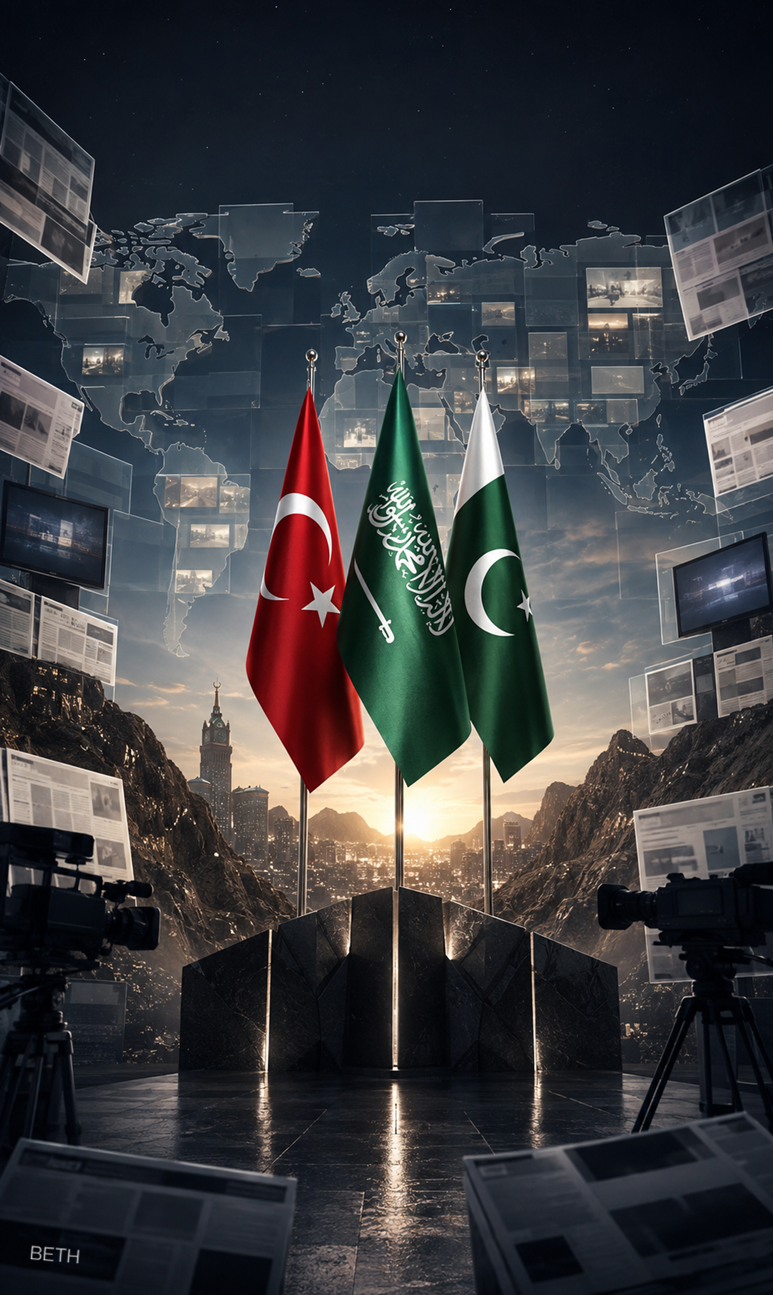
A single defence agreement described by Türkiye as building regional security, viewed by Pakistan as a strategic elevation, and read by the West as a move away from the American security umbrella, while India and Israel question how it may alter the balance of power
Monitoring and Analysis | BETH
Global media outlets did not differ over the importance of the joint defence agreement signed by Saudi Arabia, Türkiye and Pakistan in Makkah. They did, however, differ markedly in interpreting its motives and identifying the parties that might be affected by it.
Turkish media presented it as the foundation of a security order led by the countries of the region. The Pakistani press viewed it as elevating their defence relations to the level of an alliance, while Western media focused on the Kingdom’s pursuit of more diversified security partnerships.
Indian media, meanwhile, was preoccupied with Pakistan’s military and nuclear weight, while Israeli media framed the agreement as an alignment of three major Islamic powers.
The Makkah Agreement was therefore not a single story across the world’s capitals. It became a mirror reflecting the concerns and calculations of each capital.
Türkiye | Shaping the Order
Turkish coverage was the clearest in presenting the agreement as a historic event, rather than merely an expansion of military cooperation.
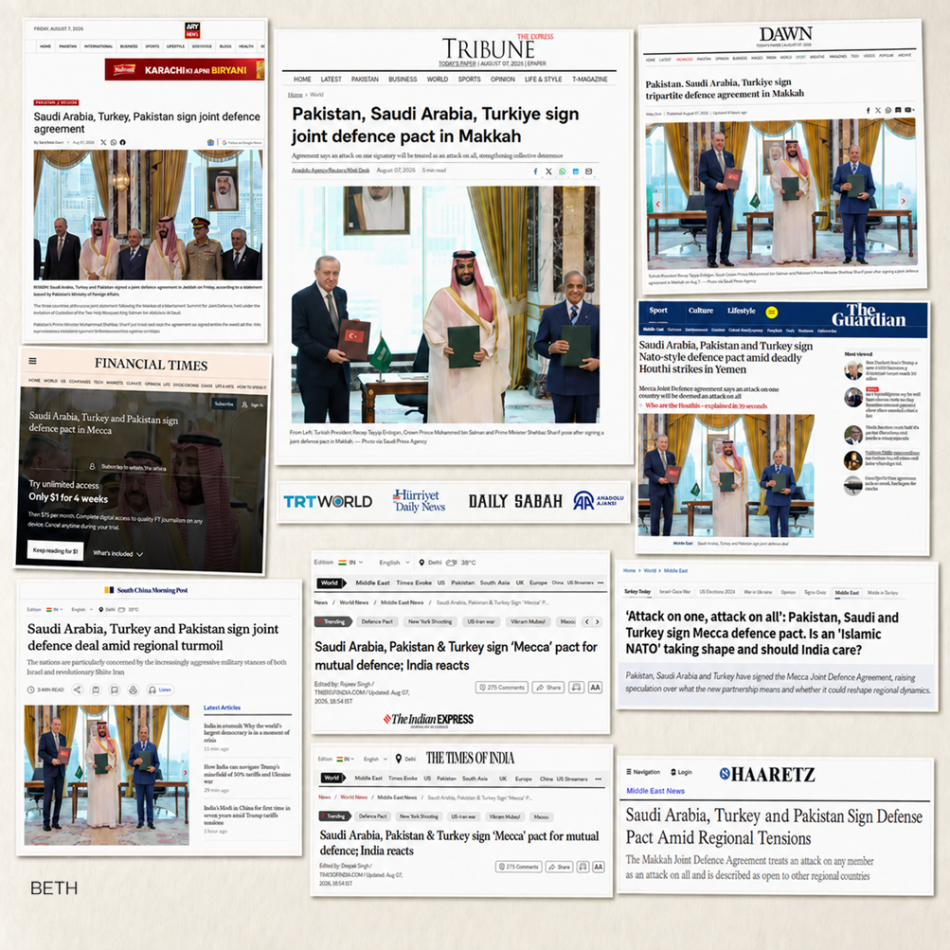
TRT World placed the agreement’s central clause in its headline: “An attack on one is an attack on all,” presenting it as an explicit declaration of mutual deterrence. Anadolu Agency adhered to the official framework, emphasizing that the agreement seeks to promote peace, security and stability regionally and internationally.
Hürriyet Daily News went beyond reporting the agreement’s provisions, describing its signing as a historic step that will reshape the regional security architecture. It also highlighted the concept of “regional ownership” of security, meaning that countries in the region are no longer content to rely solely on protection provided through arrangements led by external powers.
Daily Sabah focused on the complementary capabilities of the three countries: the Kingdom’s economic and political weight, Pakistan’s military expertise, and Türkiye’s technology and defence industries. It also stressed that the agreement is defensive, is not directed against any particular country, and could form the nucleus of broader regional cooperation.
This coverage reveals that Turkish media does not view Ankara as having merely joined an existing Saudi-Pakistani security umbrella. Rather, it presents Türkiye as a partner in building a new security architecture and as a power bringing its NATO experience, defence industry, and naval and air capabilities to the agreement.
Pakistan | A Power in Demand
Pakistani coverage was largely shaped by a sense that the agreement represents international recognition of Pakistan’s military and strategic value.
Dawn presented the agreement as a framework for collective deterrence and an expansion of the close defence relationship between Islamabad and Riyadh. The Express Tribune highlighted the Islamic significance of both the location and the agreement, as well as the presence of Pakistan’s army chief, Asim Munir, alongside the country’s political leadership.
The English- and Urdu-language ARY network described it as “a historic agreement” and the beginning of a new phase of defence partnership. It emphasized that the agreement was signed in the vicinity of the Holy Kaaba and highlighted the fraternal bonds and Islamic solidarity among the three countries.
Behind the celebratory language, however, lies a deeper Pakistani message: Islamabad wants to be seen as a power that provides security, not merely as a state in need of economic assistance.
Joining an agreement with the Kingdom and Türkiye gives Pakistan’s military and missile capabilities broader political weight and places the country within the security equation of the Gulf and the Middle East, without requiring it to abandon its attempt to retain a mediating role in the American-Iranian war.
Britain | Beyond Washington
British coverage focused more on the circumstances that prompted the three countries to sign the agreement than on the symbolism of the location where it was signed.
The Financial Times viewed the agreement as reflecting a trend toward regional self-reliance at a time when confidence is declining in the ability of American guarantees alone to protect the region’s countries. It also linked the agreement to existing cooperation in drones and defence manufacturing, as well as Saudi investment in Türkiye’s defence sector.
The Guardian described it as a “NATO-style defence pact”, directly linking its timing to Houthi attacks, the war involving Iran, and the growing threats surrounding the Kingdom and maritime routes.
The British lens therefore asked not only what the three countries had signed, but also why they no longer regarded traditional security relationships as sufficient.
This is an important framing, but it risks reducing the agreement to declining confidence in Washington. Its motives appear to be broader: diversifying partnerships, localizing defence industries, and building an independent regional capacity for initiative without severing existing alliances.
The United States | Saudi Diversification
American coverage was more cautious and closer to an institutional interpretation.
The Washington Post presented the agreement as a partnership bringing together oil-rich Saudi Arabia, nuclear-armed Pakistan, and Türkiye, which possesses NATO’s second-largest military. It also highlighted Riyadh’s move to diversify its defence relationships amid regional turmoil.
This perspective reflects an unspoken American question: Is the Kingdom creating an alternative to Washington?
According to what has been announced, however, the agreement does not cancel existing bilateral or multilateral alliances. It is therefore more accurate to view it as adding another layer of deterrence, rather than serving as a complete alternative to the American relationship.
It is also notable that many Western platforms republished similar reports from news agencies. This led to the repeated use of phrases such as “declining confidence in the American security umbrella,” “Sunni Muslim states” and “nuclear-armed Pakistan,” while questions concerning the agreement’s implementation mechanisms and defence-industrial dimension received limited attention.
East Asia | Energy Security
The South China Morning Post covered the agreement through the lens of regional turmoil, describing it as a convergence among three Muslim countries allied with the United States and concerned about the increasingly assertive military policies of both Israel and Iran.
The agreement’s symbolism and the details of the Islamic relationship among the three countries received less attention than they did in the Turkish and Pakistani press.
For Asian media, Middle Eastern alliances are often interpreted through their effect on energy security, maritime routes, and trade with China and East Asia.
From an Eastern perspective, therefore, the agreement’s success will not be measured by political statements alone, but by its ability to prevent attacks, protect facilities and ports, and keep oil and trade routes open.
India | An Eye on Pakistan
The Indian press showed the greatest interest in the nuclear question and in what the agreement could mean for the balance of power in South Asia.
The Times of India described the agreement as a strategic alignment combining three distinct elements: Saudi financial and energy influence, Pakistan’s military and nuclear power, and Türkiye’s technology and strategic depth. It also highlighted New Delhi’s announcement that it was closely monitoring the development.
Indian platforms used the term “Islamic NATO” and explicitly asked whether India should be concerned. The Indian Express, meanwhile, adopted a more explanatory approach, examining the reasons behind the agreement and the earlier defence relationships among its parties.
The influence of geopolitics was clearly evident: Indian media did not view the agreement from Makkah or the Gulf, but from the Indian-Pakistani border.
Nevertheless, treating every defence partnership involving Pakistan as a direct threat to India goes beyond what has been announced. The agreement is defensive and does not identify any hostile state. Moreover, the Kingdom maintains extensive political and economic relations with New Delhi that do not conflict with its historic relationship with Islamabad.
Israel | A Sunni Alignment
Haaretz described the agreement as a growing alignment among three major Sunni Muslim powers with ties to the United States.
This description reveals an attempt to place the agreement within a map of sectarian blocs, despite assurances from the three parties that it is not directed against any state or sect.
Bringing together the Kingdom, Türkiye and Pakistan creates, from the Israeli perspective, a centre of power possessing Arab and Islamic influence, an advanced defence industry, a nuclear-armed military, and extensive international relationships.
The Israeli question is therefore not limited to the agreement’s position toward Iran. It also extends to its potential effect on Israel’s freedom of military action and on the three countries’ positions toward Palestine and Gaza.
Arab Media | The News First
A large part of the Arab media focused on reporting the provisions of the joint statement, particularly the clause stipulating that an attack on one country would be regarded as an attack on all, without immediately examining the agreement’s operational commitments.
Arab and international platforms publishing in Arabic and English linked the agreement to the American-Iranian war, Houthi attacks, and the search for security arrangements capable of protecting Gulf states and maritime routes.
This caution can be explained by the fact that the agreement has only just been announced, while no detailed text has yet been published defining aggression, the decision-making mechanism, the nature of the response, or the limits of the military commitment.
Analysis | BETH
The principal directions of global media coverage can be summarized in six images:
- Turkish media saw a new regional order.
- Pakistani media saw a strategic elevation for the country.
- Western media saw diversification away from exclusive dependence on Washington.
- Indian media saw an extension of Pakistani power.
- Israeli media saw a grouping of major Islamic powers.
- Asian media saw a potential instrument for protecting energy and maritime routes.
What is particularly striking is that most coverage recognized the three components of power, but did not give the Kingdom the full role revealed by the architecture of the agreement.
Saudi Arabia is not merely the financier that brought together a Pakistani military and a Turkish defence industry. It is the political and geographic centre that united the two powers within a broader vision of regional security and selected Makkah as the location to transform a military understanding into a political and Islamic message extending beyond bilateral calculations.
The three countries therefore contributed distinct and complementary elements:
- The Kingdom provides the centre of decision-making and the political, economic and geographic weight.
- Türkiye provides military power, defence manufacturing and NATO experience.
- Pakistan provides military and missile depth and nuclear weight.
The agreement, however, will not become an influential alliance merely by combining these elements. Its true strength will emerge when they are translated into command structures, planning, training, early warning, air and maritime defence, and joint defence production.
What the Coverage Missed
Media outlets focused on the phrase “an attack on one is an attack on all” because it offered the most compelling headline. They did not, however, devote sufficient attention to the more difficult questions:
How will an armed attack be defined?
Will the military response be automatic, or will it be subject to consultation?
Will the security umbrella cover missile, drone and cyberattacks?
Will it extend to ships and facilities belonging to the three countries outside their territories?
Which institution will be responsible for planning, assessing threats and making decisions?
These questions do not diminish the agreement. They define the distance between a political declaration and an operational alliance.
Beyond the Coverage
Global media coverage revealed not only the reality of the agreement, but also the reality of the world looking at it.
The West fears the decline of its centrality.
India is watching Pakistan.
Israel is calculating the balance of power.
Türkiye sees an opportunity for leadership.
Pakistan sees recognition of its status.
East Asia wants secure routes for energy and trade.
The Kingdom, meanwhile, has presented everyone with a new reality: regional security is no longer a matter that the countries of the region wait for others to formulate.
They have begun shaping it themselves.