



Makkah Shapes Deterrence
The trilateral defense agreement moves Saudi Arabia, Türkiye, and Pakistan from separate cooperation to a collective commitment—but its actual strength will be determined by its implementation mechanisms
Prepared and Analyzed by | Strategic Media Department – BETH Agency
Supervised by: Abdullah Al Omair
Makkah | BETH
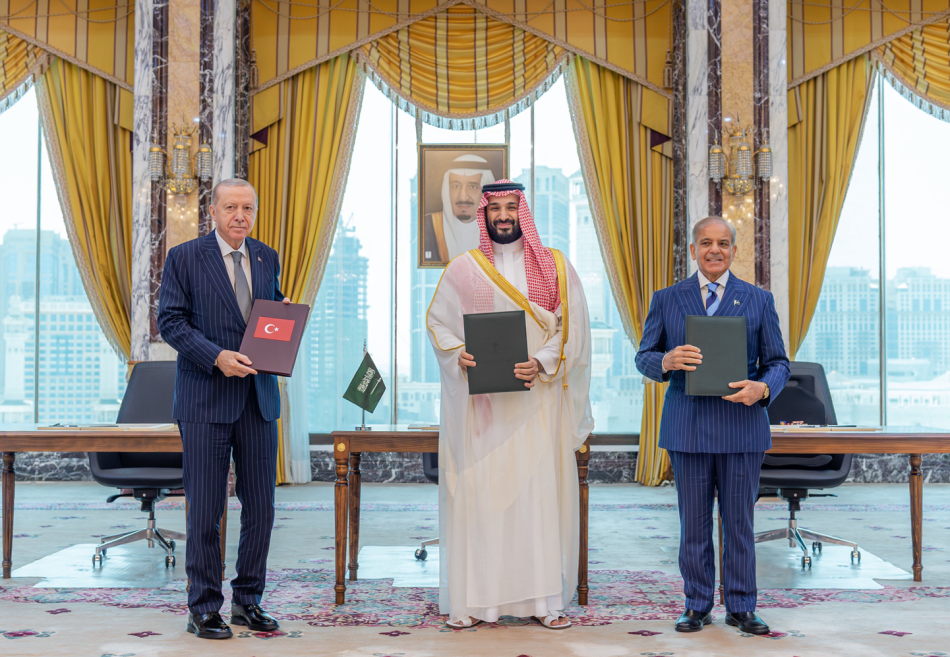
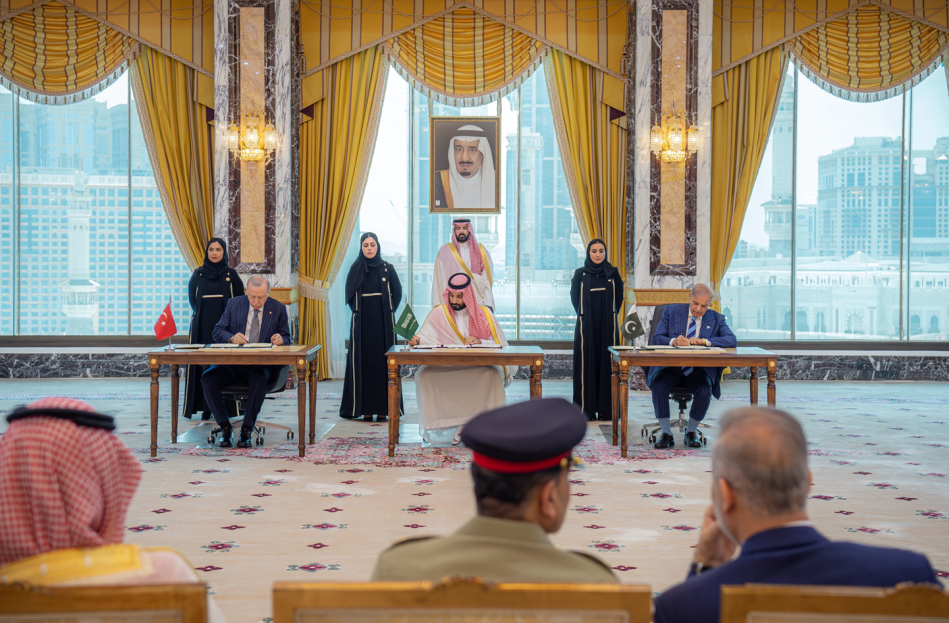
Saudi Arabia, Türkiye, and Pakistan signed the “Makkah Joint Defense Agreement,” marking a strategic shift that links the security of the three countries through a collective commitment stipulating that any armed attack against one of them shall be regarded as an attack against them all.
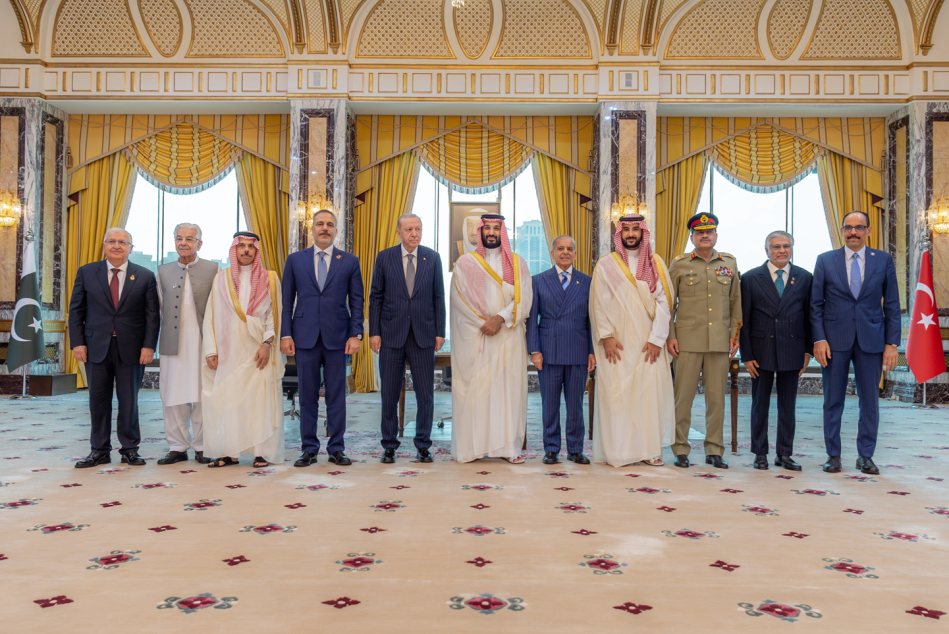
The agreement was signed by His Royal Highness Prince Mohammed bin Salman bin Abdulaziz Al Saud, Crown Prince and Prime Minister; Turkish President Recep Tayyip Erdoğan; and Pakistani Prime Minister Muhammad Shehbaz Sharif, during the Makkah Joint Defense Summit held at Al-Safa Palace.
According to the official statement, the agreement aims to strengthen collective deterrence against any act of aggression and expand all aspects of defense cooperation among the three countries, in support of security and stability regionally and internationally.
The agreement brings together three powers with complementary attributes: Saudi Arabia, with its political and economic weight and Arab and Islamic standing; Türkiye, with its military and industrial capabilities and membership in the North Atlantic Treaty Organization; and Pakistan, with its military capabilities and possession of nuclear weapons.
Yet, despite the importance of its central provision, the agreement has not publicly disclosed the mechanisms for determining what constitutes an attack, the nature of the response, or the extent to which each country is obligated to use force. At its announced stage, this makes it a strong framework for political and strategic deterrence, whose strength awaits translation into joint plans, institutions, and operational capabilities.
The Available Official Text
As of the preparation of this report, the three countries have not published the agreement’s full legal text, including its articles, definitions, and implementation mechanisms.
What is officially available is the statement of the Makkah Joint Defense Summit, published by Pakistan’s Ministry of Foreign Affairs. Its complete Arabic translation reads as follows:
At the gracious invitation of the Custodian of the Two Holy Mosques King Salman bin Abdulaziz Al Saud, the President of the Republic of Türkiye, His Excellency Mr. Recep Tayyip Erdoğan, and the Prime Minister of the Islamic Republic of Pakistan, His Excellency Mr. Muhammad Shehbaz Sharif, visited the Kingdom of Saudi Arabia on 24 Safar 1448 AH, corresponding to August 7, 2026.
His Royal Highness Prince Mohammed bin Salman bin Abdulaziz Al Saud, Crown Prince and Prime Minister, received His Excellency the President of the Republic of Türkiye and His Excellency the Prime Minister of the Islamic Republic of Pakistan at Al-Safa Palace in Makkah, where the Makkah Joint Defense Summit was held. During the summit, the distinguished relations between the Kingdom of Saudi Arabia, the Republic of Türkiye, and the Islamic Republic of Pakistan were reviewed, along with a number of issues of mutual interest.
Guided by the longstanding historical relations among the three countries, based on the enduring bonds of brotherhood and Islamic solidarity that unite them, and building upon their shared strategic interests and longstanding defense cooperation, His Royal Highness Prince Mohammed bin Salman bin Abdulaziz Al Saud, Crown Prince and Prime Minister; His Excellency Mr. Recep Tayyip Erdoğan, President of the Republic of Türkiye; and His Excellency Mr. Muhammad Shehbaz Sharif, Prime Minister of the Islamic Republic of Pakistan, signed the Makkah Joint Defense Agreement, reflecting the three countries’ commitment to strengthening their collective security and supporting peace, security, and stability in the region and beyond, in pursuit of a secure and prosperous future.
The agreement aims to strengthen collective deterrence against any act of aggression and stipulates that any armed attack against any one of the three countries shall be regarded as an attack against them all. It also provides for strengthening all aspects of defense cooperation among the three countries.
What Do We Know for Certain?
The official statement reveals four principal commitments:
First, the agreement is trilateral and not a collection of parallel bilateral agreements. This means it links the security of all three countries within a single framework.
Second, its stated purpose is to strengthen collective deterrence, rather than merely provide training or facilitate the exchange of expertise.
Third, any armed attack against one of the countries shall be regarded as an attack against all three.
Fourth, cooperation is not limited to responding to an attack. It encompasses “all aspects of defense cooperation,” a broad formulation that could extend to training, armament, military exercises, intelligence, air and missile defense, maritime security, and military manufacturing.
However, this broad formulation does not mean that all these fields have been approved in detail. Rather, it means that the agreement allows them to be developed through subsequent implementation arrangements.
What Has Not Been Announced?
The published statement does not answer a number of fundamental questions:
- What is the legal definition of an “armed attack”?
- Does the agreement include attacks by armed groups and militias?
- Does it cover drone attacks, cyberattacks, and maritime sabotage?
- Who determines that an incident has reached the level of an armed attack?
- Is the military response automatic, or is it preceded by political consultations?
- Is each country obligated to deploy its forces, or may it choose the form of assistance it considers appropriate?
- What is the agreement’s geographical scope?
- Does it cover vessels, aircraft, and forces located outside the territories of the three countries?
- Will a joint military command or a trilateral defense council be established?
- Will forces or defense systems be permanently stationed in the territory of any of the countries?
- Does the agreement require domestic ratification procedures before entering into force?
- What is the agreement’s duration, and what is the mechanism for withdrawing from it?
- Does it permit other countries to join in the future?
These questions do not diminish the agreement’s value, but they distinguish between the announced political commitment and the military capability that can be implemented.
Is It a New Article Five?
In principle, the wording of the Makkah Agreement resembles Article 5 of the North Atlantic Treaty, which considers an armed attack against one member state to be an attack against all members.
However, similarity in wording does not mean the commitments are identical.
Article 5 of the North Atlantic Treaty does not automatically require every member to declare war. Instead, it allows each member to take the action it deems necessary, including the use of armed force. It also rests on an integrated institutional structure that includes a permanent council, military command, defense plans, interoperable forces, periodic exercises, and unified intelligence and communications networks. Official text of Article 5
The Makkah Agreement, by contrast, has announced the collective commitment, but details concerning the nature of assistance and the decision-making mechanism have not been published.
It is therefore more accurate to describe it as a collective defense agreement with the potential to evolve, rather than a fully institutionalized military alliance in its current form.
Why Now?
The agreement was not born on the day it was signed. The official statement refers to longstanding defense cooperation and shared strategic interests. It was also preceded by the strategic defense agreement between Saudi Arabia and Pakistan and lengthy discussions about Türkiye joining a trilateral framework.
Regional developments, however, accelerated the transition from consultation to signature.
The U.S.-Iran war revealed the expanding scope of threats and demonstrated that attacks were no longer confined to the states at war. They extended to maritime navigation, critical infrastructure, cities, and ports, opening simultaneous fronts from the Gulf to the Red Sea and Yemen.
The agreement also followed an escalation in Houthi attacks, the injury of civilians in Najran, threats against Saudi vessels and facilities, and warnings of possible attacks from multiple directions.
From this perspective, the timing of the agreement does not appear to be a declaration of involvement in the war. Rather, it is a preemptive message that bringing the war to the territories or interests of the three countries will no longer remain a bilateral confrontation between the aggressor and the targeted state.
Why Makkah?
Choosing Makkah as the signing venue is not a mere protocol detail.
The agreement could have been signed in Riyadh, Ankara, or Islamabad. However, naming it the “Makkah Agreement” gives it a dimension that extends beyond the three parties and links it to Saudi Arabia’s standing and the depth of all three countries within the Islamic world.
This does not automatically transform it into an open Islamic alliance, but it gives the agreement a political and symbolic identity that could become the basis for broader cooperation should the three countries choose that course in the future.
Makkah is not merely the signing venue; it is part of the message.
What Does Saudi Arabia Add?
Saudi Arabia represents the agreement’s political, economic, and geographical center.
It holds the greatest influence over energy markets, lies between the Gulf and Red Sea theaters, and maintains an extensive network of relations with the United States, China, Europe, India, and the Arab and Islamic worlds.
Saudi Arabia is also leading broad programs to develop military industries and localize defense spending, making the agreement an opportunity to move from purchasing systems to participating in their manufacture and development.
Riyadh can connect Turkish and Pakistani capabilities to its requirements in air and missile defense, drones, maritime security, munitions, military electronics, training, maintenance, and technology transfer.
Saudi Arabia therefore contributes more than capital or a market. It provides the center of gravity capable of transforming bilateral relations among the three countries into a single strategic network.
What Does Türkiye Add?
Türkiye possesses one of NATO’s largest armies, extensive operational experience, and an advanced defense industry encompassing drones, missiles, ships, armored vehicles, electronics, and command-and-control systems.
Its NATO membership also gives it experience in joint operations, interoperability, and multinational planning.
However, Türkiye’s membership in the alliance does not mean that NATO’s capabilities or guarantees have automatically transferred to the Makkah Agreement. Ankara’s obligations under each agreement are subject to that agreement’s own legal scope and independent political mechanisms.
Türkiye adds to the trilateral agreement the ability to transform deterrence from a political declaration into an industrial and military system capable of being built.
What Does Pakistan Add?
Pakistan possesses a large military, extensive experience in training and operations, considerable air and missile capabilities, and longstanding defense relations with Saudi Arabia and Türkiye.
It is also the only Islamic country that possesses nuclear weapons, automatically raising international attention toward any defense agreement in which it participates.
However, Pakistan’s nuclear status does not mean that the Makkah Agreement has established a nuclear umbrella for the three countries.
The official statement does not mention nuclear weapons, extended nuclear deterrence, the conditions governing their use, or nuclear consultation mechanisms. Consequently, asserting that the agreement has established a nuclear umbrella goes beyond the published text.
It is more accurate to say that Pakistan’s nuclear capability gives the agreement indirect strategic weight, but it does not become an explicit nuclear guarantee without a clear text or declaration.
Is Riyadh Moving Away from Washington?
The agreement does not necessarily mean replacing the security partnership with the United States or constructing an axis against it.
The United States will remain an important partner for Saudi Arabia, Türkiye, and Pakistan to varying degrees. The three countries’ armed forces also depend on multiple international systems and relationships that cannot be severed by a single decision.
The agreement, however, reveals a broader Saudi orientation toward diversifying sources of security, just as the Kingdom has diversified its economic, investment, and political relationships.
The distinction is important: diversification does not mean rupture, and autonomy does not mean hostility.
Saudi Arabia seeks strong relations with the major powers, while simultaneously working to build greater capacity within the region, so that its security does not remain dependent on a decision issued from a single capital.
Iran, Israel, and India
The agreement did not identify any particular state as the source of the threat. This appears intentional, as it gives the agreement a general defensive character and does not officially turn it into an alliance directed against a specific party.
However, its timing will lead Iran to interpret it in light of the war, attacks by groups associated with it, and threats directed at Gulf infrastructure.
Israel will view it as a convergence among three major Islamic powers possessing advanced military, industrial, and strategic capabilities.
India, meanwhile, will closely monitor the implications of the collective defense provision for any potential confrontation with Pakistan, while recognizing that Saudi Arabia maintains important strategic and economic relations with New Delhi and that the published text of the agreement does not automatically specify how existing disputes or wars initiated by one of the parties would be handled.
This is where the importance of the unpublished provisions becomes apparent: Does the agreement cover any attack regardless of its cause, or does it distinguish between aggression and self-defense? Does it require the agreement of all three countries in classifying an incident?
The Strength and Limits of Deterrence
The agreement’s strength begins with the uncertainty it creates for any potential adversary: If it attacks one country, will it face three?
That question alone raises the cost of military calculations, which is the essence of deterrence.
However, ambiguity that proves useful before a war may become a problem once war breaks out, unless prior answers have been agreed upon regarding command, forces, missions, and response time.
Deterrence is not created by the text alone. It is also created by the adversary’s ability to see the preparedness behind the text.
The effectiveness of the Makkah Agreement will therefore increase if it is followed by:
- A permanent trilateral defense body or council.
- An urgent consultation and decision-making mechanism.
- Joint plans to confront potential threats.
- Periodic training and military exercises.
- An early-warning and information-sharing network.
- Integration in air and missile defense.
- Maritime cooperation to protect Hormuz, Bab Al-Mandab, and the Red Sea.
- Joint military manufacturing and munitions projects.
- Clear rules for dealing with cyberattacks and attacks by proxies.
Three Armies or One System?
The three countries possess substantial military capabilities, but combining capabilities does not automatically amount to integrating them.
Weapons, communications systems, combat doctrines, and sources of armament differ. Their geographical priorities also vary: Saudi Arabia focuses on the Gulf, the Red Sea, and the protection of critical infrastructure; Türkiye looks toward the eastern Mediterranean, the Black Sea, and the Syrian and Iraqi borders; while Pakistan places its borders with India and Afghanistan at the center of its calculations.
The agreement’s success will not lie in eliminating these differences, but in identifying the common ground among them: air and missile defense, protection of corridors, counterterrorism, intelligence, cybersecurity, and military manufacturing.
If this common ground is built in practical terms, the three countries will no longer be merely three cooperating armies, but a multidimensional deterrence system.
Not an Offensive Alliance
A distinction must be made between a joint defense agreement and an alliance intended to wage wars.
The statement links the agreement to security, stability, and peace, and makes its activation dependent upon the occurrence of an “armed attack” against one of the countries—not upon one country’s decision to launch an external military operation.
This distinction is necessary to protect the agreement politically and legally, and to reassure countries that might view it as a new axis directed against them.
Its strength does not lie in searching for an enemy, but in persuading any potential enemy that the cost of an attack has become higher.
Further Analysis | BETH
The Makkah Agreement is not merely the addition of Türkiye to the previous Saudi-Pakistani agreement. It is a restructuring of the security landscape across an area extending from the Gulf and the Red Sea to the eastern Mediterranean and South Asia.
It brings together three forms of power:
- Saudi Arabia’s political and economic power and strategic location.
- Türkiye’s military and industrial power and NATO experience.
- Pakistan’s military and missile depth and nuclear weight.
However, the real test will begin after the signing.
If the agreement remains confined to the statement, it will be a powerful political message and an important form of moral deterrence.
If it is followed by a coordination command, contingency plans, integration in early warning and air and maritime defense, and joint manufacturing projects, it will become one of the most significant changes in the regional security architecture in decades.
The agreement does not declare the end of reliance on international allies, but it does declare the end of accepting that the region’s security should remain an exclusively external responsibility.
Beyond the Agreement
The most important statement is not merely that an attack against one country shall be regarded as an attack against them all.
What matters most is that, for the first time, the three countries have decided to make this statement together—and from Makkah.
Deterrence begins with weapons, but it is completed by political certainty: that the aggressor will not choose its opponent in isolation and will not alone determine the boundaries of the battle.
The Makkah Agreement has laid the foundation stone for a greater idea:
That the countries of the region should build part of their security with their own hands and move from waiting for protection to participating in its construction.
The Calculus of Power
The strength of defense agreements is not measured solely by the number of countries that join them. Every new country brings not only its military capabilities, but also its own threat maps, conflicts, commitments, and strategic calculations.
From this perspective, the trilateral framework appears to be founded on deliberate complementarity rather than the mere gathering of three countries. Saudi Arabia represents the political, economic, and geographical center of gravity; Türkiye contributes military strength, an advanced defense industry, and NATO experience; while Pakistan gives the agreement military and missile depth, as well as indirect nuclear weight.
Thus, none of the parties duplicates the role of another. Instead, each contributes an element the framework requires: a center that leads and connects, a power that manufactures and executes, and strategic depth that elevates the level of deterrence.
The limited number of parties during the founding stage may therefore constitute a source of strength, facilitating the convergence of interests, accelerating decision-making, and preventing commitments from expanding before their implementation mechanisms have been established.
Effective alliances do not begin with a multitude of flags, but with a clearly defined threat, complementary capabilities, and the certainty that each party will stand in the agreed position when the test comes.
The trilateral agreement may become a nucleus capable of expansion, but successful consolidation must always precede enlargement. Adding a country to a defense agreement does not merely mean adding another military; it means redrawing the boundaries of the entire commitment.