



Day 150 🇺🇸⚔️🇮🇷: Riyadh Shapes Deterrence

While Washington searches for an exit from an expanding war with no agreed final objective, Saudi Arabia is leading the formation of an international coalition to protect the Red Sea, Bab al-Mandab, and the Gulf of Aden
Monitoring and Analysis | Strategic Media Department – BETH
Supervised by Abdullah Al-Omairah
Riyadh | BETH
The U.S.-Iran war is moving toward a broader and more dangerous phase, as President Donald Trump’s administration considers a plan for an intensive air campaign lasting between ten days and two weeks. The campaign would target command centers and missile and drone facilities belonging to Iran’s Islamic Revolutionary Guard Corps, while Pakistan-led diplomatic efforts continue.
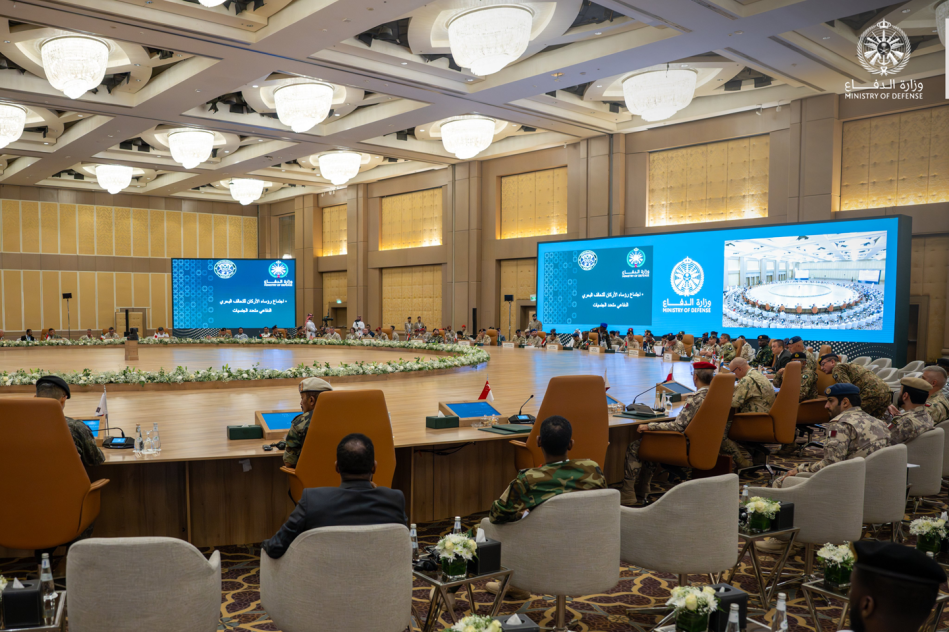
As discussions within the U.S. administration reveal disagreements over the war’s ultimate objective and how to end it, Saudi Arabia is leading an international effort to establish a multinational maritime defense coalition headquartered in Riyadh. The coalition aims to protect maritime corridors and deter attacks on commercial vessels, energy tankers, and maritime infrastructure in the Red Sea, Bab al-Mandab, and the Gulf of Aden.
The meeting hosted by the Saudi Ministry of Defense brought together chiefs of staff and representatives from 43 countries, alongside the Delegation of the European Union to the Kingdom, out of 51 countries and organizations invited. Fourteen countries announced their joint support for the coalition project and its founding arrangements.
A War Searching for an Objective
The plan prepared by U.S. Central Command chief Admiral Brad Cooper reveals that Washington no longer views limited strikes as sufficient to stop Iranian attacks or reduce Tehran’s ability to threaten U.S. forces and maritime navigation.
The plan calls for a sustained air campaign lasting between ten and 14 days, aimed at degrading Iran’s missile capabilities, drone systems, and Revolutionary Guard command centers. But increasing the scale of the strikes does not, by itself, answer the more difficult question:
What political objective is military force supposed to achieve?
Within the U.S. administration, disagreement persists between those who prioritize preventing Iran from acquiring a nuclear weapon, those focused on ensuring freedom of navigation through the Strait of Hormuz, and those seeking to destroy Iran’s missile and drone capabilities.
These objectives are not identical. Each requires its own military operations, negotiating conditions, and endpoint.
This may explain Trump’s anger during the security meeting held at the White House. The United States has achieved tactical victories and struck Iranian targets, but it has so far been unable to convert those strikes into a clear strategic gain or an agreement that ends the war.
Washington therefore faces a difficult paradox: every strike may weaken part of Iran’s power, but it may simultaneously expand the battlefield and make exiting the war more difficult.
In a sign that the tools of pressure may be expanding, senior Israeli sources said that the United States and Israel are considering imposing a land blockade on Iran, alongside the continuing naval blockade of Iranian ports and following the failure of the military options employed so far to reopen the Strait of Hormuz, according to Britain’s Daily Telegraph. The naval blockade of Iranian ports is already in place as part of renewed U.S. military operations.
Considering a land blockade does not mean that a decision to implement it has been made. It does, however, reveal a shift in thinking from striking military capabilities to restricting Iran’s movement and supply lines while intensifying pressure on its economy.
Imposing a land blockade on a country as vast as Iran, with its extensive borders, would require broad cooperation from neighboring states. It could also open new arenas of tension without guaranteeing that the strait would be reopened or that Tehran would retreat.
Here, the American dilemma emerges once again: whenever one tool fails to achieve the objective, another is added, causing the war to expand before its ending becomes clear.
Saudi Arabia Changes the Equation
On the other side, the Kingdom does not view threats to maritime navigation as an isolated incident or a crisis that will end with the current round of fighting. It sees them as a prolonged challenge requiring an organized international framework.
The Saudi initiative is therefore not limited to assembling warships or coordinating temporary operations. It seeks to build a multinational maritime defense institution with a charter, an organizational structure, command-and-control arrangements, operating mechanisms, technical teams, and reference documents.
This is where the initiative’s strategic value lies.
The proposed coalition does not merely respond to the current threat. It establishes a collective capability to confront future threats, whether attacks on vessels, the targeting of energy tankers, strikes against maritime facilities, or disruptions to supply chains and international trade.
Why the Red Sea?
The Red Sea connects the Indian Ocean with the Mediterranean through Bab al-Mandab and the Suez Canal. Protecting it is therefore not a limited regional concern.
Any disruption along this corridor affects energy flows, insurance rates, shipping costs, supply chains, and the delivery of goods to global markets.
Attacks on navigation do not threaten only the countries bordering the Red Sea. Their effects extend to exporting and importing countries, transport companies, ports, and consumers across different continents.
The Saudi initiative is founded on this reality: no single country can bear responsibility for the security of a maritime corridor serving international interests. Its protection must therefore be a collective responsibility.
What Does the Participation of 43 Countries Mean?
The participation of 43 countries does not mean that all of them have become members of the coalition. It does, however, reveal a growing conviction that the maritime threat has exceeded the capacity of limited alliances and temporary arrangements.
The joint statement issued by 14 countries represents the project’s first political nucleus. It includes:
Saudi Arabia, Kuwait, Bahrain, Qatar, Pakistan, Türkiye, Egypt, Jordan, Yemen, Bangladesh, Nigeria, Sudan, Djibouti, and Somalia.
These countries combine influential geographical positions along maritime corridors with varying military capabilities and political, demographic, and economic weight that could give the coalition strategic depth extending beyond the Red Sea.
Keeping membership open also allows the initiative to develop gradually from a founding nucleus into a broader international framework once interested countries complete their national procedures and approvals.
The Coalition Has Not Yet Been Launched
It is important to distinguish between announcing the coalition project and commencing its operations.
The Riyadh meeting agreed that military planners from countries wishing to join would continue working to finalize the coalition’s charter and reference documents, build its organizational structure, determine command-and-control arrangements and operating mechanisms, and form the necessary technical teams.
Once interested countries complete their national procedures, the project will move toward signing the charter, launching the coalition, and commencing its missions.
This means that Riyadh has laid the political and military foundations, while the most delicate phase now begins: translating international support into operational commitments, forces, capabilities, rules of engagement, and a unified command system.
Who Protects the Sea?
The Saudi initiative comes at a moment when maritime corridors have become a direct part of the war, rather than merely routes affected by it.
When commercial vessels, energy tankers, and maritime infrastructure are targeted, the sea becomes an instrument of political, military, and economic pressure, while global trade becomes an undeclared party to the conflict.
The coalition therefore carries a dual deterrent message:
First, an attack on a vessel or tanker will no longer remain an isolated confrontation between the attacker and the affected country.
Second, the security of Bab al-Mandab, the Red Sea, and the Gulf of Aden will not be subject to the will of militias or the calculations of powers that use them to threaten countries and markets.
Riyadh as the Command Center
Selecting the Kingdom as the coalition’s headquarters reflects not only its geographical position, but also its role in the security equation governing energy, trade, and maritime corridors.
Saudi Arabia overlooks both the Red Sea and the Arabian Gulf and lies between the world’s most important energy-producing regions and the principal routes through which their exports travel. It also maintains security and economic ties with the countries bordering the Red Sea, Bab al-Mandab, and the Gulf of Aden.
The Kingdom is therefore moving from protecting its own waters and national interests to leading an international framework that safeguards a shared global interest.
The coalition’s focus on a defined area also gives it an opportunity to develop a clear mandate and reduce overlap with other maritime coalitions operating in the region.
Between Two Plans
On the 150th day of the war, two different approaches are emerging in the region.
Washington is considering a more intensive air campaign, but it continues to debate what it wants to achieve and how the operations can be ended once they begin.
Riyadh, meanwhile, is building a long-term framework that defines the objective before launching the mission: protecting maritime corridors, deterring threats, and safeguarding freedom of navigation and global trade.
U.S. military power may be capable of destroying facilities and systems within two weeks, but it cannot, by itself, guarantee the security of the seas once the aircraft stop flying.
The success of the coalition led by the Kingdom, however, will not be measured by the number of strikes it conducts, but by its ability to prevent attacks, keep vessels moving, ports operating, and energy flowing.
The Saudi initiative thus goes beyond managing a temporary military crisis and begins establishing a new security equation:
Instead of waiting for the next attack, the world begins building the force that can prevent it.