
Defeating the Throne, Not the Civilization
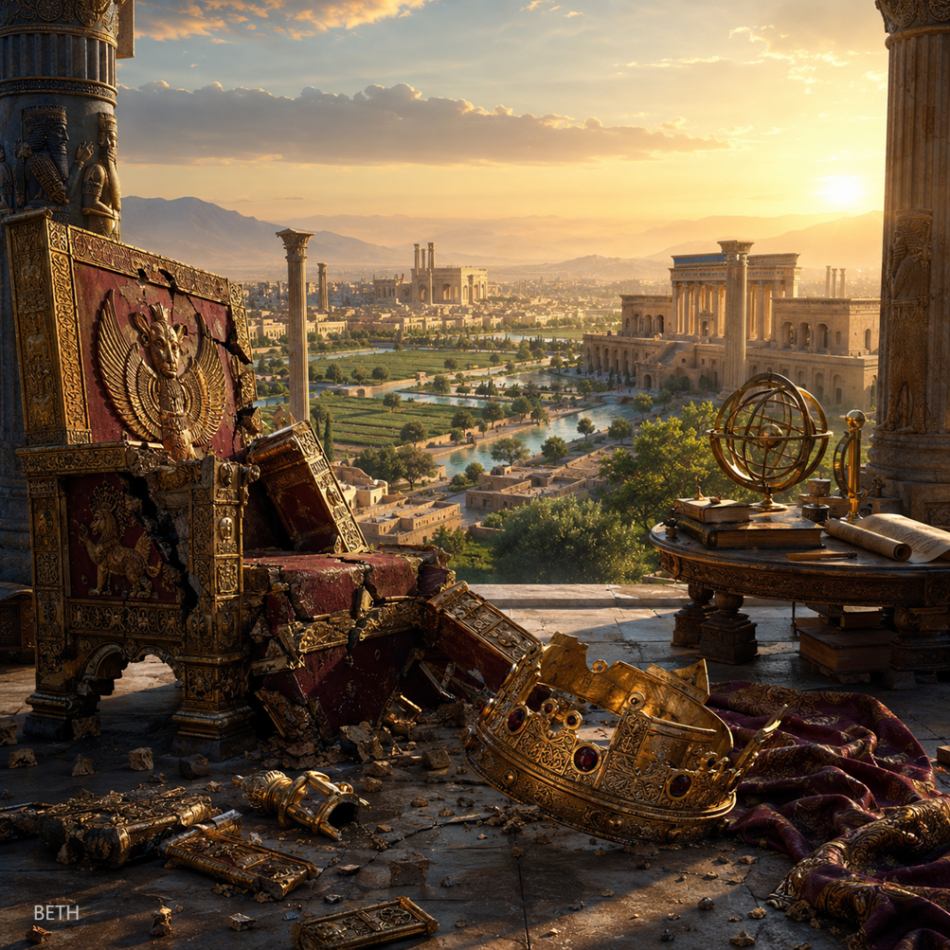
How Did Umar ibn al-Khattab, May Allah Be Pleased with Him, Bring Down the State of the Khosrows While Saving Society from Falling with It?
Prepared and analyzed by | Strategic Media Department – BETH Agency
Supervised by: Abdullah Al-Omairah
Persia in the seventh century was not a small state brought down by an army larger than its own.
The Sasanian Empire was one of two great powers that shared influence over the ancient world. It possessed an organized army, a military aristocracy, an administration for taxation and agriculture, a wealthy capital, and extensive experience in wars against the Romans.
When Umar ibn al-Khattab, may Allah be pleased with him, assumed the caliphate in 634 CE, he was not leading an empire whose institutions and armies he had inherited. Rather, he was leading an emerging state from the Arabian Peninsula that faced two powers superior to it in numbers, wealth, and experience.
Nevertheless, by the end of his reign, the Khosrows had lost Iraq and their capital, Al-Mada’in; their largest army had been defeated at Nahavand; and the center that had regrouped forces and sent them back into battle had disintegrated.
Yet Persian society did not disappear.
The land continued to be cultivated, the cities continued to function, and language, culture, and knowledge continued to develop. The Persians later became among the foremost builders of Islamic civilization in administration, literature, philosophy, medicine, and science.
How, then, did the throne fall while society survived?
Was this merely the result of a military victory, or the product of an early understanding of the difference between defeating a hostile state and destroying the country it governed?
The fall of the Sasanian state did not cause all Iranians to convert to Islam in a single day. The country first moved from the rule of the Khosrows into the framework of an Islamic state whose authority was founded upon the Holy Qur’an and the Sunnah of the Prophet, peace and blessings be upon him, with the principles they carried of justice, protection of society, and regulation of rights and duties. Meanwhile, large communities retained their religions and cultures.
Iranians then entered Islam gradually over generations, through contact with Muslims, conviction in the religion, participation in society and the state, trade, intermarriage, and the transmission of knowledge, alongside social and economic factors that varied from one region to another. The political transformation was therefore rapid, but the religious and civilizational transformation was slower and deeper.
Spreading Islam was an objective of the state, but spreading it did not mean forcing peoples to embrace it. The conquests expanded the territory of Islamic rule and opened the way for the call to Islam, while faith remained a matter of choice. The gradual conversion of Iranians to Islam over centuries demonstrates that the sword brought down the authority of the Khosrows but did not impose the faith upon society.
When Iranians became part of the Islamic community, they did not lose their cultural identity. Instead, they carried their knowledge and experience into the new civilization, transforming from a society ruled by the Khosrows into an essential partner in building the Islamic world.
Before Answering
This period requires methodological caution.
The principal Islamic sources, such as Al-Baladhuri and Al-Tabari, were written some time after the events and transmitted multiple accounts of delegations, battles, and dialogues. Modern studies also differ over the dates of certain events, the sizes of armies, and the details of confrontations.
Encyclopaedia Iranica confirms that accounts of the conquest are sometimes contradictory and that the precise course of some events and the numbers of forces cannot be established with certainty.
This research, therefore, does not rely solely on famous literary dialogues, nor does it turn every account into an indisputable fact. Instead, it examines decisions supported by their outcomes:
What did Umar do before the battle?
How did he adjust his policy after defeat?
Where did he stop?
And what did he preserve after victory?
A Powerful State That Exhausted Itself
The Sasanian state did not fall because it was militarily weak in absolute terms.
Its forces were larger than the Muslim armies in several battles. They fought fiercely, retook some regions, and repeatedly attempted to overturn peace agreements and rebuild resistance.
But its military power rested upon a state exhausted by accumulated pressures:
A long and destructive war with the Byzantine Empire.
Conflict within the ruling families and the aristocracy.
Disruption in the succession to the throne after the killing of Khosrow II in 628 CE.
The declining prestige of the royal court.
And financial, social, and religious pressures upon the population.
Studies explain that the final war with the Romans exhausted both states. The Sasanians, however, subsequently entered a succession crisis that lasted approximately four years, while the Islamic state was unifying the Arabian Peninsula and building new political and military cohesion.
Persia was not a fragile structure that the Muslims pushed over.
It was a massive structure whose pillars had been exhausted from within. A more cohesive and mobile power then arrived and broke its center of gravity.
Here lies the first lesson:
Great states do not fall merely when they lose their weapons, but when their political structures become incapable of transforming the power they possess into a unified decision.
Umar Defined the Objective
Umar ibn al-Khattab, may Allah be pleased with him, did not regard the Persians as a people who had to be subjugated. He regarded the Sasanian state as an imperial power that threatened the Islamic state and reorganized its armies after every defeat to resume the fighting.
He understood that the problem did not lie in the failure of temporary negotiations, but in a governing structure deeply convinced of its own stature—one that still viewed the Arabs from a position of imperial superiority and could not imagine that the balance of power had changed.
The Muslims sent delegations to Yazdegerd III and Rostam before Al-Qadisiyyah, but the negotiations produced no settlement because the Sasanian court treated those who approached it as a force that could be deterred or despised, rather than as a new party with which it had to reach an understanding.
Modern studies caution against taking the details of dialogues contained in traditional accounts literally. They nevertheless confirm that the two armies waited for months before Al-Qadisiyyah and that negotiation and the call to Islam were present before the battle began.
With the continued military mobilization and attempts to retake Iraq, merely driving the Sasanian army back came to mean postponing the war rather than ending it.
The objective therefore emerged gradually:
To destroy the Sasanian throne’s ability to reproduce aggression, not to destroy Persian society or erase its civilization.
He Did Not Begin with the Final Plan
It would be wrong to portray Umar as though he had drawn up, from the very first day, a complete plan for bringing down the Sasanian Empire and then implemented it without alteration.
True leadership does not know the entire future.
It identifies the objective and then learns from the battlefield.
After assuming the caliphate, Umar’s initial attention was focused on confronting the Byzantine offensive in the Levant, while he sent forces to support the Iraqi front.
At the Battle of the Bridge in 634 CE, the Muslims suffered a severe defeat at the hands of the Sasanian army and its war elephants. Their commander, Abu Ubayd Al-Thaqafi, was killed, and the forces were compelled to withdraw.
Umar did not conceal the defeat, nor did he respond by sending the same army back into the same battle.
He rebuilt the force, assembled troops from multiple tribes, benefited from the knowledge of local fighters, and then chose Sa’d ibn Abi Waqqas to command the army at Al-Qadisiyyah.
He treated defeat as information.
It revealed to him the effect of the elephants, the danger of crossing a river without securing a route of retreat, and the strength of the Sasanian army when it was able to impose the location and conditions of battle.
The difference between a state that learns and a state that collapses is that the former asks after defeat:
What did we misjudge?
The latter searches for someone upon whom to place the blame.
Leadership from Madinah
Umar was not present on the battlefields, but he was not distant from the decision-making.
He sought information about the land, roads, rivers, and positions of armies; followed the movement of forces; consulted the Companions; selected commanders; and sent instructions. Yet he left the management of battlefield details to those who could see them firsthand.
This represented an early form of separation between strategic and operational command.
Umar defined the objective and the general limits.
Sa’d ibn Abi Waqqas managed the battle according to its circumstances.
The Caliph did not attempt to direct the movement of every unit from Madinah, nor did he leave the army to move without a political objective.
This was one of the reasons for the campaign’s cohesion:
The decision was unified, but execution was not paralyzed by centralization.
Al-Qadisiyyah Broke the Army
Al-Qadisiyyah, in the mid-630s CE, was the battle in which the Sasanian state lost a large army and its commander Rostam, opening the road to Al-Mada’in.
The enormous figures contained in some accounts cannot be confirmed. Studies, however, suggest that the Sasanian army enjoyed numerical superiority and agree that the defeat was a military disaster that ended its effective control over Iraq.
Umar did not treat the victory as the end of the war.
A defeated army can regroup if its capital, treasury, leadership, and supply network remain intact.
The forces therefore advanced toward Al-Mada’in, the Sasanian center of government, administration, and wealth.
Yazdegerd III fled with his entourage, the capital fell, and the state lost a large part of its treasury and the resources of Iraq, which represented its economic center and one of its principal sources of revenue.
Al-Qadisiyyah defeated the army.
The fall of Al-Mada’in severed the connection between the throne and its resources.
Where Did Umar Stop?
After the fall of Iraq, Umar did not immediately advance deep into the Iranian plateau.
The Zagros Mountains were a natural barrier that could have become a boundary between the two states.
This pause reveals that he was not pursuing endless expansion, but balancing the removal of the threat against the cost of advancing into a vast territory that would be difficult to control.
The Sasanian forces, however, regrouped. Military movements, raids, and attempts to recover lost territories continued.
When it became clear that the mountains had not become a stable frontier and that the Sasanian court remained capable of rallying nobles and armies behind it, the decision was made to strike the new center of mobilization.
The Battle of Nahavand in 642 CE, known in Islamic sources as “the Victory of Victories,” broke the last major Sasanian military concentration capable of retaking Iraq, threatening the Islamic state, and obstructing its expansion.
Nahavand did not end every form of resistance inside Iran, nor did all the provinces fall immediately.
It did, however, end the throne’s ability to wage a unified, centrally directed war.
Here, historical language must be precise:
Umar did not complete the conquest of all Persian territories, nor did he witness the death of Yazdegerd III. Umar died in 644 CE, while Yazdegerd lived until he was killed in 651 CE during the caliphate of Uthman ibn Affan, may Allah be pleased with him.
But Umar led the phase that broke the army, captured the capital, deprived the throne of its resources, and ended its ability to rule the empire from a single center.
He effectively brought down the system of the Khosrows, even though the last Khosrow survived for years carrying the title without a cohesive state.
Why Did Society Not Fall?
Here begins the deeper value of the experience.
The victorious army could have distributed Iraq’s fertile lands among the fighters, as many armies throughout history had done, turning military victory into private property and immediate spoils.
Umar, however, refused to distribute the land of Al-Sawad among the soldiers. He left it in the hands of its people to cultivate and benefit from in return for paying the kharaj land tax. This preserved production and the rights of future generations, while preventing the fighters from becoming a class of landowners who controlled both the land and its inhabitants.
The decision was not merely financial.
It was a decision about the nature of the new state.
Had the land been distributed, the army would have become a landowning class, farmers would have lost their livelihoods, agriculture, taxation, and irrigation networks would have collapsed, and a prolonged conflict would have begun between the conquerors and the population.
Leaving the land with its people preserved the cycle of production and prevented military victory from turning into economic dismantlement.
Economic studies indicate a degree of continuity between the Sasanian and Islamic periods, particularly in taxation and local administration.
This is the difference between an invasion that consumes a country and a conquest that intends to govern it:
The first sees the land as spoils.
The second sees it as a society that must continue.
He Did Not Abolish the Entire Administration
A new authority cannot govern a vast country merely by changing the flag above the building.
The population needs people who can manage water, agriculture, markets, tax collection, and roads, and who know the boundaries of villages, the sizes of landholdings, and their productive capacity.
A measure of the local administrative system therefore remained in place. Some of the dihqans—a class of landowners and local officials—continued to administer affairs, collect taxes, and maintain order.
This did not represent recognition of the legitimacy of the fallen throne, but rather the use of knowledge necessary for society to continue functioning.
Sovereignty had changed, but the new state did not act as though everything that preceded it had to be erased.
Here lies an important principle:
Changing a regime does not require destroying every institution that operated under it. An institution that served tyranny should be reformed, while an institution that preserves water, food, records, and human life should be protected.
The Army Outside the City
Basra and Kufa were established as military and administrative cities instead of dispersing soldiers throughout the old cities and villages.
This decision had consequences extending beyond military organization.
It preserved the army’s cohesion and mobility, reduced daily friction with the population, and prevented soldiers from gradually seizing homes, land, and markets.
The separation was neither complete nor permanent, but the creation of new cities for the troops established a distance between military power and the society that had come under the new rule.
This is what many modern wars lack:
An army defeats a state and then spreads throughout society without restraint, transforming victory into a daily occupation that produces resistance and chaos.
Religion Was Not Imposed on the Day of Battle
The Muslims came with a religious message, and Islam was present in their call, discourse, and formation. Iranian society, however, did not convert to Islam immediately after the fall of the Sasanian state.
Zoroastrian, Christian, and Jewish communities continued to exist. Cities and provinces concluded different agreements according to how they entered the new system of rule, while non-Muslims became subject to taxation arrangements that later developed through jurisprudence and administration.
The conversion of Iranians to Islam was a gradual process that varied from one region to another and extended over centuries. It was not a military decision implemented after Nahavand.
This religious and social continuity provides historical evidence that bringing down the ruling authority did not amount to eradicating the population’s identity or immediately forcing the entire society to abandon its beliefs.
Accuracy also requires that we not paint an idealized picture devoid of pain.
The conquest was a war in which bloody battles were fought, people on both sides were killed, and captivity, losses, and suffering occurred—consequences inseparable from the nature of war.
Serious research does not need to deny the cruelty of war. It does, however, distinguish between an army seeking to break the fighting force and eliminate the source of aggression, and an army that makes the extermination or uprooting of the population its objective.
The aim of Umar’s army was not to erase the Persians, but to bring down the government directing the war and then open the way for society to live under a new system. There is a difference between a power that destroys peoples and one that defeats the throne while leaving the people their land, lives, and future.
Civilization Did Not Belong to Khosrow
The Sasanian throne represented the state, but it did not represent everything the Persians had created.
Civilization exists in language, knowledge, crafts, agriculture, cities, and the memory of the people—not in the crown alone.
When the crown fell, these components did not disappear.
Iranians gradually entered the Islamic state and society. Their experience in administration, medicine, astronomy, literature, and philosophy passed into the new civilization. Within it, they subsequently produced figures, schools, and institutions whose influence extended beyond Iran.
Umar’s policies alone did not preserve Persian civilization. That was the outcome of centuries of interaction, transformation, resistance, and creativity.
His early decisions, however, prevented the new era from beginning with the uprooting of the land and its inhabitants and the erasure of everything that had existed before.
He brought down the authority that had fought him, but did not make society’s survival conditional upon the survival of that authority.
This Is How Umar Prevailed
Umar led a state and an army with a different mentality—one completed by the teachings of Islam, but not created out of nothing.
The Arabs did not emerge from the desert without history or experience. They carried a language, culture, social systems, and experience in trade, covenants, and warfare, all formed in an Arabian Peninsula with deep roots in history.
The desert taught them endurance, patience, courage, speed of movement, and limited dependence on resources. Islam then united the divided tribes, redirected their courage from rivalry among themselves toward a common purpose, and connected power with faith, discipline, and responsibility.
With this spirit, the Muslim fighter no longer saw the splendor of the Sasanian court or the size of its army as proof that it could not be defeated.
He knew that the value of an army was not measured only by the number of its soldiers and weapons, but also by the unity of its command, the clarity of its purpose, the steadfastness of its men, and their willingness to sacrifice.
Umar did not prevail because of a single factor.
He prevailed because the Sasanian state was divided, while his leadership was unified.
His army was faster, more enduring, and more capable of taking the initiative, while its opponent relied upon a heavy force that required fixed resources, routes, and supply lines.
He learned from the defeat at the Battle of the Bridge and altered the command and the plan, while the Sasanian state continued to assume that superiority in numbers and equipment would be sufficient to recover what it had lost.
He also prevailed because Islam gave the fighters more than enthusiasm. It granted them unity of purpose, discipline, a sense of equality, and responsibility before Allah.
The new power did not emerge from an empty desert. It emerged from a society nourished by a deeply rooted civilizational heritage, refined by the desert, and then rebuilt by Islam, which unified its purpose and directed its energy.
Umar also separated strategic command from battlefield execution.
He did not regard the defeat of an army as the end of the war, but pursued the centers of command, financing, and mobilization.
He knew when to stop, and then recognized when stopping had become more dangerous than advancing.
Military power, however, explains only the fall of the throne.
The survival of society is explained by the decisions made after victory:
Not distributing the land.
Maintaining production.
Making use of the local administration.
Keeping the army in its camps and cities.
Accepting peace agreements with cities.
And not turning differences of religion and language into a justification for erasing the population.
What Can Be Learned Today?
The seventh-century experience cannot be transferred literally to the modern state.
International law, the nature of armies, national borders, citizenship rights, technology, and the global economy have all changed.
But its strategic principles can still be examined.
Define Whom You Are Fighting
One of the most dangerous mistakes in war is to equate the regime with the people.
If the adversary expands from a military or political institution into an entire nation, the war becomes limitless and loses all moral and political legitimacy.
The objective was to end the Khosrows’ ability to wage war, not to end Persia.
Today, too, a confrontation with a regime must not turn into hostility toward its people, history, and culture.
Do Not Make Humiliation an Objective
A state can win militarily and, through the foolishness of its administration, plant the seeds of another war.
Humiliating society, plundering its resources, destroying symbols unrelated to aggression, and imposing chaos upon it all give the defeated regime a new life in the people’s memory.
Preserving dignity, services, and rights, by contrast, deprives the regime’s remnants of the ability to present themselves as the protectors of the nation.
Learn from Defeat
The Battle of the Bridge was not the end of the project, but it was the end of an incorrect way of managing it.
A capable state does not deny failure, rename it, or turn it into a media victory.
It extracts knowledge from failure that prevents its repetition.
Plan for the Following Day
Bringing down the capital does not mean that an alternative state has been established.
The absence of a plan for administration, security, water, food, and salaries may cause society to look back with longing upon the regime that the victor overthrew.
Umar preserved the land, agriculture, and local administration because he understood in practice—even if he did not use the terminology of the modern age—that a victory that brings the state to a halt is nothing more than a deferred defeat.
The story did not end with the fall of the throne of the Khosrows. It began with society’s transition from ossified political thought and an administration incapable of renewal to a system that sought to meet people’s spiritual, material, and intellectual needs, making the continuation of their lives part of the meaning of victory.
Do Not Distribute the State as Spoils
The decision to leave the land of Al-Sawad in the hands of its people represents one of the most profound lessons of the experience.
A country whose institutions, resources, and contracts are turned into rewards for the victors loses the trust of its people and creates a class that benefits from chaos.
Public resources must remain the property of society, not of those who possessed weapons at the moment the regime fell.
Preserve the Institutions and Remove Their Harmful Function
Not everything established by the former regime is evil, just as the survival of an institution does not mean the survival of the regime’s ideology.
The apparatus of repression should be dismantled.
An army that continues the aggression should be dissolved or rebuilt in accordance with the law.
But population records, water networks, agriculture, hospitals, municipalities, and technical expertise must not be destroyed merely because they operated under a previous government.
The state is not merely its ruler.
Society Is a Partner in Civilization
Over time, Iranian societies did not enter Islamic civilization as silent followers, but became among its greatest producers. A society that is granted safety and time does not lose everything it has accumulated; rather, it redirects its experience within a new civilizational sphere.
Speaking of Iran’s civilizational heritage does not mean that the Sasanian faith or the beliefs associated with it produced the scientific creativity that emerged later.
As the people of Iran gradually entered Islam, Islam redirected the experience that society possessed within a monotheistic vision that made the pursuit of knowledge, contemplation of the universe, and service to humanity religious values. It opened before them a vast civilizational space in which knowledge moved among peoples.
At the height of Islamic civilization, many scholars and writers of Iranian origin emerged and contributed to the development of religious, linguistic, medical, philosophical, and mathematical sciences. Among them were:
Imam Al-Tabari in Qur’anic exegesis and history; Imam Muslim ibn Al-Hajjaj in Hadith; Abu Hamid Al-Ghazali in jurisprudence and thought; Sibawayh in grammar; Abu Bakr Al-Razi and Ibn Sina in medicine and philosophy; Al-Khwarizmi in algebra and arithmetic; Abu Rayhan Al-Biruni and Omar Khayyam in astronomy and mathematics; and Ibn Al-Muqaffa in literature and translation.
The fall of the throne of the Khosrows therefore did not lead to the exclusion of Iranian society. Rather, it opened a new sphere in which it became an essential partner in building a civilization that extended from the East to Andalusia.
The Throne, the State, and the Nation
The experience of Umar ibn al-Khattab, may Allah be pleased with him, reveals distinctions that modern politics needs to recover:
The throne is not the state.
The state is not society.
And society is not the whole of civilization.
The throne can be brought down while the institutions of the state are preserved.
The state can be reformed while society is protected.
A society can change its religion or political system over time without losing its language and memory.
The mistake made by many regimes is that they convince people that the nation’s survival is conditional upon their own.
When the regime is threatened, it declares itself to be the nation.
And when it falls, it tries to bring the country down with it.
But the fall of the Khosrows proved that the Iranian people were greater than Khosrow.
BETH Reading | Victory After the War
The brilliance of Umar’s experience lay not only in his victory over an army that outnumbered his own.
It lay in the fact that he did not allow victory to consume its purpose.
Had the land been turned into spoils, agriculture into ruins, and the population into permanent enemies, the fall of Al-Mada’in would have been the beginning of a war rather than its end.
But the throne fell, and society remained capable of production and life. It then entered the building of Islamic civilization with its cultural and scientific strength.
Here lies the answer to the research question:
Umar brought down the state of the Khosrows by identifying the center of danger, learning from defeat, unifying decision-making, striking the army and then the capital, and finally destroying the throne’s ability to remobilize.
He preserved society because he did not turn the land into a reward for the army, abolish the administration the people needed, place soldiers inside cities without restraint, or turn the war against the ruling authority into a war against the identity of Persia.
The experience was not free of bloodshed, pain, or mistakes; no war is.
But it produced an extremely important distinction between what had to be ended and what had to be saved.
At a time when some regimes hide behind their peoples and portray their fall as the fall of the nation, Umar’s lesson returns with clarity:
Defeat the source of aggression, but do not destroy the country.
Bring down the throne if it becomes a threat, but open a path to life for society after it.
A state that wins a battle can bring down its adversary.
But leadership that knows what to preserve after victory is what prevents civilization from falling with it.
Related Topic