



Europe Is Burning
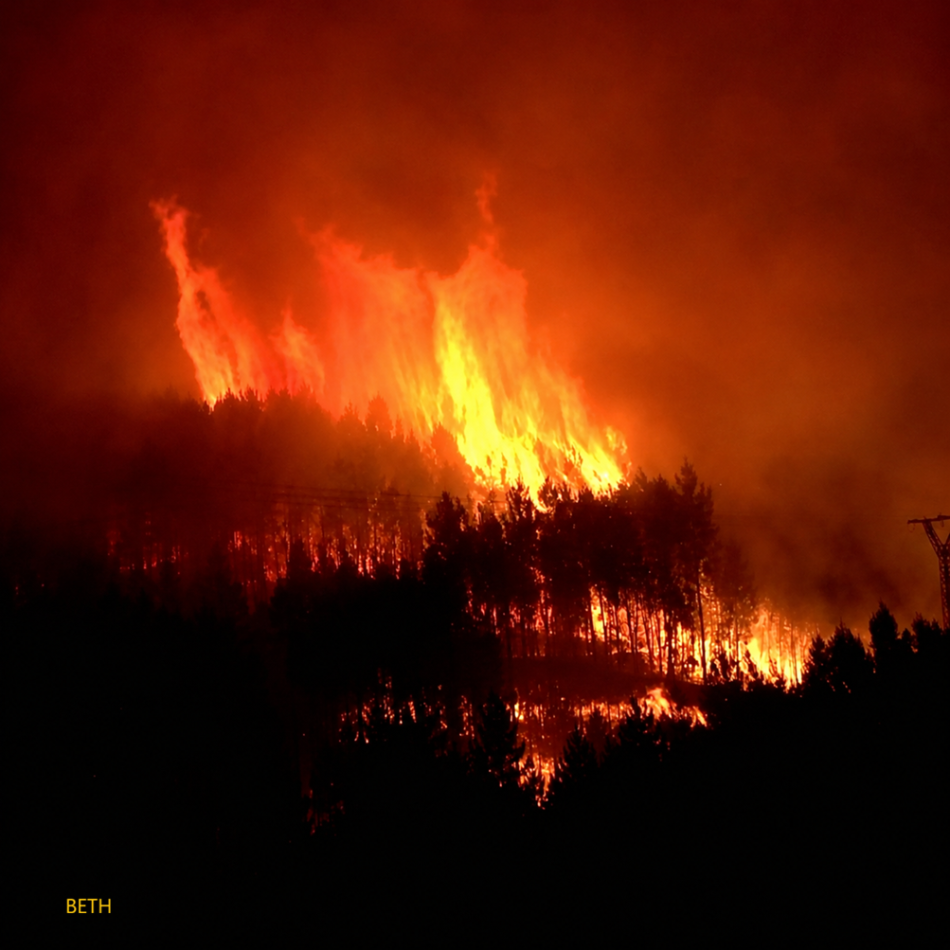
Fires force hundreds of thousands to evacuate and consume vast areas of France and Spain, while heatwaves test European countries’ ability to protect their populations and manage emergencies that transcend national borders
Monitoring and Analysis | Strategic Media Department – BETH Agency
Supervised by: Abdullah Al-Omairah
France, Spain | BETH
Europe has been battling fires since the beginning of July, amid successive waves of heat and drought.
Wildfires in Europe are no longer limited seasonal incidents that can be contained by sending firefighting teams to a remote area.
The fires sweeping through France and Spain, with their risks extending to Portugal, Greece, and other parts of southern Europe, are now threatening cities, tourist areas, factories, roads, and electricity networks, and forcing massive evacuations at the height of the tourist season.
More than 300,000 people have been evacuated in France and Spain, in one of the largest wildfire-related evacuation operations Europe has witnessed, while the scale of the fires has required the intervention of the European Union Civil Protection Mechanism and support for both countries with aircraft, helicopters, and firefighting teams from several nations.
The danger does not lie in the number of fires alone.
It lies in their simultaneity, the breadth of the areas they cover, their proximity to population centers, and their outbreak under high temperatures, low humidity, and winds capable of changing the direction of the fire within minutes.
France | The Most Dangerous Season Since the War
France’s most dangerous fires have been concentrated around Gironde and the Landes forests in the southwest of the country, near Bordeaux and the Atlantic coast, which is crowded with residents and tourists.
The flames have consumed approximately 42,000 hectares in the Gironde region, while the authorities have been forced to evacuate large numbers of residents and tourists and clear campsites and coastal areas as temperatures began to rise again.
President Emmanuel Macron described the situation as the most dangerous France has faced since the Second World War, while the state mobilized thousands of firefighters, military personnel, and police officers, and sought European aerial support to reinforce its national capabilities.
Although crews succeeded in stabilizing parts of the fire, the authorities have not declared the danger over, because rising temperatures, drought, and winds could reignite edges that have remained burning beneath the ashes.
Some areas have also witnessed the formation of massive fire clouds as heat and smoke rose into the upper layers of the atmosphere.
This phenomenon does not remain merely a result of the fire, but can become a force that drives it, producing strong winds, atmospheric disturbances, and lightning capable of igniting new hotspots far from the original front.
Here, firefighters are no longer facing only a fire moving within the weather.
They are facing a fire that creates its own weather.
Spain | Record Areas
Spain is facing widespread fires around Madrid, the province of Ávila, and other regions, amid a new heatwave and evacuation operations involving tens of thousands of people.
Some of the fires have become among the largest in the country’s history, while the area burned since the beginning of the year has exceeded 150,000 hectares, with the danger continuing in forests and areas adjacent to cities and villages.
The government declared a national emergency in the worst-affected areas and deployed firefighting forces, aircraft, and military units, while also requesting support from the European Civil Protection Mechanism.
Spain received aircraft, teams, and vehicles from Portugal, Italy, Greece, and Türkiye, along with urgent maps produced by the Copernicus satellites to monitor the spread of the fires and identify threatened facilities, roads, and communities.
But the scale of the mobilization also reveals the extent of the pressure.
When multiple areas are burning at the same time, the problem is no longer possessing a firefighting aircraft, but deciding which front it should be sent to first, how many hours it can operate, and who will protect the other areas if the fires expand.
Southern Europe | A Longer Season
The current wave of fires was preceded by major blazes in Portugal, Greece, Croatia, and Albania.
In Portugal, more than 1,200 firefighters and hundreds of vehicles and aircraft took part in confronting a fire that consumed approximately 13,000 hectares, while areas in Greece experienced fires that reached industrial facilities and produced toxic smoke, prompting the authorities to evacuate residents and warn them against opening windows.
This spread means that Europe is no longer facing a limited “wildfire season” during the hottest weeks of summer, but a danger that begins early and may extend into the autumn.
Officials and experts have warned that some hotspots could remain active until November, and that the longer season reduces countries’ ability to transfer firefighting aircraft between regions and continents according to their different seasons.
Why Are the Fires Expanding?
Not every fire has a single cause.
Some may begin with lightning, an electrical fault, agricultural machinery, or human negligence, while others may be deliberately ignited.
But the spark alone does not explain why a small fire becomes a front extending for dozens of kilometers.
Extreme heat dries out trees and soil.
Prolonged drought turns vegetation into fuel.
Winds carry sparks to new areas.
Construction near forests places residents and homes directly in the path of the fire.
Meanwhile, the accumulation of dry grass and trees resulting from poor forest management gives the fire additional material with which to continue.
Here, a distinction must be made between the cause of ignition and the cause of the disaster.
The spark may be human or natural, but climatic conditions, land management, and urban expansion determine whether it will be extinguished within a limited area or develop into an uncontrollable fire.
Climate change does not create every spark, but it prepares a hotter and drier environment that allows fire to spread faster and last longer.
The Damage Extends Beyond the Forest
The loss begins with trees and wildlife, but it does not end there.
Fires destroy homes, farms, factories, electricity and communications networks, close roads and railway lines, halt tourism activity, and push insurance companies to raise prices or reassess their coverage of high-risk areas.
The damage to tourism comes at an extremely sensitive time, as fires are burning in coastal areas that receive large numbers of visitors during the summer.
Extinguishing a fire does not mean that the area immediately returns to normal.
Burned soil loses its ability to absorb water, increasing the risk of flooding and landslides when rain falls.
Smoke raises pollution levels and affects people with heart and respiratory diseases, even in cities located far from the fire.
Forests need years or decades to regain their balance, while some ecosystems may never return to their previous condition.
As for evacuated residents, they may return to intact homes, or to land where nothing remains to return to.
How Is Europe Confronting the Fire?
The European response operates through three circles.
The first is national and includes firefighting services, civil protection, police, armed forces, and local authorities.
The second is cross-border, through the European Civil Protection Mechanism, which coordinates requests for assistance and moves aircraft, teams, and equipment between countries.
The third is technological, through satellites, warning systems, digital maps, and forecasts of wind direction and smoke dispersion.
For the summer of 2026, the European Union prepared the largest joint response in its history, comprising 22 firefighting aircraft and five helicopters, along with 777 firefighters from 14 countries who were pre-positioned in the areas most exposed to danger. European Commission
As the fires in France and Spain expanded, seven aircraft and four helicopters from European countries and Türkiye were sent to France, while Spain received six aircraft and ground teams and vehicles from Portugal.
The Copernicus program also provides rapid emergency maps that help identify the boundaries of the fire, open roads, and homes and facilities located within the danger zone.
This is an advanced system, but it is not without limits.
Aircraft Are Not Enough
The fires reveal that Europe possesses a strong structure for cooperation, but faces a gap between the expansion of the danger and the pace at which its capabilities are growing.
Water-dropping aircraft are a limited resource, and pilots capable of operating in conditions of smoke, wind, and low altitude cannot be trained quickly.
One of the largest aerial firefighting service companies has recorded more than 5,000 flight hours in Spain and Portugal since the beginning of 2026, more than double the previous year.
Europe has ordered 22 new Canadair aircraft, but the first planes will not arrive before 2028, leaving a capability gap for at least two seasons.
Nor can an aircraft extinguish a fire on its own.
It reduces the intensity of the fire and opens the way for ground crews, but it needs nearby water, maintenance, fuel, weather that permits flying, and precise coordination that prevents crews from being exposed to danger.
When France, Spain, Portugal, and Greece all need support at the same time, the dilemma emerges:
Who helps whom when fires are burning everywhere?
Disaster Tests the State
Major events reveal capabilities that do not appear on ordinary days.
The number of aircraft and firefighters is important, but it is not enough to judge a state’s ability.
True efficiency appears in:
The speed of detecting and reporting the fire.
Clarity of command and distribution of responsibilities.
Warnings reaching residents at the right time.
Organizing evacuation without roads becoming congested.
Protecting hospitals, nursing homes, and tourist campsites.
Providing shelters, food, and healthcare.
Maintaining electricity and communications.
And the speed of returning residents and compensating those affected.
A country may possess modern equipment but delay making the evacuation decision.
It may succeed in extinguishing the fire but fail to restore life to the area.
It may save residents but repeat the same mistakes in forest management and construction, allowing the disaster to return years later on a larger scale.
Therefore, emergency-management capability is not measured by the number of aircraft appearing in photographs, but by the number of lives saved, the areas protected, and the time the state needs to restore services.
Prevention Is Cheaper Than Heroism
Firefighting aircraft and heroic scenes attract attention, but the more important battle begins before the fire starts.
It begins with clearing forests of dry fuel, establishing firebreaks, regulating construction in dangerous areas, maintaining power lines, monitoring human activity, training residents in evacuation, and preventing an entire city from having only one exit route.
It also begins with identifying groups that may be unable to escape on their own, preparing advance lists of the elderly, the sick, and people with disabilities, and providing alternative means of communication if networks fail.
A warning that arrives after the fire has closed the road is no longer a warning.
An evacuation plan that has not been tested before the disaster may become part of it.
The strongest system is not merely the one that extinguishes the largest fire, but the one that prevents the spark from becoming one.
When Fire Changed History
Rome | 64 AD
The Great Fire of Rome lasted for several days and destroyed large parts of the city during the reign of Emperor Nero.
Nero’s direct responsibility remained a matter of historical dispute, but the fire became a political tool, as Christians were accused of starting it and subjected to persecution, while parts of Rome were rebuilt according to urban arrangements that were more resistant to fire.
The fire has remained an example of how a disaster can be transformed from an urban event into a struggle over narrative and power.
London | 1666
The Great Fire of London began in a bakery, then spread through a city of narrow streets whose buildings were predominantly made of wood.
It destroyed thousands of homes, dozens of churches, and public buildings, but subsequently led to the imposition of new building regulations, including the use of brick and stone instead of wood, regulation of building heights, and the widening of some streets.
The fire did not merely rebuild London.
It rebuilt the concept of safety within the city.
Peshtigo and Chicago | 1871
The Peshtigo Fire in Wisconsin broke out on the same day that the Great Chicago Fire began.
Chicago gained greater fame because of its status and the scale of urban destruction, but Peshtigo was deadlier, killing between 1,200 and 2,500 people and burning more than one million acres, making it the deadliest wildfire in American history.
The fire revealed the role of drought, winds, logging waste, and the absence of forest management in turning the region into a mass of fuel.
Chicago, meanwhile, transformed the disaster into a starting point for rebuilding the city according to new standards and later became a center for the development of modern architecture.
Black Saturday | 2009
The Australian state of Victoria witnessed hundreds of fires in a single day under exceptional temperatures and winds.
A total of 173 people were killed and more than 2,000 homes were destroyed, and the disaster led to a broad review of warning and evacuation systems, vegetation-fuel management, and policies governing whether residents should remain or leave.
The most important lesson was that long experience with wildfires does not grant a state immunity if conditions exceed the limits of its plans.
The Camp Fire | 2018
The Camp Fire swept rapidly through the city of Paradise in California, killing 85 people and destroying or damaging more than 19,000 buildings.
Investigations revealed problems in electrical infrastructure, warning systems, and evacuation, particularly when tens of thousands of people attempted to leave the area through limited roads at the same time.
The fire proved that danger does not begin when the flames reach the home.
It begins when cities are built within combustible areas without exit routes and warning capabilities proportionate to their populations.
BETH Reading | What the Fire Reveals
Europe’s fires are not a test for firefighters alone.
They are a test of urban planning, forest management, infrastructure, warning systems, leadership, cooperation among countries, and the ability to transform data into a decision before the flames outpace the authorities.
The crisis reveals that European countries possess significant capabilities, an advanced solidarity mechanism, satellites, aircraft, and specialized teams.
But it also reveals that the danger is growing at a pace that may exceed the speed at which capabilities can be built.
New aircraft require years.
A neglected forest needs only minutes to ignite.
Simultaneous fires can exhaust a system established on the assumption that countries would not all need assistance at the same time.
Europe’s success, therefore, will not be measured only by the number of fires it extinguishes this summer.
It will be measured by what it does after they are extinguished:
Will it rebuild what burned in the same way?
Will it merely increase the number of aircraft?
Or will it reconsider forests, cities, energy, warning systems, and evacuation, and treat wildfires as a permanent danger rather than a seasonal incident?
Disaster reveals the power of nature.
But the way it is confronted reveals the power of the state.
The strength of a state is measured on ordinary days by what it builds, but when fire breaks out, it is measured by the speed of what it saves, the precision of what it manages, and what it learns so that the same disaster does not return in a more severe form.