

Saudi Arabia’s 2027 Budget Forum | Non-Oil Revenue Covers 37% of Government Spending
The finance minister says Saudi Arabia has no immediate need to draw on its reserves. The investment minister reports more than SAR 6 trillion in investment over five years, and the communications minister announces plans to launch an AI assistant for every citizen in early 2027.
Riyadh | BETH
Wednesday, November 25, 2026
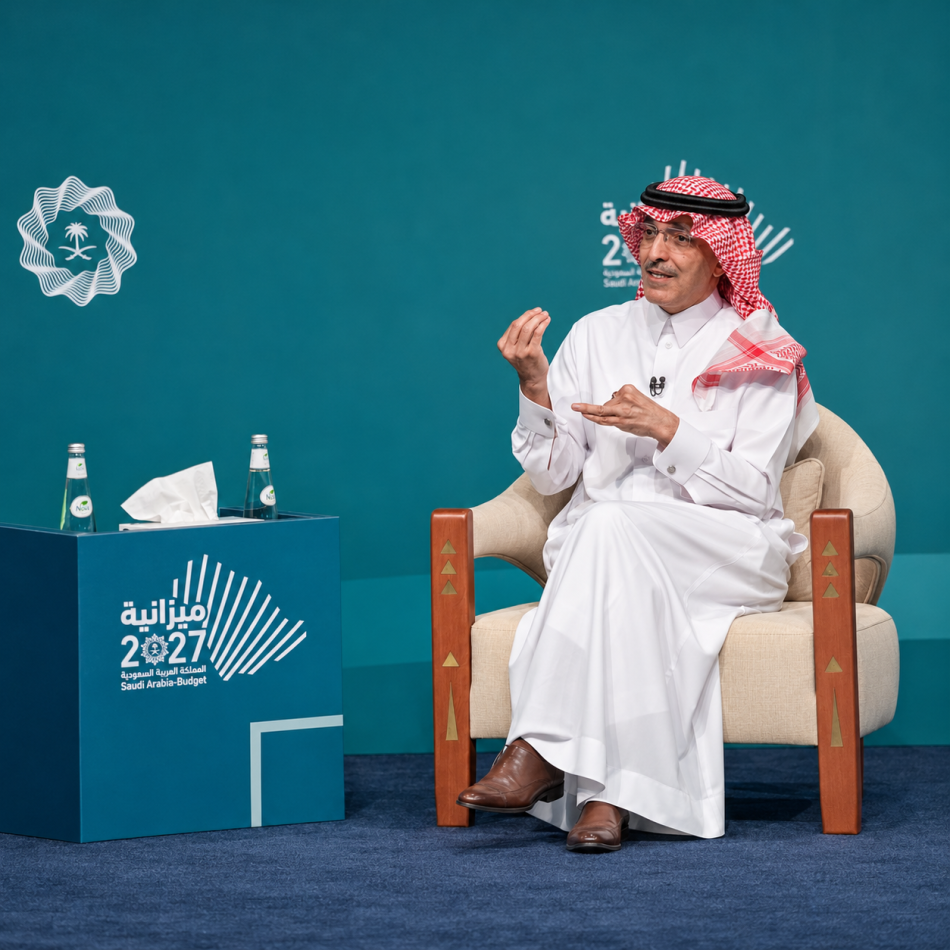
At the 2027 Budget Forum in Riyadh, Saudi Arabia’s ministers of finance, investment, and communications and information technology outlined how the Kingdom responded to supply chain disruptions, where investment is headed following years of infrastructure expansion, and how citizens will access government services in the future.
The forum took place a day after Saudi Arabia approved its state budget, with SAR 1,392.10 billion in spending, projected revenue of SAR 1,201.54 billion, and a projected deficit of SAR 190.56 billion.
Al-Jadaan | Non-Oil Revenue Reduces the Impact of Oil Revenue Volatility on Spending
Speaking at a session on fiscal resilience, Finance Minister Mohammed bin Abdullah Al-Jadaan said non-oil revenue now covers about 37% of total government spending, up from 16% in earlier years. He said the increase had reduced the impact of oil revenue fluctuations on public spending, made spending more stable and improved the government’s ability to plan over the medium term.
Al-Jadaan said the institutional capabilities the Kingdom had developed in the decade since the launch of Saudi Vision 2030 had improved its ability to make decisions quickly, assess different scenarios and manage crises. Earlier investments in infrastructure had also given the Kingdom practical alternatives when disruptions occurred. He added that non-oil GDP, consumption and private investment continued to grow despite global and regional challenges.
He said citizens remained the government’s foremost priority, alongside providing basic care to residents. The government’s priorities include maintaining services, improving quality of life, and creating jobs and business opportunities while responding to crises.
Reserves and the deficit. Al-Jadaan said the Kingdom currently has no need to draw on its reserves, which have increased by about 20% since 2022 despite budget deficits. He explained that part of the return on reserves invested by the Saudi Central Bank counts as non-oil revenue, and that both oil and non-oil revenue had exceeded estimates despite the challenges. He said Saudi Arabia’s debt-to-GDP ratio was among the lowest in the G20, citing demand for Saudi debt instruments and the Kingdom’s access to financing markets. He affirmed that the government aims to increase its reserves.
He said the deficit should be assessed in light of what the government spends on and what that spending achieves. The government accepts a deficit when the economic and social returns on spending exceed the cost of financing it and help broaden the economic base.
Supply chains and Jeddah port. Al-Jadaan said the government had worked with the private sector to establish alternative logistics routes since the crisis began on February 28, 2026. This included redirecting shipments from Eastern Province ports to Red Sea ports and using railways, roads and the Kingdom’s northern border crossings to maintain supplies of essential goods and services.
He said logistics operations were reorganized in less than 48 hours. The number of trucks entering Jeddah port empty and leaving loaded rose fivefold, from about 2,000 to 10,000 a day.
Private-sector financing and job protection. Al-Jadaan said the government balances domestic and international borrowing to avoid crowding out private-sector borrowers in the local market. The updated State Revenue Law gives agencies more flexibility in estimating revenue, clarifies their collection responsibilities, and makes it easier for businesses in affected sectors facing cash-flow pressures to pay amounts owed to the government in installments.
He highlighted the reactivation of SANED to support affected sectors and protect Saudi jobs, as well as the Public Investment Fund’s efforts to deepen partnerships with the private sector. He also noted that the National Development Fund and its affiliated banks and funds are rescheduling loans, financing working capital, and providing additional credit and guarantees to keep goods and production inputs available.
Spending priorities. Al-Jadaan said there was no ceiling on the funding needed by the military and security sectors to defend the Kingdom and protect its citizens and residents. He praised government agencies, including military and security bodies, for improving spending efficiency, achieving savings, rescheduling some projects and restructuring programs. These efforts help prioritize spending that directly affects citizens, maintain essential services and strengthen the ability of the relevant authorities to respond to threats.
Al-Saif | Investment Exceeds SAR 6 Trillion Over Five Years
Investment Minister Fahad Al-Saif said during the session on investment opportunities in promising sectors that investment in Saudi Arabia exceeded SAR 6 trillion between 2021 and 2025, including more than SAR 1.3 trillion in 2025. Investment rose 6% in the first half of 2026 compared with the same period a year earlier.
Al-Saif said the Kingdom had invested heavily in infrastructure over the past five years and that its priority now was to build on that work and attract investment that could make use of it. Referring to Tourism Minister Ahmed Al-Khateeb’s remarks on infrastructure readiness, he identified tourism as one of the promising sectors that had attracted substantial investment.
He attributed the Kingdom’s appeal to domestic, regional and international investors to the resilience it had demonstrated over the previous six months in supplying energy to global markets and maintaining transport, logistics, communications and technology services.
Alswaha | An AI Assistant for Every Citizen in the First Quarter of 2027
Communications and Information Technology Minister Abdullah bin Amer Alswaha announced that the Kingdom plans to launch an AI assistant for every citizen in the first quarter of 2027. The Saudi Data and Artificial Intelligence Authority (SDAIA) will launch it in partnership with government agencies. Users will be able to speak in their local dialects to ask about government services and complete transactions, including renewing passports, asking about vaccinations and enrolling students in school.
Alswaha said the initial trial involved 500 users, with thousands expected to participate in the next pilot phase. The Kingdom then plans to develop specialized AI agents for health, education, commerce, transport and logistics and connect them to the personal assistant so government services can work together and anticipate users’ needs.
From digitizing transactions to completing them by voice. Alswaha outlined the shift from paperless government to remote services, followed by the consolidation of government platforms from 800 to 450. He said more than 1,800 services were available through Tawakkalna. He also said the Kingdom ranked fourth globally in the overall digital government index and first in five of its main indicators, including digital government services, reaching its top-five target four years ahead of schedule.
He cited Najiz, which serves more than eight million users annually, and said the time needed to issue court rulings had fallen from more than 200 days to 20 days. He also noted the use of AI to support the justice system. The Nusuk platform has reached 70 million users, and the government finance system has automated 85% of its services and more than 90% of its workflows. He added that half of the digital government effort is overseen by the Digital Government Authority and implemented by SDAIA.
The digital economy approaches SAR 500 billion. Alswaha said the digital economy was nearing SAR 500 billion, while digital commerce between businesses and consumers grew 30% in the latest quarter to reach SAR 100 billion. He highlighted the contribution of 420,000 Saudi men and women working in communications, technology, space, AI and cybersecurity.
He said investments in digital infrastructure over the past decade had helped keep services and businesses running during crises. He cited the Kingdom’s first-place ranking among G20 countries for digital competitiveness in 2020 and said it ranked first in digital readiness this year. Telecommunications service quality rose from less than 70% to 95%, while the service gap narrowed to 1%, he said.
Alswaha said the telecommunications market was projected to grow 3.9% in 2026 and the technology market 9.4%. The National Technology Development Program, backed by SAR 2.6 billion, has supported more than 1,500 technology companies.
Saudi companies expand internationally. Alswaha said the Kingdom had nine companies valued at $1 billion or more, several of which emerged from the nonprofit sector. He praised the Saudi Federation for Cybersecurity, Programming and Drones and the Mohammed bin Salman Foundation (Misk) for developing talent and supporting entrepreneurs. He highlighted the Hudhud mapping and navigation app, which has surpassed two million customers and recorded two million trips, as well as Barq, a company in a fintech sector with more than 200 firms.
He said Salla serves 100,000 stores and more than 18 million shoppers in over five countries, with SAR 65 billion in transactions. Unifonic began with $13,000 in investment and has approached a $1 billion valuation, while Foodics has processed more than six billion orders in 35 countries. He added that Saudi-developed technologies and protocols were in use in more than 80 countries.
Alswaha also cited a Saudi company that developed indoor 5G coverage solutions with support from the National Technology Development Program. Its technology was deployed on the Riyadh Metro and at airports before the company expanded to India with contracts worth more than SAR 1 billion over five years. He said Noon and Classera had helped support education for more than 30 million students across the region.
AI infrastructure. Alswaha said the Kingdom aims to rank among the world’s top five countries in AI by developing infrastructure and data centers, expanding adoption of AI applications, and making Saudi talent and companies more competitive globally.
He said 80 square kilometers across more than 20 sites had been allocated and that the Kingdom was expanding its network to more than 20 subsea cables linking east and west and north and south. He said the network would allow services to reach three billion people from Saudi Arabia with a latency of 30 milliseconds, and that capacity available to countries in the region had increased by 50%.
Alswaha linked data center expansion to the Kingdom’s ability to supply energy. According to the figures he presented, Saudi Arabia influences 20% of the global energy mix and directly accounts for 12% of energy supplies. He cited the use of technology to improve energy efficiency and achieve daily savings equivalent to about 660,000 barrels. He also highlighted HUMAIN’s work with Saudi companies to develop AI agents, the Limitless program’s efforts to connect entrepreneurs with computing resources, talent and investment, and investments in Saudi companies including Mozn.
Al-Fadley | Agriculture Contributes a Record SAR 124 Billion to GDP
Minister of Environment, Water and Agriculture Abdulrahman bin Abdulmohsen Al-Fadley said the sector’s achievements in 2026 reflected the impact of government support and investment in infrastructure, natural resource management, food and water security, vegetation cover, and environmental protection. These efforts also encouraged private-sector participation and the adoption of modern technologies and sustainable practices.
Al-Fadley said agriculture contributed a record SAR 124 billion to GDP in 2025, while production of key agricultural commodities reached about 13 million tonnes. Exports of dates and date products rose to SAR 1.1 billion by the end of the third quarter of 2026, with Saudi Arabia retaining its position as the world’s largest exporter by value.
He said the ministry and its partners had strengthened supply stability by diversifying import sources and maintaining adequate stocks of strategic commodities. An agricultural financing portfolio of up to SAR 5 billion was also allocated to support production, rural development and investment in modern technologies.
In the water sector, Al-Fadley said Saudi Arabia reinforced its position as the world’s largest producer of desalinated water, with output reaching 17 million cubic meters per day in 2026. Water transmission capacity rose to 18.3 million cubic meters per day, while storage capacity reached 32.5 million cubic meters. Local content in the water sector exceeded 68%, and the reuse rate for treated water reached 33.47%, alongside efforts to improve supply efficiency and conserve water.
Under the Saudi Green Initiative, planting reached the equivalent of about 184 million trees, while the area of rehabilitated degraded land reached 1.254 million hectares. More than 10,700 animals were released into their natural habitats. In waste management, 74 investment opportunities covering 99 facilities were activated, with capital investment exceeding SAR 11 billion, supporting the circular economy and attracting investment to the sector.
Enas Al-Eisa | Kindergarten Enrollment Reaches 48%
Deputy Minister of Education Dr. Enas Al-Eisa said the early years lay the foundation for a child’s ability to learn, communicate, explore and acquire skills. The ministry continues to invest in early childhood and expand and improve kindergarten provision. She said enrollment rose 35% in 2025 and the enrollment rate has now reached 48%.
Speaking at the forum’s “Decision and Impact” segment in a presentation titled “Investing in People: A Nation’s Ambition and Its Citizens’ Drive,” Al-Eisa said digital infrastructure helps keep education going at every level. The Madrasati platform has enabled more than 6.5 million students to learn, interact and access educational resources inside and outside the classroom. It has also made it easier for schools to switch to remote learning when needed.
Al-Eisa stressed the importance of curricula that develop thinking, scientific curiosity and creativity and give students opportunities to discover and build on their abilities. She said Saudi students had won more than 150 international awards and registered more than 30 patents. The Kingdom now has 29 specialized schools dedicated to identifying talent in fields including science, culture, sports and technology.
She said the National Unified Admissions Platform standardizes application procedures, improves transparency and fairness, and offers more than 5,000 academic specializations across universities and technical education and training institutions.
Al-Eisa said 70% of Saudi scholarship students abroad attend universities ranked among the world’s top 50. She added that established universities had offered academic and training programs in the Kingdom the previous week.
She described developing and empowering teachers as one of the ministry’s most important investments. The National Institute for Educational Professional Development helps teachers build their skills, pursue continuing education and improve classroom performance. She said that investment had helped students and teachers win 16 international awards.
BETH Analysis | How Can the Impact Be Measured?
Revenue diversification helps the government keep essential services and priority projects funded when oil income fluctuates. Al-Jadaan offered a practical example of what earlier infrastructure investment made possible. Alternative transport routes and ports allowed the government and private sector to redirect freight in less than 48 hours.
The SAR 6 trillion figure captures the scale of investment over five years. The next phase can be assessed by the projects that enter operation, the jobs they create and the private capital they attract. For digital services, the test begins when the AI assistant launches. How many transactions can citizens complete on the first attempt, and how much time will it save them?
Reporting and Analysis | Strategic Media Department – BETH News Agency