



Day 143 🇺🇸⚔️🇮🇷: Revenge Widens the War
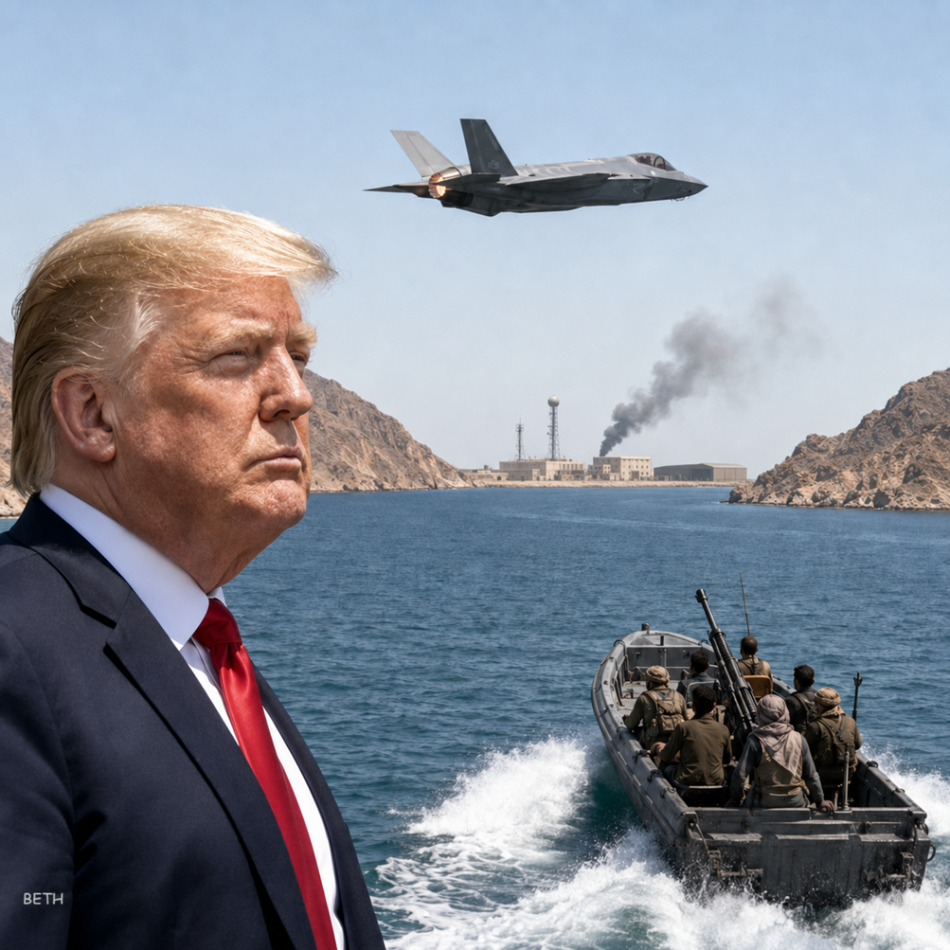
U.S. strikes extend from the Caspian Sea to Hormuz, while Iran mobilizes the Houthis toward Bab al-Mandeb, narrowing the distance between a personal war and a regional conflict
BETH | B
The U.S.-Iran war has entered a broader and more dangerous phase. American strikes have extended from an Islamic Revolutionary Guard Corps naval headquarters on the Caspian coast in the north to sites near the Strait of Hormuz in the south, coinciding with Houthi movements supervised by Iranian experts near Bab al-Mandeb.
In Washington, another dimension has been added to the conflict. U.S. sources reported that President Donald Trump has grown increasingly skeptical of diplomacy, sees himself as being in “revenge mode” against Iran, and does not believe there is currently a better option than continuing the military strikes.
From the Caspian to Hormuz
U.S. strikes on Friday targeted a headquarters belonging to the Islamic Revolutionary Guard Corps Navy in Zibakenar, in Iran’s northern Gilan Province.
Gilan Deputy Governor Ali Bagheri said the attack damaged some of the equipment at the facility, with no casualties reported according to preliminary information.
The attack coincided with explosions near Ahvaz, Andimeshk, and Omidiyeh in Khuzestan Province, as well as in areas near Qeshm Island and Bandar Abbas.
The U.S. Central Command announced the completion of its thirteenth consecutive night of operations inside Iran, stating that the latest wave of strikes lasted more than two hours.
This geographic expansion indicates that the campaign is no longer targeting only capabilities directly linked to the Strait of Hormuz. It is also pursuing the Revolutionary Guard’s infrastructure, command centers, and naval presence deep inside Iranian territory.
The War Becomes Personal
U.S. sources say the war has taken a personal toll on Trump and several of his senior advisers, amid continuing intelligence warnings of potential Iranian plots to assassinate the president and other U.S. officials.
This changes the logic of decision-making.
When a president views a war as a matter of revenge and personal protection, calculations of cost and duration may recede behind the desire to punish the adversary and prevent it from appearing capable of issuing threats.
Yet another voice remains within the U.S. inner circle. Jared Kushner and U.S. envoy Steve Witkoff still believe that an agreement with Iran is possible, despite the diminishing prospects for diplomacy.
Washington is therefore moving between two directions: a president increasingly convinced of the need to continue the strikes, and two negotiators attempting to keep the door to an agreement open.
Iran Opens the Bab al-Mandeb Front
Tehran, meanwhile, appears to be responding to the widening strikes inside its territory by expanding the threat beyond Iran.
Yemeni military sources reported that an attempted infiltration by Houthi elements toward forward positions overlooking the Strait of Bab al-Mandeb had been thwarted. The operation was reportedly supervised by experts from Iran’s Islamic Revolutionary Guard Corps.
The infiltrators were forced to retreat following clashes with Yemeni forces stationed on Mayyun Island and in the surrounding areas.
Earlier reports indicated that Iran had transferred commanders and advisers from the Revolutionary Guard, along with missile- and drone-related equipment, to Houthi-controlled areas of Yemen.
This suggests that Tehran may be attempting to establish a parallel maritime front: if pressure intensifies in Hormuz, the Houthis move in Bab al-Mandeb, leaving global trade caught between two threatened waterways at the same time.
Two Waterways, One War
The conflict now extends across three interconnected locations:
The Caspian Sea, where a Revolutionary Guard naval headquarters was targeted.
The Strait of Hormuz, where the U.S.-Iran confrontation is concentrated.
Bab al-Mandeb, where the Houthi card is being activated with Iranian support.
The conflict is no longer solely about reopening the Strait of Hormuz. It is increasingly about Iran’s ability to threaten the maritime and energy network stretching from the Arabian Gulf to the Red Sea.
Beyond the Developments
Tehran may be unable to stop the strikes inside its territory, but it is attempting to raise the cost of their continuation beyond Iran.
Washington may be capable of expanding its target list, but it faces the risk of shifting from a limited campaign to protect navigation into an open-ended war driven by calculations of revenge and spread across multiple fronts.
Kushner and Witkoff remain holding onto a diplomatic thread that grows weaker with every passing night.
The danger now is not merely that the war will continue, but that it will become personal in Washington, regional in Iran’s responses, and global in its consequences for navigation and energy.