



Day 142 🇺🇸⚔️🇮🇷: The Bomber Above the Blockade
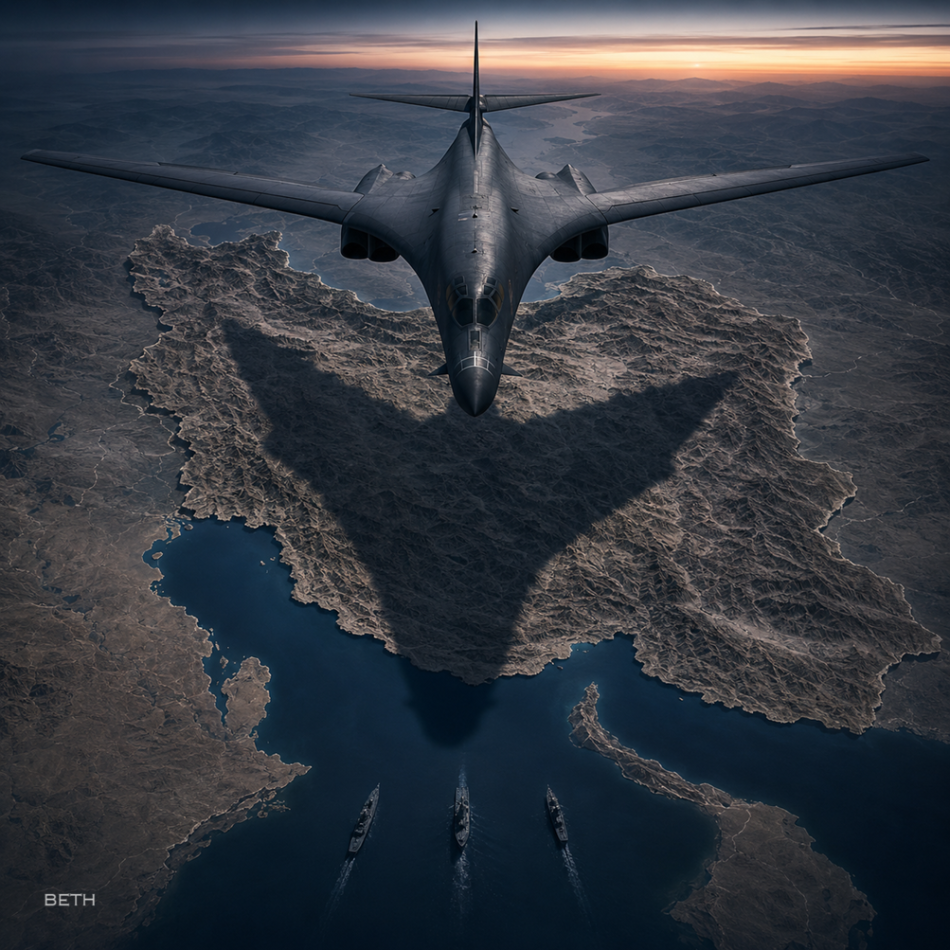
Washington completes its twelfth night of strikes and deploys the B-1 against the Revolutionary Guard—a combined air and naval campaign constraining Iran’s ability to wage war and conduct trade
BETH | B
The United States has completed its twelfth consecutive round of strikes inside Iran, while simultaneously expanding its naval blockade and deploying the B-1 strategic heavy bomber for the first time since fighting resumed.
U.S. Central Command said the strikes targeted maritime capabilities, missile and drone storage facilities, coastal surveillance sites, and air-defense systems, with the stated aim of degrading Iran’s ability to attack civilian mariners and commercial vessels.
CENTCOM said U.S. forces had targeted dozens of Iranian military sites on land during July while reimposing the blockade at sea. It reported redirecting nine commercial vessels and disabling another to prevent ships from entering or leaving Iranian ports.
The command also confirmed that more than 50,000 U.S. military personnel are deployed across the Middle East in a state of heightened alert and combat readiness.
The Bomber Enters the Battle
U.S. officials revealed that the military used a B-1B Lancer long-range bomber on Tuesday to strike targets associated with Iran’s Islamic Revolutionary Guard Corps. It was the first mission involving the aircraft since the temporary de-escalation collapsed twelve days earlier.
The bomber took off from an airbase in Britain, although CENTCOM did not disclose the targets it struck or the results of the mission.
The B-1 can carry 24 bombs weighing 2,000 pounds each, or substantial numbers of other munitions and cruise missiles. It also combines supersonic speed with a heavy combat payload.
Its deployment therefore represents more than the addition of another aircraft to the campaign. It introduces the capacity to strike numerous targets in a single mission or launch long-range weapons from beyond the reach of Iranian air defenses.
Analysis
A War on Two Fronts
The latest operations show Washington conducting two complementary campaigns.
In the air: destroying missiles, drones, air defenses, radars, command centers, and logistics infrastructure.
At sea: preventing vessels from entering or leaving Iranian ports and restricting Tehran’s ability to trade and export.
Airstrikes weaken the military assets protecting the ports and the Strait of Hormuz, while the blockade exploits that weakness to exert control over maritime traffic.
The United States is therefore targeting not only Iran’s capacity to attack, but also its ability to finance the continuation of the war.
Why Deploy the B-1 Now?
The twelfth night of strikes suggests that the pool of exposed, easily accessible targets is beginning to shrink, and that the campaign is entering a phase requiring aircraft capable of carrying heavier payloads and striking dispersed or fortified targets in a single sortie.
The B-1 may have been deployed to achieve three objectives:
- Intensify the strikes without significantly increasing the number of sorties.
- Reach targets deeper inside Iranian territory.
- Signal that Washington can move from gradual attrition to heavier bombardment.
The bomber’s involvement does not, however, prove that a full-scale war has begun. Operational details remain undisclosed, and the extent of the damage caused by the mission is still unknown.
The aircraft’s political significance is clear; its battlefield impact in this particular operation still requires evidence.
The Blockade May Be More Dangerous Than the Bombing
Iran may be able to repair a facility or move missiles to another location. Sustained disruption of its maritime trade, however, places its economy and military financing under mounting daily pressure.
Every vessel redirected sends a warning to shipping and insurance companies:
Entering an Iranian port is no longer an ordinary commercial decision; it is a risk directly connected to a military confrontation.
The blockade’s effects may therefore accumulate over time. Revenues decline, shipping and insurance costs rise, and importing the equipment and materials required to rebuild what the airstrikes destroy becomes increasingly difficult.
The bombers strike Iran’s capabilities today.
The blockade targets its ability to continue the war tomorrow.
What Does the Presence of 50,000 Troops Mean?
The figure does not necessarily indicate preparations for a ground invasion. The deployment includes air and naval forces, missile defenses, intelligence units, logistics personnel, and troops assigned to protect U.S. bases.
It does, however, demonstrate that Washington is no longer conducting a limited punitive operation. It has assembled a military structure capable of sustaining and expanding the campaign while defending itself against Iranian retaliation.
As this deployment continues, the U.S. administration will face two increasingly urgent questions:
What is the campaign’s ultimate political objective?
And when will military superiority produce an outcome that can be secured and sustained?
The Real Test
The United States has maintained the tempo of its strikes, expanded the blockade, and demonstrated its ability to deploy heavy bombers.
Military success, however, cannot be measured by the number of nights or munitions alone.
The real test is whether this pressure compels Iran to:
- Stop attacking ships.
- Reopen the Strait of Hormuz.
- Accept a verifiable settlement.
- Or continue escalating and extend the war to regional infrastructure and interests.
If Tehran continues fighting despite its losses, Washington will face a difficult choice: expand the target list or remain trapped in a war of attrition with no clearly defined end.
Brief Conclusion
On the twelfth night, the United States combined the bomber and the blockade.
The B-1 entered the campaign to increase the volume and depth of the strikes, while the U.S. Navy continued restricting maritime traffic to and from Iranian ports under the protection of a force exceeding 50,000 personnel.
The objective is no longer the destruction of a single launch site or storage facility. It is to dismantle Iran’s capacity to fight and then constrict the resources it needs to rebuild.
In short: the bomber strikes Iran’s power, while the blockade deprives it of time and money. The decisive question is whether tightening the pressure will force Tehran to retreat—or drive it to widen the war.
Prepared and analyzed by the Strategic Media Department – BETH Agency
Supervised by Abdullah Alomairah