



The Last Stick: Why Is the Regime Burning Iran?
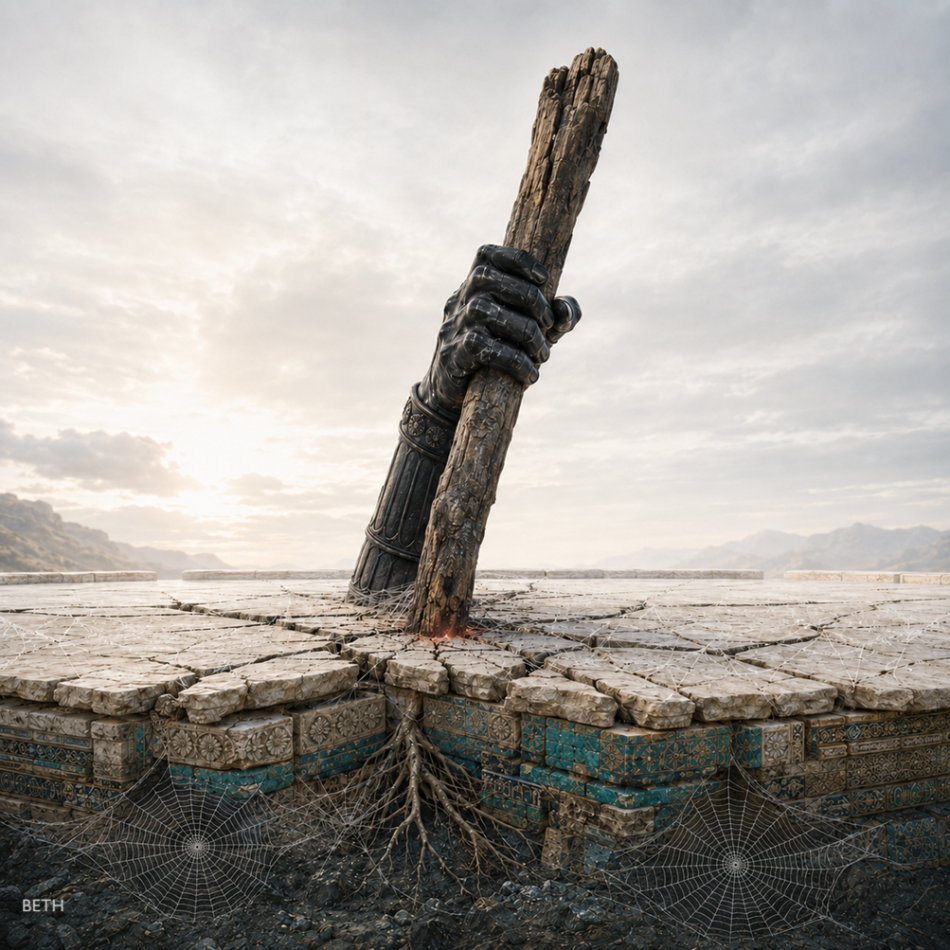
The IRGC continues fighting despite the overwhelming imbalance of power: Is it defending the country, or defending its own survival within it?
From “Khamenei Like a Madman with a Stick” to a regime that continues brandishing it even as the war comes close to breaking it
Prepared and analyzed by the Strategic Media Department – BETH Agency
Supervised by Abdullah Alomairah
Night after night, Iran is being subjected to U.S. strikes targeting military command centers, air defense systems, missile and drone launch and storage sites, maritime capabilities, coastal radar installations, and logistics networks connected to the Strait of Hormuz.
The United States is not merely striking what Iran has already launched. It is striking Iran’s ability to launch again.
Meanwhile, the Islamic Revolutionary Guard Corps continues expanding its attacks against regional states, threatening maritime routes, and mobilizing Iran’s regional proxies, while Tehran works through intermediaries to secure negotiations that could ease the pressure.
The war is expanding.
Iranian capabilities are being depleted.
The economy is paying the price.
And every day, the country is being drawn deeper into danger.
Yet the regime does not stop.
This raises the question that military communiqués do not answer:
Why does a regime that knows the balance of power is against it continue fighting, even if doing so leads to Iran’s destruction?
Does the IRGC truly believe it can defeat the United States?
Or is it no longer fighting for Iran to prevail, but to prevent its own collapse from within?
Before the Stick Breaks
Several years ago, I wrote an article titled:
“Khamenei Like a Madman with a Stick.”
The idea was not intended as a psychological diagnosis of the man. It was an interpretation of how the Iranian regime manages conflict.
A madman holding a stick does not frighten others merely because of his strength, but because no one can predict where his next blow will land.
He may strike his adversary.
He may strike those around him.
He may strike himself.
Yet everyone hesitates to approach him because no one knows where the stick will fall.
When others attempt to calm him, it may appear that they fear him. Yet de-escalation can sometimes be a means of limiting his danger while waiting for the right moment to take the stick from his hand.
Today, the image returns in a more dangerous form.
The Iranian stick is no longer being brandished from a distance.
It has been used at sea, against neighboring countries, and through missiles, drones, and armed proxies.
At the same time, it is being broken by military strikes targeting the hand, the instrument, and the stores of power behind them.
The question is no longer:
What should the world do when confronted by a man brandishing a stick?
It is now:
What does the regime do when it discovers that the stick no longer frightens its adversaries and that the hand holding it has itself become the target?
It Is Not Fighting to Win
By the standards of conventional warfare, the IRGC does not possess the ability to defeat the United States.
The disparity in air power, intelligence, surveillance, command and control, and the capacity to sustain operations leaves Tehran no realistic path to military victory in the conventional sense.
But the regime does not necessarily need to win in order to continue fighting.
Its real objective may be to deny the United States a clean, rapid, and inexpensive victory.
It therefore seeks to:
- Increase American casualties.
- Threaten U.S. bases and interests across the region.
- Extend the danger to neighboring states.
- Disrupt navigation through the Strait of Hormuz.
- Pressure energy, insurance, and shipping markets.
- Open new fronts through regional proxies.
- Demonstrate that the regime’s collapse would not automatically produce stability.
- Push Washington and its allies toward an agreement that preserves part of the regime’s structure and capabilities.
The regime is not fighting to defeat the United States militarily.
It is fighting to make the cost of defeating it greater than the cost Washington is willing to bear.
Here lies the difference between fighting to win a war and fighting to spoil an enemy’s victory.
The Regime Fears Peace
Ending the war might appear to be the natural choice for a regime facing escalating attrition.
For the Iranian regime, however, peace is not always less dangerous than war.
The moment the strikes stop, questions will begin inside Iran:
Who started the confrontation?
What did decades of spending on missiles and regional proxies achieve?
How were military sites and senior leaders penetrated?
Why were state facilities destroyed?
Who is responsible for the human and economic losses?
Were these sacrifices made to defend Iran, or to defend the regime’s project?
War allows the authorities to postpone these questions.
It enables them to turn dissenters into traitors, protests into conspiracies, failure into steadfastness, casualties into martyrdom, and internal division into a threat to national security.
During war, the regime can tell Iranians:
This is not the time for accountability.
In peace, it may discover that accountability is the first thing awaiting it.
The regime may therefore fear the moment the bombardment stops, because that is when Iranians will turn their eyes away from the sky and back toward those who govern them.
A War for the State or a War for the Regime?
There is a difference between a state that fights to protect its people and a regime that uses the state to protect itself.
The state asks:
How do we protect the land, the people, and the economy?
A threatened regime may instead ask:
How do we preserve power, even if the land, the people, and the economy are lost?
This is when wars reach their most dangerous point: when the interests of those in power separate from the interests of the state.
Ending the war may become a national necessity, yet appear to the regime as a concession that threatens its prestige.
A military withdrawal may protect cities, yet appear to the IRGC as the beginning of deterrence’s collapse.
An agreement may offer a path to saving the economy, yet open the door to an internal reassessment of the entire project that has governed Iran since 1979.
The question then ceases to be:
Will Iran lose the war?
It becomes:
Would the regime rather see Iran lose than lose power itself?
The IRGC: A State Within the State
The IRGC was established after the 1979 revolution to protect the new regime and the revolution’s principles, not as a conventional military force whose sole mission was to defend the country’s borders.
Over time, it expanded from a military institution into a security, political, and economic network wielding influence both inside and beyond the state.
Specialized studies indicate that the IRGC has become one of Iran’s most powerful economic actors, with interests in energy, construction, defense manufacturing, telecommunications, and transport, alongside its political influence and military power. Specialist sources also describe it as the institution most closely tied to the regime’s protection and survival.
For the IRGC, therefore, the regime’s collapse would not merely mean the replacement of a president or government.
It could mean:
- Losing the legitimacy from which its powers derive.
- The dismantling of its economic empire.
- Holding its commanders accountable for decisions that led to war and turmoil across the region and beyond.
- Losing its regional influence networks.
- The fragmentation of its units and command centers.
- The transfer of control over missiles and military installations.
- The end of the state it has constructed within the Iranian state.
The conventional military may fight to protect Iran.
The IRGC also fights to protect the regime that gives it power.
This does not mean that all its members think alike. Divisions may emerge between those who believe the state must be saved and those who have tied their entire fate to the regime’s survival.
The most hardline leadership, however, understands that any new political order may redefine the IRGC’s role or dismantle it altogether.
For that leadership, fighting becomes a defense of its existence, not merely its negotiating position.
This leads to the harshest question:
Is the IRGC defending Iran, or is it fighting with Iran to defend itself?
Why Does It Strike Those Around It?
When the regime cannot stop the strikes inside its own territory, it may attempt to expand the war beyond it.
Attacks against regional states and threats to maritime navigation are not necessarily evidence of a balanced military contest. They may instead be attempts to change the nature of the conflict.
If the war remains confined to the United States and Iran, Washington can concentrate its power on specific targets.
But if it spreads to ports, trade routes, neighboring countries, Bab Al-Mandab, and the Strait of Hormuz, the cost becomes regional and international.
Iran’s message is not:
We can defeat the United States.
It is:
We will not allow you to defeat us without making others pay the price.
Every rise in oil prices, disruption to shipping, increase in insurance costs, and expansion of fear across the region may convince the regime that it has acquired new bargaining leverage.
But this strategy carries the risk of producing the opposite result.
Instead of breaking apart the opposing coalition, it may unite the affected states against Iran.
Instead of demonstrating strength, it may expose that the regime can no longer retaliate against the source of the attacks and has therefore turned toward weaker or closer targets.
Instead of protecting Iran, it may provide its adversaries with additional justification for expanding their operations.
The stick with which the regime sought to frighten everyone may ultimately unite them around the decision to break it.
The Ideology That Redefines Defeat
The behavior of the Iranian regime cannot be understood through politics and military calculations alone.
The regime built its legitimacy around an ideological vision that gives the conflict a meaning beyond the boundaries of the state and its immediate interests.
This discourse invokes concepts such as:
- Permanent revolution.
- Resistance to global arrogance.
- Victimhood.
- Preparing the way for the future.
- Conflict between the forces of truth and falsehood.
- Awaiting Imam Al-Mahdi.
It is essential, however, to distinguish clearly between Shiism as one of the schools of Islam and the transformation of some of its concepts into a political ideology used to justify the continuation of power, war, and interference with the fate of the state, society, and the surrounding region.
There is no universally accepted Shiite doctrine stating that Iran’s destruction is a prerequisite for the appearance of Al-Mahdi, or that the state should pursue devastation to hasten his arrival.
Nor can such an interpretation be attributed to Iranian society as a whole. It is an extremist political interpretation that the regime has attempted to entrench and deploy ideologically, creating a compliant audience in which questions are suppressed and losses are accepted as sacred destiny rather than the consequences of policies whose architects can be held accountable.
Studies of the political use of supernatural beliefs and Mahdist ideas in Iran show that some hardline currents have employed religious language to present their leaders as part of a divine trajectory, portray their adversaries as representatives of evil, and transform political decisions into sacred battles. Cambridge University Press examined this historical intersection in Superstition as Ideology in Iranian Politics.
The danger therefore lies in the political interpretation of religious belief.
If a faction within the regime believes it is engaged in a historic battle that prepares the way for an ultimate victory, it will not interpret losses as a pragmatic state would.
A strike may be presented as a test.
A dead commander as a martyr.
A blockade as evidence of the enemy’s fear.
Destruction as the price of steadfastness.
And military defeat as a stage preceding a deferred victory.
The regime can thus transform every outcome against it into evidence supporting its narrative.
How Does It Win After Losing?
An ideological regime possesses a capability that conventional regimes do not easily command:
The ability to redefine victory.
Victory may no longer mean protecting cities, the economy, or human life.
It may not mean shooting down an aircraft, sinking a ship, or stopping the bombardment.
It may mean nothing more than survival.
If the leadership remains in place, the regime will claim victory.
If the IRGC survives, it will claim to have defeated the enemy’s objectives.
If it retains some missiles, it will claim that deterrence remains intact.
If its proxies survive, it will claim that the so-called Axis of Resistance still exists.
And if the country is destroyed, it will claim that Iran paid a historic price because it refused to surrender.
The people are therefore excluded from defining what victory means.
The regime defines victory, then demands that the people pay its price.
It may survive atop the ruins of cities and present its mere survival as a victory for Iran.
The Psychology of the Bunker
When regimes are besieged, they do not always become more rational.
Sometimes they become more dangerous because they lose the ability to retreat.
At the beginning of a confrontation, a regime believes it has numerous options.
But as losses accumulate, every retreat becomes an admission that everything already sacrificed achieved nothing.
This is where the “sunk-cost” dynamic takes hold:
The higher the cost of a decision rises, the harder it becomes to admit that the decision failed. The decision-maker therefore incurs additional costs to avoid acknowledging that the earlier sacrifices were wasted.
The governing question shifts from:
How do we save the country?
To:
How do we stop others from saying that we lost?
War also isolates leaders inside narrow security circles.
Accurate information becomes scarce.
Officials become afraid to report bad news.
Hardliners move closer to the center of power.
Pragmatic voices recede because advocating retreat may be interpreted as betrayal or weakness.
The regime begins to believe its own rhetoric.
It sees every mediation effort as evidence that the enemy is afraid.
Every delay in achieving a decisive outcome as a victory.
Every missile that reaches its target as proof that capability remains.
And every internal objection as a foreign conspiracy.
This is the psychology of the bunker:
Reality contracts around the leadership, while the image of an imagined victory expands across its walls.
Is Regime Change America’s Objective?
The United States says its strikes are targeting Iranian military capabilities, command centers, air defense systems, missiles, drones, and maritime assets threatening navigation.
U.S. Central Command has confirmed that these components have been targeted throughout the war, which began 140 days ago, especially during its latest rounds. The targets have included command centers, launch and storage sites, maritime capabilities, air defenses, and military logistics infrastructure.
But targeting military power is one thing; overthrowing the regime is another.
To date, there has been no clear official U.S. declaration identifying regime change as the stated objective of the war. The trajectory of the operations, however, suggests that the end goal may extend beyond weakening Iran’s military and nuclear programs to dismantling the system of power that guarantees the regime’s survival.
Such a strategy may involve:
- Dismantling command-and-control centers.
- Weakening the IRGC.
- Destroying the capabilities that protect the regime.
- Strangling sources of financing and export revenue.
- Dismantling the network of regional proxies.
- Exposing military weakness to the Iranian public.
- Monitoring divisions between hardliners and pragmatists.
- Allowing economic, political, and social pressure to accomplish what aircraft alone cannot.
Under this scenario, the United States would not overthrow the regime through a direct decision or military invasion.
It would remove the pillars supporting it, then allow the regime’s own internal weight to bring it down.
A Policy Conducted with Allies
The United States is not operating in a vacuum.
Targeting Iranian capabilities, protecting maritime routes, strengthening air defenses, monitoring military movements, and cutting financing all require a network of allies and partners.
The emerging strategy may involve a division of roles:
- The United States strikes Iran’s military capabilities.
- Israel gathers intelligence and pursues concealed programs.
- Regional states protect their airspace, waters, and infrastructure.
- Sanctions pressure the economy and financial networks.
- Mediators test Tehran’s willingness to retreat.
- Intelligence agencies monitor divisions inside the regime.
- The opposition attempts to present a political alternative.
The success of this policy, however, cannot be measured solely by its ability to weaken the regime.
It must also be measured by whether it can prevent Iran from becoming a failed state afterward.
If the allies agree on eliminating the threat but disagree over the shape of the following day, they may win the war only to open the door to a greater crisis.
The Paradox: War May Strengthen the IRGC
The natural consequence of military strikes may appear to be the weakening of the IRGC.
War, however, can produce a temporary paradox.
The weaker civilian institutions become, the more the regime depends on armed organizations.
The greater the internal fear, the more expansive the role of the IRGC, the Basij, and the security apparatus becomes.
And as political and military commanders are killed, a more hardline generation may rise in their place.
A recent study warned that war, despite killing commanders and weakening capabilities, may increase the militarization of Iranian politics in the short term.
This means that degrading the IRGC’s military capabilities does not automatically end its political grip.
The IRGC may lose missiles and storage facilities while gaining greater control over what remains of the state.
It may use the war to eliminate rivals, monopolize decision-making, and silence society.
The battle is therefore not only about weapons.
It is also about the regime’s ability to transform its own fear into renewed authority.
Iran Is Not the Regime
One truth must not be lost amid the noise of war:
Iran is not the Iranian regime.
Iran is a people, a geography, a society, and a history older than the rule of the mullahs and the IRGC.
The regime, by contrast, is a governing structure created in 1979. It can change without Iran collapsing.
Destroying Iran is not a victory.
Impoverishing its people is not liberation.
And the regime’s fall cannot be considered an achievement if it leaves behind a fragmented state, a devastated economy, uncontrolled weapons, unmonitored nuclear material, and conflict among competing centers of power.
The problem is not merely that the regime refuses to be defeated.
The problem is that it may tie Iran’s fate to its own and tell the Iranian people:
Either we survive together, or we fall together.
The regime that claims to protect the country then becomes one of the greatest threats to its survival.
What Comes After the Fall?
Overthrowing a regime is easier than building the political order that follows it.
The experiences of Iraq and Afghanistan demonstrated that military superiority can remove the center of power, but cannot by itself create legitimacy, institutions, or social consensus.
Iran is too complex to be reduced to the moment its leadership falls.
It contains:
- More than 90 million people.
- Provinces, ethnic communities, and competing interests.
- A conventional army, the IRGC, the Basij, and multiple security services.
- A nuclear program, dispersed facilities, and sensitive stockpiles.
- Economic networks linked to governing institutions.
- Domestic and external opposition movements with differing orientations.
- Borders with highly sensitive states and regions.
- A location that controls a significant part of global energy security.
The question is therefore not only:
Who brings down the regime?
It is also:
Who prevents the state from falling with it?
Who controls the missiles?
Who protects the nuclear facilities?
Who ensures the continuity of institutions and public services?
Who represents the Iranian people?
Will the military and the IRGC accept a transitional authority?
Will IRGC units fragment or turn into armed groups?
Can the opposition move from rejecting the regime to governing a state?
If these questions have no answers, the regime’s fall may become not the end of one war, but the beginning of several.
Why Does It Refuse to Stop?
The reasons the regime continues fighting can be summarized in seven points:
1. It Equates Its Survival with Iran’s Survival
The regime presents itself as the state, turning every call for political change into an attack on the nation.
2. It Fears Accountability
Ending the war would open the files of failure, penetration, losses, spending, and regional proxies that have retreated or collapsed.
3. The IRGC Is Defending Its Empire
For the IRGC, this is not merely a battle over borders. It is a battle over influence, economic power, weapons, and political existence.
4. It Can Redefine Defeat
As long as the regime remains standing, it can call its survival a victory, regardless of the losses inflicted on Iran.
5. It Wants to Raise the Cost of Its Removal
Threatening neighboring states, energy flows, and maritime routes sends the message that ending the regime will not come without a price.
6. It Believes Time May Save It
U.S. policy may change, public support for the war may decline, the allies may divide, or mounting losses may force new negotiations.
7. It Fears Peace More Than War
War temporarily silences the domestic public. Peace restores its voice and its questions.
Where Is Iran Heading?
Four principal scenarios are emerging:
Fighting Until Collapse
The IRGC continues escalating while the United States keeps striking its capabilities and resources, until the regime loses the ability to manage both the war and the state.
The collapse may begin with the economy, a division within the leadership, or a rebellion inside state institutions rather than a single military strike.
An Internal Coup
Military and political figures conclude that the hardline faction’s survival would mean the end of the state. They move to remove it and enter negotiations that preserve institutions while presenting a different leadership.
This path may save the state, but it could preserve part of the regime’s existing structure under a new name.
A Deal That Saves the Structure
The regime accepts major concessions regarding its nuclear program, missiles, maritime routes, and regional proxies in return for an end to the strikes, a gradual easing of pressure, and the preservation of its internal structure.
Such an agreement could end the war without ending its underlying causes.
The Regime Falls, Followed by Chaos
The central government collapses before a viable alternative emerges, pushing Iran into a contest among the IRGC, the conventional military, opposition movements, and local forces.
This would be the most dangerous scenario for Iran and the region, even if some of the regime’s adversaries initially viewed it as a rapid victory.
The Last Stick
Several years ago, the image was of Khamenei as a madman holding a stick that everyone feared approaching.
Today, the danger no longer lies in the stick alone.
It lies in the possibility that the regime, realizing the stick is about to break, may use whatever remains of it to strike the ground beneath its feet.
It may drop the stick and save the country.
It may accept an exit that preserves the state.
It may continue brandishing it in the hope that its adversaries will retreat.
But the greatest danger is that it may decide Iran does not deserve to survive if the regime can no longer rule it.
Conclusion
The IRGC is not continuing to fight because the balance of power offers it a clear path to victory.
It is continuing because defeat threatens more than its bases and missiles. It threatens the regime that gives it authority, the economy that finances its influence, and the political ideology that justifies its existence.
Its behavior may therefore appear irrational from the perspective of Iran’s national interest, yet become comprehensible from the perspective of the regime’s survival.
The problem is that the ruling authority’s logic of survival may become suicidal madness for the state.
Iran may survive a military defeat.
It may rebuild its infrastructure and economy.
It may transition to a new political order.
But it may not easily survive a leadership that binds the country’s fate to its own and would rather see the nation burn than relinquish power.
The regime is not fighting today so that Iran can prevail. It is fighting so that Iran cannot live without it.
The last stick is therefore not the missile, the IRGC, or the Strait of Hormuz.
The last stick is Iran itself.
The man who held the stick, Khamenei, is dead, but the stick did not fall with him. Shattered, it passed into the hands of the IRGC, which continues to brandish what remains of it—even if Iran itself becomes the target of its final blow.