



Day 140 🇺🇸⚔️🇮🇷: The Mountain Under Threat
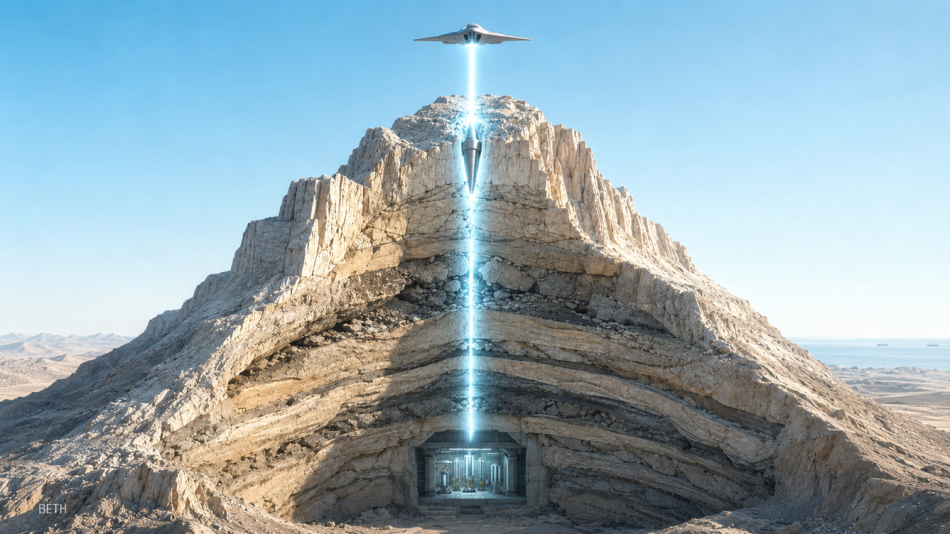
Washington concludes the eleventh night of strikes and declares its ability to reach “Pickaxe Mountain,” while Israel leaves the decision to expand the war to Trump
BETH | B
The United States concluded its eleventh consecutive night of strikes inside Iran as Washington’s messaging shifted from wearing down Iran’s visible military capabilities to threatening its most heavily fortified nuclear sanctuary deep beneath the mountains.
U.S. Central Command, CENTCOM, announced that the latest wave targeted military operations centers, maritime capabilities, aircraft hangars, drone storage facilities, and military logistics infrastructure. The stated objective was to further degrade Iran’s ability to threaten commercial shipping in the Strait of Hormuz.
Eleven consecutive nights of strikes indicate that Washington is no longer carrying out isolated responses to Iranian attacks. It is now conducting a systematic campaign of attrition against Iran’s ability to command, store, launch, resupply, and reactivate assets after they are struck.
The escalation follows the collapse of the interim agreement on July 7, the resumption of confrontation over the Strait of Hormuz, Tehran’s declaration that the waterway was closed, and the restoration of the U.S. blockade on Iranian ports, alongside Iranian attacks targeting Gulf states and Jordan.
The Mountain Enters the Battle
In the most significant development, U.S. Secretary of Defense Pete Hegseth told a congressional hearing that the United States possesses the capability to strike the fortified nuclear facility inside “Pickaxe Mountain,” adding that Washington has multiple military options for dealing with the site.
Hegseth described Iran as being in the weakest military position he had ever seen, while acknowledging that Tehran still retains capabilities it can use.
His statement followed reports that Tehran had transferred thousands of centrifuges into a network of deep tunnels inside the mountain near Natanz. Neither the volume of the equipment moved nor its intended use has been independently established, but the uncertainty surrounding the site has placed it at the center of the conflict’s next phase.
The importance of Hegseth’s statement lies not merely in confirming that another site can be attacked, but in the message it conveys:
What Iran concealed to protect its ability to return is now on the U.S. target list.
Israel Watches
At the same time, a senior Israeli official said the decision to expand the war with Iran rests with U.S. President Donald Trump, stressing that Israel does not currently wish to join the direct confrontation between Washington and Tehran.
He warned, however, that any Iranian attack on Israel would trigger a large-scale response employing the full range of Israeli military capabilities.
The position reflects a clear division of roles: the United States is leading the current campaign, while Israel keeps its forces on alert and avoids opening a direct front unless Iran targets it.
In Britain, reports indicated that newly appointed Prime Minister Andy Burnham had retained the policy allowing the United States to use Diego Garcia and RAF Fairford for operations London describes as defensive actions against Iranian threats.
The operational network supporting the American campaign is therefore expanding, even if the number of direct participants is not.
Analysis
From Destroying Weapons to Destroying Sanctuary
During the previous nights, U.S. strikes concentrated on dismantling Iran’s military system: command, surveillance, aircraft, missiles, drones, maritime capabilities, and logistics.
The introduction of “Pickaxe Mountain” into the military discourse indicates that the United States is approaching a different level of warfare.
The objective is no longer limited to denying Iran the weapons it is using today. It now extends to denying the regime the capabilities it has stored away for use tomorrow.
Tehran had been relying on a separation between two levels of capability:
- Visible assets, some of which could be sacrificed during the war.
- Deeply buried assets preserved for rebuilding military power after the fighting ends.
The threat to the mountain strikes at the foundation of this strategy. If the tunnels are no longer a guaranteed sanctuary, Iran’s losses become cumulative rather than temporary.
Can the United States Reach It?
The ability to strike the mountain does not necessarily mean the ability to destroy everything inside it.
Deep, dispersed tunnel facilities were designed to withstand bombardment, and their central chambers may remain difficult to reach even with bunker-penetrating munitions.
But the United States does not always need to destroy an entire facility to disable it.
It can target:
- Tunnel entrances and exits.
- Electricity and communications networks.
- Ventilation and cooling systems.
- Transport and supply routes.
- Surface installations connected to the facility.
- Personnel and command centers responsible for its operation.
The mountain could therefore remain standing while the facility inside it becomes incapable of functioning.
There is a major difference between destroying a site and depriving it of its purpose. Washington may be more concerned with the latter.
Why Threaten Before Striking?
Declaring the ability to target “Pickaxe Mountain” may be part of a pressure campaign preceding a military decision.
The United States is sending Tehran a final message: whatever remains protected underground could become the price of continuing to close the Strait of Hormuz and rejecting a verifiable settlement.
The mountain thus becomes leverage in negotiations conducted under military pressure.
If Iran agrees to reopen the strait, halt its attacks, and submit suspected facilities to inspection, the strike may be averted.
But if it continues fighting or uses negotiations as cover to reactivate its nuclear program, the threat could become a military operation.
Washington is presenting the regime with a stark choice:
Either disclose what it has hidden or risk losing it.
Why Is Israel Not Entering the War Now?
Israel’s decision not to join the campaign does not mean it has withdrawn from the confrontation.
Its restraint allows it to preserve its readiness, reduces the immediate risk of expanding the war, and enables Washington to present its operations as a means of protecting maritime navigation, military bases, and U.S. forces rather than waging an Israeli war by proxy.
At the same time, Israeli military power remains available as a strategic reserve if Iran attacks Israel or the American campaign fails to address the nuclear threat.
The current equation can be summarized as follows:
The United States fights, Britain facilitates, Israel waits, and Iran attempts to spread the cost of the war across the region.
Washington’s Challenge
Despite overwhelming U.S. military superiority, Iran retains the ability to threaten bases, ships, and neighboring states, disrupt shipping and energy flows, and activate additional fronts through its allies.
The war has also cost the United States approximately $37.5 billion so far, according to Hegseth’s testimony before Congress. This is increasing domestic pressure on the administration to define the campaign’s objective and its endpoint.
It is therefore not enough for Washington to demonstrate its ability to strike. It must prove that its strikes can produce a sustainable political outcome.
A war that destroys capabilities without producing a settlement could become a prolonged contest between bombardment and reconstruction.
Foresight
The next phase is likely to follow one of three paths:
A Strike on the Mountain
Washington concludes that the site presents a threat that cannot be contained and targets its entrances and operational infrastructure. The war would then move from degrading conventional weapons to attacking the heart of Iran’s fortified nuclear program.
An Agreement Under Threat
Tehran is pushed toward a settlement that includes reopening the Strait of Hormuz, ending its attacks, and accepting effective monitoring of deeply buried facilities. In this scenario, the value of the threat would lie in what it prevented rather than what it destroyed.
An Expansion of the Fronts
Iran responds with further attacks against regional states, military bases, or maritime traffic. Israel enters the confrontation directly, U.S. and British operations expand, and the conflict shifts from a focused campaign into an open regional war.
Concise Summary
On the eleventh night, the United States continued destroying the military infrastructure Iran uses above ground.
But today’s message concerns what lies beneath it.
By declaring its ability to strike “Pickaxe Mountain,” Washington is signaling that it intends to prevent Tehran from sheltering its nuclear program inside tunnels and reviving it after the war ends.
Israel has left the decision to expand the conflict to Trump, while Britain has kept its bases available for defensive operations. Iran, meanwhile, remains capable of retaliating and raising the cost of the war, despite being in an exceptionally weak military position.
In short: the United States is no longer pursuing only what Iran launches; it is now pursuing what Iran has hidden to rebuild its power later.
If the mountains represent the regime’s final sanctuary, the war’s approach toward them means Iran is entering its most dangerous phase yet.
Prepared and analyzed by the Strategic Media Department – BETH Agency
Supervised by Abdullah Alomairah