



Who Makes Peace?
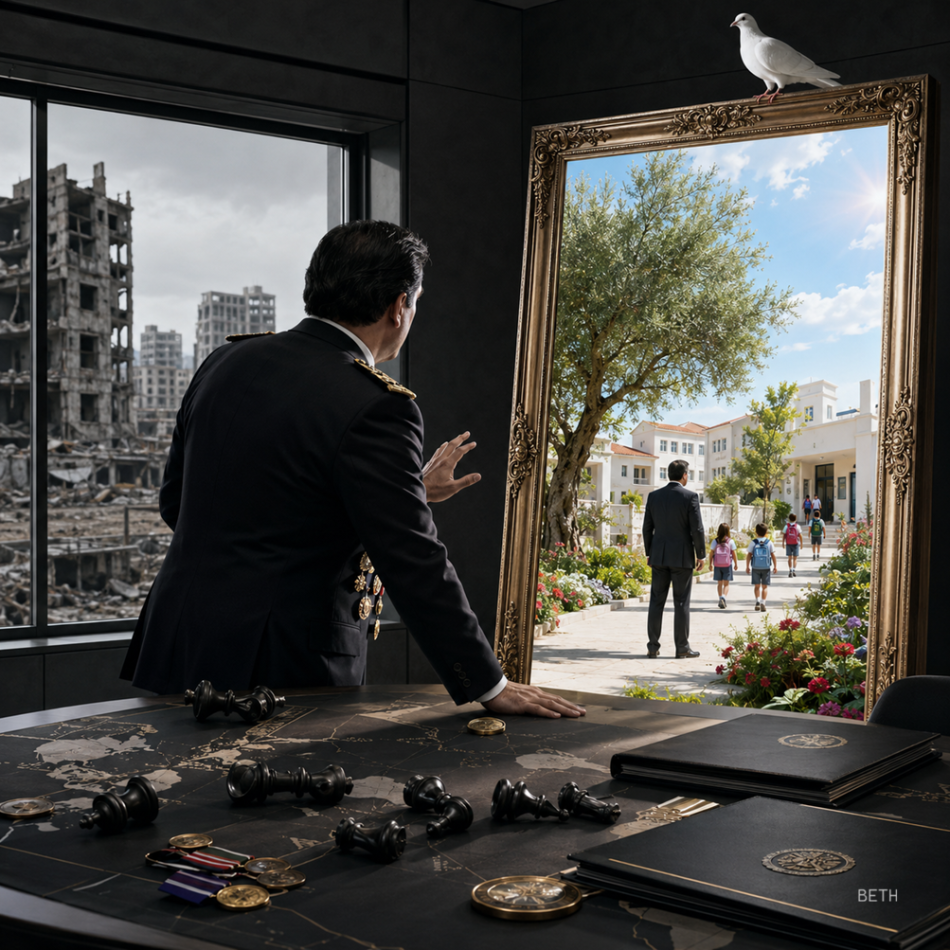
The Region Between Those Who Build the State and Those Who Cannot Survive Without War
An Analytical Report
Prepared and analyzed by: Strategic Media Department at Bth Agency
Supervised by: Abdullah Al-Omira
Wars do not always begin with a gunshot, and peace does not always begin with an agreement.
War may begin in a mind that sees the other only as a target, in a leader who feels valuable only when standing before a map, or in a group that fears losing its weapons—and, with them, its reason for existence.
Peace may begin with a simple idea: that a person should be able to sleep without waiting for a missile, or wake without searching for his child beneath the rubble.
Between these two mindsets, our region has stood for decades. The world speaks to it about peace, then fills its skies with aircraft, supplies its various sides with weapons, and asks its people to trust a future they see approaching atop a tank.
The question is not: Who talks about peace?
Everyone does.
The real question is: Who can live without war?
Peace Carrying a Rifle
One political theory holds that peace is protected not by good intentions, but by a balance of power. There is some truth in this. A weak state may tempt stronger parties to attack it, and an agreement unprotected by institutions and legitimate power may be overturned by the first armed group.
The mistake begins, however, when power ceases to be the guardian of peace and becomes its very definition.
Power can stop gunfire, push back an army, and deter aggression, but it cannot force a person to feel safe toward someone standing before him with a rifle.
Silence can be imposed by force, but reassurance cannot.
A state can be compelled to sign an agreement, but its people cannot be forced to regard it as just if they feel it was signed under coercion or transformed military defeat into a permanent political order.
Peace founded on the humiliation of one side does not end war; it merely postpones it until a new power, a new generation, or a new moment of anger emerges.
The Arab Character
Many Western and Israeli assessments are mistaken when they assume that sustained pressure produces permanent acceptance.
The Arab character, shaped by its historical and social experiences, may remain patient for a long time, endure what is unexpected, and seek a settlement when it preserves both blood and dignity. But it becomes more resistant when it senses that what is being demanded is not peace, but a declaration of submission.
An Arab may accept a mutual concession, but will not accept seeing his leader being led.
He may accept the limits imposed by necessity, but cannot easily coexist with the sight of a party asking him for trust while a rifle remains visibly strapped to its back.
This does not mean glorifying stubbornness or turning war into a virtue. On the contrary, courage does not lie in continuing to fight when fighting has become futile, just as wisdom does not lie in accepting an agreement that plants the seeds of the next explosion.
The more difficult equation is to create a peace that makes no one feel broken and allows no one to become the permanent master of others.
Israel and the Dilemma of Power
Since Israel’s establishment, security has remained a central obsession within its political and military structure. With every war, the conviction has grown within parts of its institutions that greater power will produce greater security.
But the decades have demonstrated that military superiority, however overwhelming, cannot by itself produce political stability.
Israel can destroy a building, assassinate a leader, and weaken an army or an organization. But force alone cannot erase the memory of a people, abolish a right, or transform fear of Israel into acceptance of it.
The problem is not that Israel possesses power, but that some mindsets believe power is sufficient; that security can be built unilaterally; and that the other side will eventually accept whatever is imposed upon it if subjected to greater pressure.
This mindset may win a battle, but with every victory, it plants the seeds of a new adversary.
Israel will not know stable peace for as long as its leadership includes those who need fear in order to govern, war to postpone domestic questions, and a permanent enemy to preserve the cohesion of their supporters.
Whoever builds his legitimacy upon danger fears the disappearance of that danger more than the people themselves do.
The Other Side of the Mirror
Responsibility, however, does not lie with the Israeli mindset alone.
On the Arab side, groups emerged under the banner of resistance, then gradually evolved into forces that needed the conflict to continue in order to justify their weapons, influence, and defiance of the state.
When weapons become the source of authority, peace becomes a threat to those who possess them.
A group that built its status upon war will face a difficult question when the war ends: Why do its weapons remain outside the institutions of the state? Why does the decision of war and peace remain in its hands? And what function will it perform if the army alone becomes responsible for protecting the borders?
Groups such as Hezbollah should therefore not be judged solely by what they say about resistance, but by what they have done to the state in which they operate.
Have they made Lebanon more sovereign, or turned it into a battleground?
Have they protected its national decision, or shared control over it through force of arms?
Have they prevented war, or made its outbreak possible through decisions beyond the authority of state institutions?
Peace cannot be built under an Israeli government that sees force as the only path, nor under an armed group that regards the state as a restraint on its movement.
Extremists on both sides may appear to be enemies, but the survival of each helps sustain the other, because the fear created by one becomes an argument in the hands of the other.
Who Benefits from the Fire Continuing?
One question reveals much about the positions of all parties:
What would each side lose if peace were achieved?
The citizen would regain his life.
The displaced would return home.
The economy would breathe again.
The state would rebuild its institutions.
But arms dealers would lose a market, armed groups would lose their justification, and leaders who built their image on battlefields would have to prove their competence in schools, hospitals, and the economy.
This is why starting a war is sometimes easier than ending one.
In wartime, a leader can demand silence in the name of danger. In peace, he must answer the people’s questions: What have you built? What have you repaired? How did you spend the money? And why do poverty, corruption, and failure remain?
War gives some leaders excuses. Peace takes them away.
Those Incapable of Peace
History has known leaders who excelled at commanding armies but failed to manage the day after the war.
The world has known leaders who mastered escalating threats, mobilizing the masses, and presenting a conflict as an existential battle—only to discover that returning to negotiations was more difficult than going to the front.
The problem does not lie in one particular name or a single state, but in a recurring pattern of leadership from East to West:
A leader who believes that retreating from a mistake is weakness.
A president who fears that a settlement will end his role.
A government that uses an external enemy to conceal its domestic failures.
A regime that turns the nation into a testing ground for the ambitions of its leaders.
Such leaders may be highly skilled in the marketplace of war. They know how to threaten, form alliances, mobilize, and purchase weapons. Yet they are often incapable of managing peace, because peace requires political imagination, calculated concessions, justice, patience, and the courage to confront extremists within one’s own camp.
Opening a war may require a single order.
Closing it requires a state.
The World That Manages the Flames
It would be unjust to absolve the major powers of responsibility.
The West speaks frequently about stability, yet for decades it has pursued a policy of managing fragile balances: no party is allowed to achieve complete victory, no region is allowed to attain complete stability, and the need for protection, weapons, and mediation never ends.
There may be no closed room in which someone literally says, “Do not allow the region to become peaceful.” Yet many policies have produced precisely that outcome in practice.
Weapons are sold to adversaries, then mediation is offered between them.
Issues are left without just solutions, then surprise is expressed when they explode.
Violence is condemned when committed by one party and given another name when practiced by an ally.
The peoples of the region are asked to respect an international law they do not see applied by the same standard.
Through this double standard, peace loses its credibility and is transformed from a human value into a political instrument used by the powerful when it suits them.
The world does not merely need mediators who stop gunfire. It needs an order that does not reward those who start it.
The Saudi Model
In contrast to the logic of crisis management, Saudi Arabia has built its regional policy in recent years upon a different idea: there can be no development on a burning battlefield, and no sustainable investment in a region awaiting its next war.
Within the Saudi vision, peace is not merely a moral slogan, but a strategic necessity.
A state that plans for today, tomorrow, and the day after tomorrow—and builds cities, industries, and partnerships—does not regard chaos as an opportunity, but as an obstacle to the future.
Yet Saudi Arabia’s call for peace has not been based on asking Arab parties to abandon their rights or accept humiliation in exchange for calm.
It is founded on a peace that safeguards the sovereignty of states, restores decision-making to their institutions, prevents armed groups from hijacking it, and places development where war once stood.
This is the difference between peace as surrender and peace as a project for life.
Saudi Arabia does not want the region merely to enjoy one quiet night. It wants the causes that repeatedly make it awaken to war to change.
Lebanon: The Beginning of the Road?
What is taking place in Lebanon may be an early test of whether this kind of peace can be built.
The path is not merely an agreement between Beirut and Tel Aviv, nor a military withdrawal alone, nor the disarmament of Hezbollah in isolation from all other elements.
Sustainable peace in Lebanon requires an integrated equation:
A withdrawal that ends occupation, an army that fills the vacuum, a state that monopolizes arms, guarantees that prevent aggression, institutions that restore citizens’ trust, and Arab and international support that rebuilds the economy and the affected areas.
Without withdrawal, disarmament becomes a demand for submission.
If parallel weapons remain, the state remains incomplete.
Without guarantees, fear returns.
And without development, peace remains an agreement among elites rather than a life for the people.
Success here would not mean Israel’s victory over Hezbollah, nor the victory of a party over Israel. It would mean Lebanon’s victory over its transformation into a battleground.
This is the most difficult victory, because it takes decision-making away from extremists on both sides and returns it to the state.
The Power That Protects Peace
Peace is not a call to lay down weapons before an aggressor, nor a demand that states place their trust in intentions.
Peace requires power—but a different kind of power: legitimate, disciplined power, subject to the state and the law, whose purpose is to prevent war rather than seek it.
There is a difference between an army that carries weapons so war cannot be imposed upon its country and a group that needs war so its weapons may remain above the country.
There is also a difference between a state that builds deterrence to protect its borders and a government that uses its superiority to impose its will beyond them.
Weapons are not always the enemy of peace. They become so when they are transformed from a means of protecting the state into a means of ruling it, or from an instrument of deterrence into a political doctrine.
Who Wants Peace?
Those who genuinely want peace are known not by their words, but by their preparations for the day that follows.
Those who want peace strengthen the state, not the group.
They protect borders rather than open fronts.
They seek justice that prevents revenge, not humiliation that postpones it.
They accept that the other side is entitled to security and dignity, just as they demand both for themselves.
Those who want war, by contrast, may speak of peace more than anyone else. Yet they impose conditions the other side cannot accept, postpone agreement whenever it draws near, preserve an enemy they need, or build their influence upon people’s fear.
The standard is not who raises an olive branch before the cameras.
The standard is: Who lays down the rifle when justice becomes possible?
Beyond Black and White
The world is not black and white. In every state, some seek peace while others fear it. Every society carries a memory of pain, and every settlement requires concessions.
Yet amid this complexity, one clear line can still be seen:
On one side stand those who build the state and invest in life.
On the other stand those who cannot imagine a role for themselves without war.
The advocates of war may prevail repeatedly, because the sound of an explosion is louder and the image of a missile travels faster than that of a school being built or a family returning home.
But history cannot live by fire alone.
After every war, people return to searching for a home, work, bread, a school, and a safe road. No matter how long their anger lasts, peoples ultimately discover that a victory which does not give them a life is not a complete victory.
Peace is not weakness, the abandonment of rights, or a gift bestowed by the powerful upon the weak.
Peace is the courage of a mind that knows when to deter, when to negotiate, when to concede, and when to refuse.
It is justice that ensures one side’s security does not become the other side’s permanent fear.
Power that knows only how to begin wars is not complete power, because the most difficult form of strength is to possess weapons—and then possess the wisdom not to make them the future of your children.
The merchants of war may create the loudest headlines in history, but the makers of peace are the ones who give history a tomorrow.
The question will therefore remain before governments, groups, leaders, and peoples:
Do you want a peace in which everyone can live, or a temporary victory that you call peace?
The region has grown weary of those who master the art of death.
It is time for those who master the making of life.