



Day 136 🇺🇸⚔️🇮🇷: Striking Around America
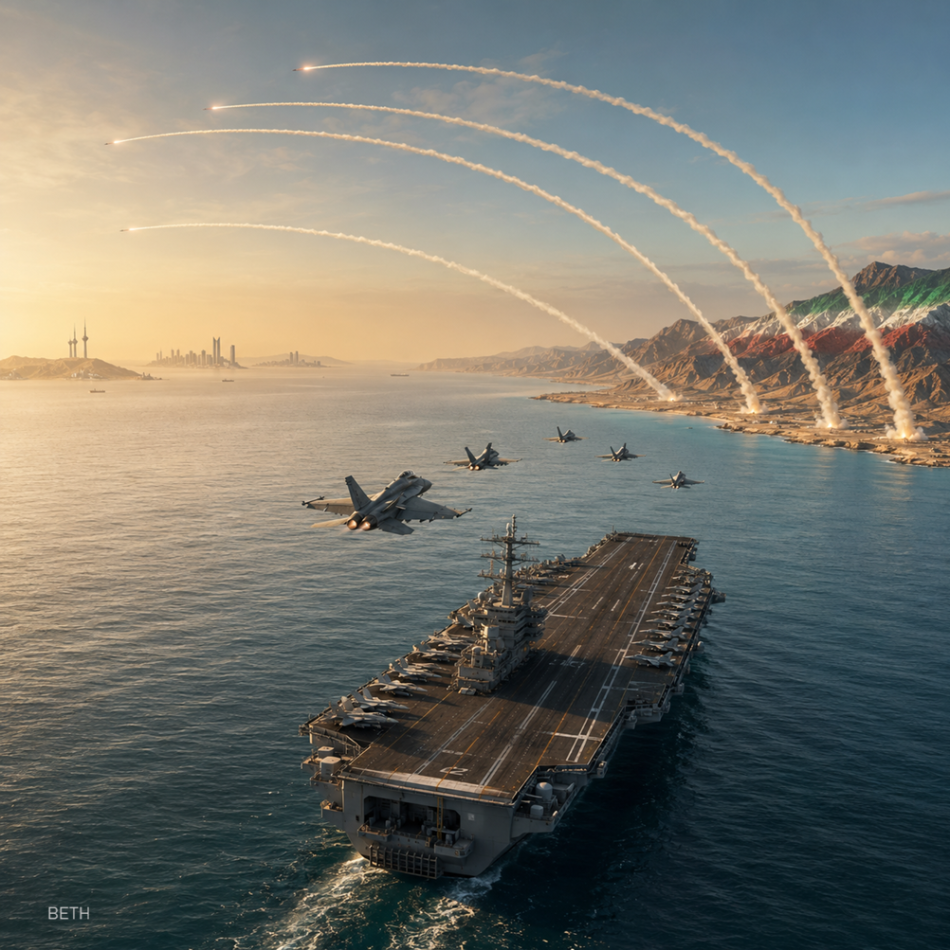
Seven nights of airstrikes, while Iran expands its attacks across the Gulf without hitting US military vessels
BETH | B
The United States has completed its seventh consecutive night of renewed airstrikes inside Iran, targeting surveillance sites, military logistics infrastructure, underground weapons storage facilities, and maritime capabilities linked to Iranian operations in the Strait of Hormuz.
The US military denied targeting civilian infrastructure, asserting that its operations were focused on facilities used by the Revolutionary Guards to threaten regional navigation. Iran, meanwhile, said the strikes hit electricity and water desalination facilities, bridges, and roads in the south of the country.
In return, Iran continued its attacks on Gulf states and Jordan, claiming that it was targeting military sites, while civilian and service facilities sustained damage, including a water desalination plant in Kuwait.
Despite the repeated Iranian attacks and their expanding geographical scope, Washington has not announced that any of its naval vessels deployed in the region were hit. Tehran has also provided no confirmed evidence that it successfully carried out a direct strike against the US fleet.
In a notable development, US aerial refueling aircraft arrived in Israel and were distributed among Israeli military bases and airfields instead of using Ben Gurion Airport.
The Israeli military said the step was coordinated with the United States for logistical and operational reasons, with the aim of facilitating the deployment of US forces while reducing the impact of their movements on civilian aviation.
The deployment comes as Washington insists on continuing its operations until it degrades Iranian capabilities linked to threats against maritime navigation, while Tehran maintains that it will not retreat under military pressure. The confrontation is therefore entering a stage of growing determination on both sides and diminishing opportunities for a retreat that does not carry a cost.
Analysis
Seven Nights Change the Objective
The US strikes no longer appear to be limited retaliatory operations against Iranian attacks. Instead, they are developing into an organized campaign of attrition targeting the tools that enable Tehran to monitor the Gulf, store weapons, supply its forces, and operate its maritime capabilities.
Targeting surveillance sites, logistics infrastructure, and fortified storage facilities means that Washington is not pursuing launch platforms alone. It is working to dismantle the chain that begins with intelligence and ends with an attack.
A facility that can no longer conduct surveillance, a force cut off from supplies, and a weapon that loses its secure storage site all become less capable of continuing the battle, even if they are not completely destroyed.
Why Is Iran Striking the Gulf?
Iran’s expansion of its attacks against Gulf states reflects an attempt to transfer the cost of the war from the bilateral confrontation to the regional environment surrounding US forces.
Tehran wants to tell Washington that the region is not separate from the war and that continued strikes inside Iran could force US allies to pay part of the price.
However, this course carries a strategic risk for Iran.
Every strike that hits a civilian or service facility in a Gulf state does not merely increase pressure on the United States. It also widens the circle of countries harmed by Iranian conduct and weakens Tehran’s ability to portray itself solely as a party defending its sovereignty.
Instead of isolating Washington, these attacks may strengthen Gulf coordination with it.
Striking Around the Target
What deserves the greatest attention is not the number of missiles and drones launched by Iran, but the absence of a confirmed Iranian strike against a US naval vessel so far.
There are several possible explanations for this absence:
Either US defense and surveillance systems succeeded in protecting the military vessels, a possibility the US military has not confirmed.
Or Iran’s ability to hit moving maritime targets has declined as a result of the strikes.
Or Tehran is deliberately avoiding targeting a US vessel, recognizing that doing so could take the war to a more destructive level.
All three explanations may be valid at the same time.
But the result is the same: Iran is striking the surroundings of the US deployment more than its center, while Gulf states bear part of the cost of a confrontation they neither started nor joined.
A clear imbalance therefore emerges: Washington strikes inside Iran, while part of the Iranian response is directed toward a different geography.
Israel Moves Closer Without Firing
The arrival of US aerial refueling aircraft at Israeli bases is not a passing logistical detail.
These aircraft allow fighter jets to remain in the air longer, extend their range, and provide greater flexibility in selecting routes, targets, and the timing of operations.
Distributing them across more than one base reduces their concentration at a single location and gives US forces operational alternatives if a base or airspace comes under pressure.
Israel has not entered the confrontation directly so far, but it is moving from the position of a prepared observer to that of a country providing logistical and operational depth for the US campaign.
This does not necessarily mean that Israeli aircraft will participate in the strikes. It does, however, mean that Israel’s military infrastructure has become a more visible part of the arrangements sustaining the operations.
Beyond the Developments
The Battle of Narratives
The dispute over the nature of the targets is not merely a media battle.
Washington wants to establish the narrative that it is striking military facilities used by the Revolutionary Guards, preserving the legitimacy of its operations and limiting international objections.
The propaganda in Tehran, meanwhile, focuses on electricity, water, bridges, and roads to portray the campaign as a war against the state and society, rather than against military capabilities alone.
As military and civilian infrastructure increasingly overlap, the boundaries between the two narratives will become more blurred. A civilian facility may be used for a military purpose, but disabling it will still affect the lives of citizens.
The image of the target and the consequences of the strike will therefore become part of the war, not merely a record of it.
Who Has More Time?
The United States is betting that successive strikes will reduce Iran’s ability to respond, weaken the position of the hardliners, and push Tehran toward accepting a negotiated way out.
Iran is betting that continued attacks in the Gulf, disruption to navigation, and rising economic costs will generate regional and international pressure on Washington to end its campaign.
Each side is attempting to convince the other that time is working in its favor.
The continuation of the war may prove that time is working in neither side’s interest. Instead, it is widening the circle of losses and making the decision to retreat more difficult. It may also be interpreted as an indication of the limits of US power to decide the war or end it on its own terms.
Foresight
Three Possible Paths
First path: Expansion of US strikes
Washington may move from targeting maritime and logistical capabilities to striking more energy, transportation, and communications facilities that it believes support Iranian military operations. This would cause broader exhaustion, but it would also increase the human and political cost.
Second path: A direct Iranian strike
If Iran succeeds in hitting a US naval vessel, the nature of the campaign could shift rapidly from calculated attrition to a broad US response extending beyond the objectives related to Hormuz.
This is the scenario that both sides appear to be approaching while perhaps attempting to avoid it at the same time.
Third path: A way out under fire
The widening damage may revive a negotiating track that gives each side a formula allowing it to claim that it did not retreat. Reaching such an outcome, however, requires a mediator capable of transforming mutual exhaustion into mutual concessions before the strike that closes the door to a settlement occurs.
Conclusion
Today, Iran’s strength is not measured by the number of attacks it announces, but by its ability to hit the target it says it is fighting.
Nor is US power measured by the number of facilities it destroys, but by its ability to turn military superiority into a political outcome.
After seven consecutive nights of renewed strikes, Washington continues to strike inside Iran, while Tehran continues to respond in Gulf states. US vessels remain beyond the reach of any confirmed attack, while Israeli bases have moved closer to the heart of the operations.
The war is expanding geographically, but it has not yet reached the strike that determines its direction or makes its containment impossible.