



The Final Game.. Who Outsmarted Whom?
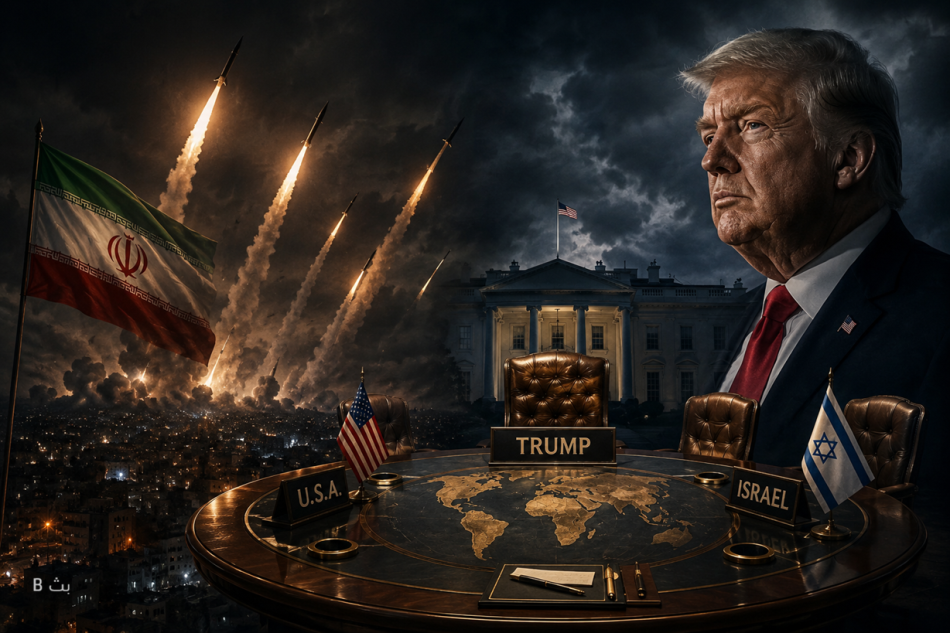
Tehran’s Missiles.. Trump’s Table
Prepared and Analyzed by
Strategic Media Department – BETH Agency
Supervision: Abdullah Al-Omairah
Within just a few hours, events moved at a remarkable pace:
Israel struck sites and headquarters linked to Hezbollah and Iran’s Islamic Revolutionary Guard Corps in Beirut’s southern suburbs.
Iran responded with successive waves of missiles toward Israel, in a move that appeared closer to a matter of restoring prestige than anything else.
Israel then announced that it was preparing a response.
Then came the American intervention.
U.S. President Donald Trump not only reaffirmed his support for Israel, but also called for no retaliation and delivered a direct message to Iran:
“The response has taken place. That is enough. Return to negotiations.”
At the same time, he emphasized the readiness of the U.S. military.
This leaves the key question open:
Were the missile launches the end of the round?
Or part of a deception?
An Unusual Scene
In traditional wars, missiles come after negotiations fail.
In the current scene, however, missiles appear to be part of the negotiations themselves.
Israel strikes.
Iran responds.
Washington immediately steps in to place a ceiling on the escalation.
As if the message were:
Allow a calculated round of confrontation... then return to the table.
This is what makes the latest developments look more like “negotiation by fire” than an open war.
Did Iran Exploit Trump’s Statement?
Hours before the Iranian response, Trump stated that Lebanon was not part of the confrontation.
The statement came at the same time Israel was striking targets in Beirut’s southern suburbs.
Then came the Iranian response.
This sequence opens the door to two interpretations:
The first is that Tehran interpreted the American message as a green light for a limited response that would not expand the conflict.
The second is that Washington had already drawn the boundaries of the next round, allowing a degree of escalation while preventing events from spinning out of control.
In both cases, the United States appears to be deeply present inside the unfolding scene rather than standing outside it.
Trump and Netanyahu
What stands out is that recent events reinforce the impression of a high level of coordination between Washington and Tel Aviv.
Israel strikes.
Iran responds.
Then Trump emerges, calling for de-escalation and a return to negotiations.
This sequence does not necessarily imply complete agreement on every detail, but it does suggest that both sides are managing events within carefully calculated limits while attempting to prevent a broader regional war at this stage.
Where Did Tehran Miscalculate?
If Iran’s leadership believed that the missile response would fundamentally alter the course of negotiations, current developments do not appear to support that assumption.
Instead of stepping back, Washington delivered an even clearer message:
Negotiations remain the preferred option.
At the same time:
The U.S. military is ready if negotiations fail.
This leaves Tehran facing a difficult equation:
A military response alone is not enough.
And walking away from negotiations carries even greater risks.
The Implications
The current situation suggests that the center of gravity is no longer the missiles themselves.
It lies in the political decisions that will follow.
Military strikes have become instruments of pressure.
The real decision, however, is still being shaped at the negotiating table.
For that reason, despite their military and media significance, the missiles appear to be part of a broader contest of wills aimed at improving positions ahead of what may be the final phase of negotiations.
Possible Outcomes
Current indicators point toward two main scenarios:
First:
A negotiated formula could emerge within a short period, allowing each side to claim a degree of political success and save face.
Second:
Negotiations could fail, opening the door to a larger military round that may include more direct American and Israeli strikes against targets inside Iran.
Yet when examining the behavior of all parties over the past several hours, the probability of an agreement still appears higher than that of a full-scale war.
Recent American messages do not resemble those of a country preparing for war tomorrow.
Rather, they resemble those of a country applying pressure in order to reach an agreement from a position of strength.
Reflection
Perhaps the real question is not:
Who launched the missile?
But:
Who wrote the script?
In the Middle East, missiles are often the visible part of the story.
The real battle is frequently fought around the table that convenes after the missiles stop flying.
Day 97 Developments
BETH | B
BETH (بث B) – All rights reserved