



Day 97: Between Tehran’s Narrative and Trump’s Information Flood
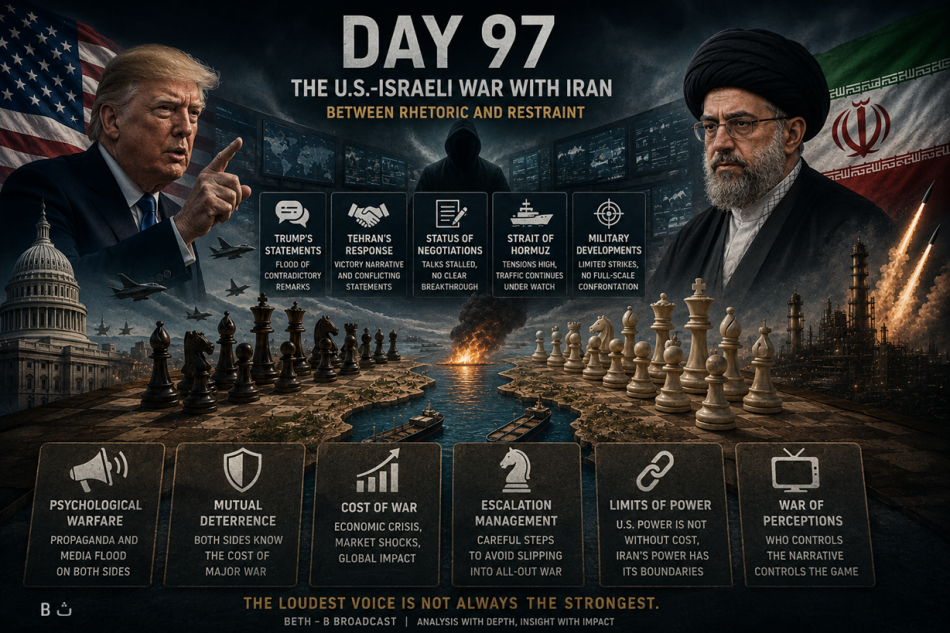
Monitoring & Analysis | Strategic Media Department – BETH Agency
06 June 2026
After 97 days of the U.S.-Israeli war with Iran, the political and media fronts remain hotter than the military ones.
Today’s landscape is no longer shaped by missiles alone.
It is shaped by competing narratives.
Conflicting statements.
Indirect messages.
And each side’s attempt to reshape the image of the war in the minds of its audience before settling it on the ground.
Khamenei Between Two Narratives
One of the most striking contradictions today emerged from within Iran itself.
While official sources had previously denied that Mojtaba Khamenei was injured during the Israeli strikes, Ahmad Khatami, a member of the Assembly of Experts, stated that Khamenei suffered a leg injury on the first day of the war and that amputation had at one point been considered before medical intervention succeeded.
The contradiction is not merely about a medical condition.
It highlights the continuing information confusion within Iranian state institutions regarding what can be disclosed and what should remain hidden.
Iran After the War
Beyond military statements, signs of a new phase are beginning to emerge inside Iran.
The internal debate is no longer focused solely on the war itself.
But increasingly on what comes after it.
An economy struggling with inflation and contraction.
Electricity shortages.
Military losses that are becoming increasingly difficult to conceal.
And growing questions about the future shape of the state once the wartime atmosphere of national mobilization fades.
Meanwhile, the Revolutionary Guard continues to promote a narrative of “victory,” viewing it as a domestic political necessity, even as battlefield realities remain more complex than official slogans.
A Mysterious Pakistani Message
In a notable development, Pakistan’s Interior Minister arrived in Tehran carrying a special message from Pakistan’s Army Chief to Mojtaba Khamenei.
Although details remain undisclosed, the timing of the message has attracted considerable attention.
Regional diplomacy often becomes more active when parties approach a significant political or negotiating crossroads.
Where Do the Negotiations Stand?
Despite the ongoing exchange of statements, there are still no clear signs of a decisive breakthrough in the negotiations.
The situation resembles a carefully managed stalemate.
No announced agreement.
No complete collapse of diplomacy.
As if both sides are continuing to buy time, each for its own reasons.
Trump: The School of Information Saturation
On the other side, U.S. President Donald Trump continues to employ a familiar crisis-management style.
Multiple statements.
Messages that appear contradictory.
Positions oscillating between escalation and openness.
Yet the apparent objective remains the same:
Increasing pressure on the opponent while improving negotiating leverage.
Trump does not always speak to explain his position.
More often, he speaks to force the other side to recalculate its own.
Why Has the Major Confrontation Not Erupted?
After months of mutual threats, the central question remains:
Why has a full-scale war not occurred?
The most plausible answer still rests on four main factors:
First: Mutual Deterrence
Both sides understand that a major war would come at a tremendous cost.
Second: Economic Consequences
Closing the Strait of Hormuz or expanding the conflict could disrupt the global economy on a massive scale.
Third: Escalation Management
Both parties appear more interested in managing tensions than in sliding into open warfare.
Fourth: The Limits of Power
American power is immense.
But it is not cost-free.
Iranian capabilities remain significant.
But they are not sufficient to impose a decisive strategic outcome.
BETH Analysis
If Trump is using an information flood of statements to gain negotiating advantages, Tehran appears to be using a flood of narratives to soften the impact of its domestic losses.
In both cases, information noise has become part of the battlefield itself.
The most important reality on Day 97 is that the conflict is no longer centered solely on missiles or negotiations.
It increasingly revolves around a larger question:
Who can shape perception before shaping the battlefield?
Perhaps the most dangerous aspect of modern wars is not what is being said.
But what people are being encouraged to believe.
This Evening
Iranian Missiles Toward the North
The Israeli military announced that it detected the launch of four missiles from Iran toward northern Israel, confirming that air defense systems are working to intercept them, while warning sirens sounded in several northern areas.
Are we witnessing a new round of retaliation within the existing rules of engagement?
Iran Raises the Stakes.. Israel Confirms a Response
The Israeli military announced this evening that it had detected 10 consecutive waves — as of the time of this report — of Iranian missiles launched toward Israel, coming just hours after Israel struck sites and headquarters belonging to Hezbollah and the Islamic Revolutionary Guard Corps (IRGC) in Beirut’s southern suburbs.
The repeated launches suggest that what is unfolding goes beyond a symbolic or limited tactical response.
Is Military Conflict Returning?
What stands out is that the region has spent recent months in what could be described as a “negotiation war,” where military pressure, diplomatic efforts, mediation, and exchanged messages have overlapped.
What Comes Next?
Israel is likely to respond.
Especially after Israeli officials confirmed that a response will come even if the Iranian strikes remain limited in scale or impact.
Information also indicates that Trump has been kept informed of the developments, and that Israel is awaiting a green light from Washington.
Some observers believe that Trump may approve limited Israeli strikes, as he is still seeking an agreement with Iran before making a major decision.
BETH Analysis
The most important indicator in tonight’s developments is not the number of missiles itself, but the possibility that the confrontation is moving from a phase of exchanged messages to a phase of redrawing the rules of engagement.
Iran appears to be attempting to establish a new equation: that attacks on its regional centers of influence will be met with a direct response.
At the same time, it is difficult for Israel to ignore such a message without attempting to break it.
For this reason, the coming hours appear highly sensitive.
The open question remains:
Are we witnessing a new round of escalation?
Or are we seeing the beginning of a return to direct military confrontation between Iran and Israel after months of political and negotiating confrontation?
IRGC: Missile Waves Could Continue for a Week
The Islamic Revolutionary Guard Corps’ announcement that missile waves against Israel could continue for a week does not appear to be directed at Israel alone, but also at Washington.
The implicit message suggests that Tehran does not view what has happened as a completed response, but rather as part of an ongoing phase whose limits are still taking shape.
At the same time, this position places Israel before the question of retaliation, particularly amid growing indications of coordination and consultations with Washington regarding the nature, scale, and objectives of any response.
The question is therefore no longer:
Will Israel respond?
But rather:
What level of response will Washington approve, and will it remain within the bounds of containment, or open the door to a new phase of escalation?
BETH Analysis
The convergence of three developments is drawing particular attention:
- Israel’s strike on Hezbollah and Islamic Revolutionary Guard Corps positions in Beirut’s southern suburbs.
- Trump’s statement hours earlier that Lebanon was not part of the confrontation.
- The subsequent Iranian response through successive waves of missiles.
These developments raise an important question:
Did Tehran seize the American signal to deliver a calibrated response without expanding the confrontation into Lebanon?
Or was Washington already setting the boundaries for the next round of escalation?
Even more intriguing is that Trump returned after the missile launches to call for a return to negotiations, as if the American message was:
“The response has taken place. Now it is time to return to the table.”
For this reason, tonight’s missile launches may not be merely a military event, but part of a broader struggle in which force is being used to improve negotiating positions.
The key question remains:
Does Israel view the missile launches as the end of this round, as Washington appears to prefer?
Or as the beginning of a new phase requiring a response that redraws the rules of engagement?
BETH (B Broadcast) – All rights reserved