



Day 131 🇺🇸⚔️🇮🇷: The United States Expands Its Strikes
BETH | B
The U.S. Central Command (CENTCOM) announced on Monday the completion of a new wave of strikes targeting dozens of military sites inside Iran, stating that the operations were conducted to ensure the continued freedom of navigation through the Strait of Hormuz.
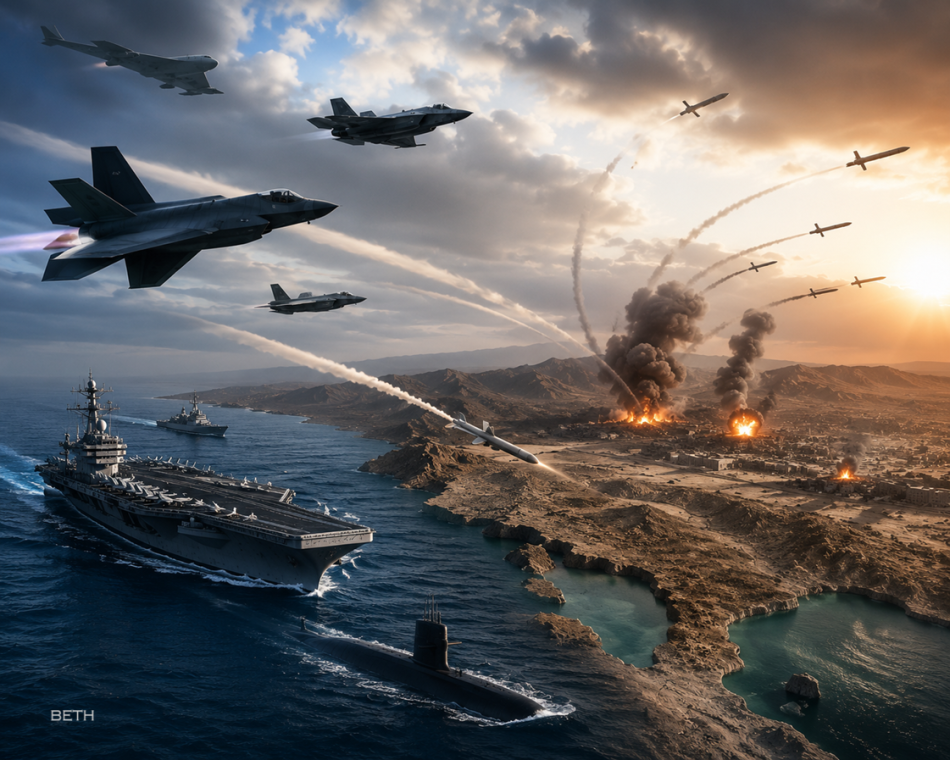
CENTCOM said the strikes targeted Iranian air defense systems, coastal radar installations, missile capabilities, drones, and fast attack boats, using B-2 Spirit strategic bombers, F-22 and F-35 fighter aircraft, Tomahawk cruise missiles launched from U.S. submarines, as well as offensive unmanned surface vessels.
Meanwhile, Iran's Islamic Revolutionary Guard Corps (IRGC) announced new attacks, claiming they targeted U.S. positions in Bahrain, Kuwait, and Jordan. Washington, however, rejected the Iranian reports alleging American casualties, confirming that no U.S. personnel had been killed or injured.
At the same time, new explosions were reported in the Iranian provinces of Hormozgan and Khuzestan, including Bandar Abbas, Qeshm, Jask, and Sirik, in addition to airstrikes near Ahvaz and Andimeshk, according to Iranian media outlets.
BETH Analysis
Today's developments indicate that the United States has moved beyond a policy of military retaliation toward a strategy aimed at degrading Iran's military capabilities.
The strikes were no longer limited to missile launch sites, but expanded to include air defense systems, radar installations, drones, and fast attack boats—the operational infrastructure on which Iran relies to manage the confrontation.
Meanwhile, the IRGC continues launching missiles and drones toward countries across the region, reflecting Tehran's commitment to maintaining regional pressure.
However, the more important question remains: Why has Iran not moved to confront directly the U.S. military assets conducting the strikes, including aircraft carriers, submarines, and the American airpower dominating Iranian airspace?
This pattern raises the possibility that Tehran is choosing battlefields that are easier to reach while avoiding a direct confrontation that could expose the limits of its military capabilities and trigger a far stronger U.S. response—or that its remaining capabilities no longer allow it to impose a balanced engagement against America's naval and air superiority.
Outlook
If operations continue at this level, the conflict may enter a phase in which the United States systematically degrades Iran's military capabilities while maintaining freedom of navigation in the Strait of Hormuz as a strategic priority.
At the same time, Iran may continue relying on missiles and drones to sustain regional tensions without engaging in direct confrontation.
The Horizon
Wars do not test weapons alone.
They test nations.
One side may possess greater military power.
The other may rely on time, attrition, and changing strategic calculations.
The question is no longer:
Who possesses the more powerful weapons?
It is:
Who can remain in the field until the end?
Military power may decide a battle.
The ability to bear the cost of war may decide history.
Yet the question that imposes itself today goes beyond the balance of military power.
American military superiority at sea, in the air, and in long-range strike capabilities is evident.
But wars are not measured solely by what armies possess.
They are measured by what states seek to achieve through the use of force.
If the United States is capable of conducting large-scale strikes, what ultimate objective has yet to be achieved?
Why does attrition continue instead of decisive resolution?
Is Washington seeking to end the war, or to impose a new security framework in the Gulf that guarantees freedom of navigation and reshapes the rules of deterrence?
Conversely, why does Iran continue launching missiles and drones toward countries across the region, while avoiding direct confrontation with the U.S. platforms from which these strikes originate at sea and in the air?
The answers may differ.
But these very questions reveal that the conflict is no longer centered on who wins the military battle, but rather on who succeeds in shaping the post-war order.