


Saudi Arabia .. When Vision Becomes Civilization
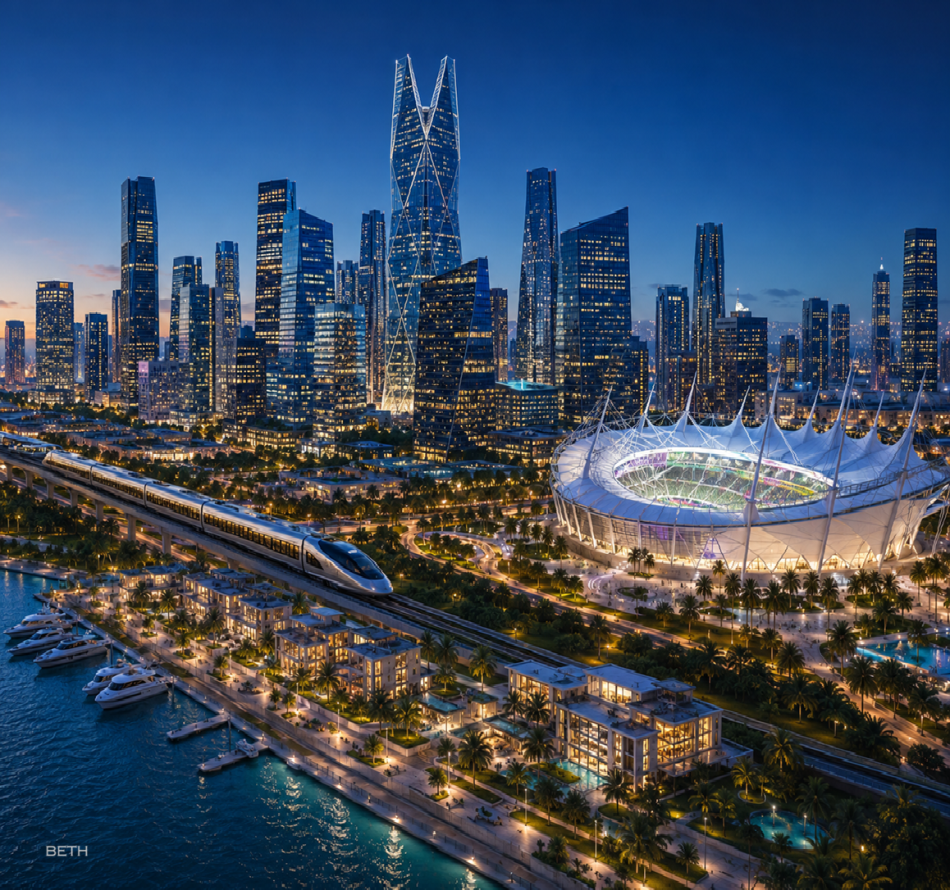
Not a Boom .. but a Civilizational Project
From Building Projects to Building the Future
Prepared and Analyzed by | Strategic Media Department – BETH
Supervised by: Abdullah Al-Omairah
On April 25, 2016, the Kingdom of Saudi Arabia launched Saudi Vision 2030, a comprehensive national blueprint to redefine the country's development path. The vision was developed by His Royal Highness Prince Mohammed bin Salman bin Abdulaziz, Crown Prince and Prime Minister, with the support of The Custodian of the Two Holy Mosques King Salman bin Abdulaziz. Its objectives included diversifying the economy, reducing dependence on oil, advancing healthcare, education, infrastructure, tourism, and entertainment, and building a more sustainable and competitive economy.
Nearly a decade later, the Vision is no longer merely a planning document.
It has become a reality taking shape on the ground.
When visitors look at Saudi Arabia today, they see cities transforming, roads being built, and major projects rising in every direction.
But what is happening is far deeper than that.
Saudi Arabia is not constructing isolated projects.
It is redefining its relationship with the future.
The real question, therefore, is not:
How many projects are under construction?
But rather:
How does a national vision evolve into a civilizational project?
The timing of this report is no coincidence.
With the beginning of the new Hijri year 1448 AH, a series of indicators has highlighted the accelerating pace of transformation across the Kingdom.
The unemployment rate among Saudi citizens has fallen to 7.2%, women's participation in the labor market has exceeded 35%, Saudi Arabia has ranked first globally in the growth of international tourism revenues, and Riyadh has attracted hundreds of multinational companies to establish their regional headquarters.
At the same time, mega-transformation projects continue to advance, digital government services are expanding rapidly, environmental sustainability initiatives are progressing, and strategic projects are moving forward across every region of the Kingdom.
While each achievement is significant on its own, their true value lies elsewhere.
Together, they demonstrate that what is taking place is no longer a collection of separate successes, but interconnected components of a single national project moving in one direction.
From Projects to Civilization
Many countries can build projects.
Civilizations, however, are not built through projects alone.
They are built through the vision that turns every project into part of a much larger system.
That is why Saudi Arabia's projects do not appear disconnected.
Energy is linked to industry.
Industry is linked to mining.
Mining is linked to transportation.
Transportation is linked to cities.
Cities are linked to quality of life.
Quality of life is linked to the economy.
And the economy is ultimately linked to people.
It is one integrated system, where no single element can be fully understood in isolation from the broader framework of Saudi Vision 2030.
A Nation Under Construction
What immediately captures the attention of visitors today is that Saudi Arabia appears to be one vast construction site.
Yet it is not the transformation of one city.
Nor the development of one sector.
Riyadh is reshaping its urban landscape.
Jeddah is redeveloping its waterfront and infrastructure.
Diriyah is restoring its historical significance.
NEOM is presenting an entirely new model for future cities.
The Red Sea Project is redefining sustainable tourism.
Qiddiya is building a global destination for entertainment and sports.
Meanwhile, transportation networks, airports, ports, railways, logistics hubs, industrial cities, mining projects, and quality-of-life initiatives continue to expand simultaneously.
Saudi Arabia therefore appears not to be constructing separate projects.
It is rebuilding its civilizational foundation as one integrated whole.
A Race Against Time
Many nations required decades to reach their current level of development.
Saudi Arabia seeks to compress time.
Not merely through speed.
But through unity of vision.
Rapid decision-making.
Cross-sector integration.
Technology-driven execution.
And continuous performance review.
As a result, the achievements of the past few years resemble developmental phases that took much longer elsewhere.
Impact, Not Spectacle
In many parts of the world, projects attract attention on inauguration day.
Then gradually lose their significance.
The philosophy guiding many Saudi projects appears fundamentally different.
The question is not:
How impressive will this project look on opening day?
But rather:
Will it still matter decades from now?
This explains the emphasis on infrastructure quality.
Sustainability.
Economic value.
Architectural excellence.
And the project's impact on everyday life.
The objective is not to create a beautiful image.
It is to create lasting value.
Oversight as Part of Construction
Mega-projects depend not only on planning.
They depend on continuous oversight.
Performance evaluation, redistribution of responsibilities, and leadership renewal have therefore become natural components of managing a national transformation of this scale.
The higher the ambition.
The higher the standards of evaluation.
Leadership changes should not be viewed simply as administrative reshuffling.
They are instruments for improving execution, maintaining momentum, and ensuring that results match national aspirations.
Success is measured not by announcements.
But by what is delivered on the ground.
People Before Concrete
Despite the scale of physical development, Saudi Arabia's transformation extends far beyond buildings and infrastructure.
Investment in people represents the other face of the Vision.
This is reflected in education, innovation, artificial intelligence, entrepreneurship, culture, quality of life, and the empowerment of national talent.
Civilizations are not built with stone first.
They are built through people capable of creating, preserving, and continuously improving them.
Beyond 2030
Many regard 2030 as the destination.
Yet official indicators suggest it is merely one milestone within a much longer national journey.
What is being built today is not designed for a few years.
It is designed for generations.
Saudi Arabia's transformation therefore resembles a long-term civilizational project rather than a government program with a fixed deadline.
Landmarks of Transformation
This philosophy is reflected in a series of landmark national projects, including NEOM, Diriyah, the Red Sea Project, Qiddiya, King Salman Park, the Sports Boulevard, Riyadh Metro, King Salman International Airport, expanding railway networks, airport expansions, ports, mining projects, industrial cities, Expo 2030, and the 2034 FIFA World Cup, alongside the growing role of the Public Investment Fund in driving economic transformation and financing strategic projects.
Official indicators also demonstrate the continued expansion of the private sector, the growth of Saudi enterprises, and the steady implementation of economic diversification programs under Vision 2030.
The Horizon
Civilizations are not built with stone alone.
Nor are they measured by the number of skyscrapers, highways, or cities.
They are measured by their ability to make every project a building block within a greater vision.
What Saudi Arabia is witnessing today may therefore not simply be the largest development program in its history.
It may represent the transition from building projects to building a civilization capable of continuously generating new projects.
This transformation is also reflected in growing international confidence in the Saudi economy.
More than 700 global companies have chosen to establish regional headquarters in the Kingdom, particularly in Riyadh, signaling a shift that goes far beyond relocating offices.
It reflects direct participation in growth, investment, and the construction of Saudi Arabia's new economy.
Civilization is not merely what we build today.
It is what we inspire the world to build with us tomorrow.