



Day 127 🇺🇸⚔️🇮🇷: Dialogue Amid the Fire
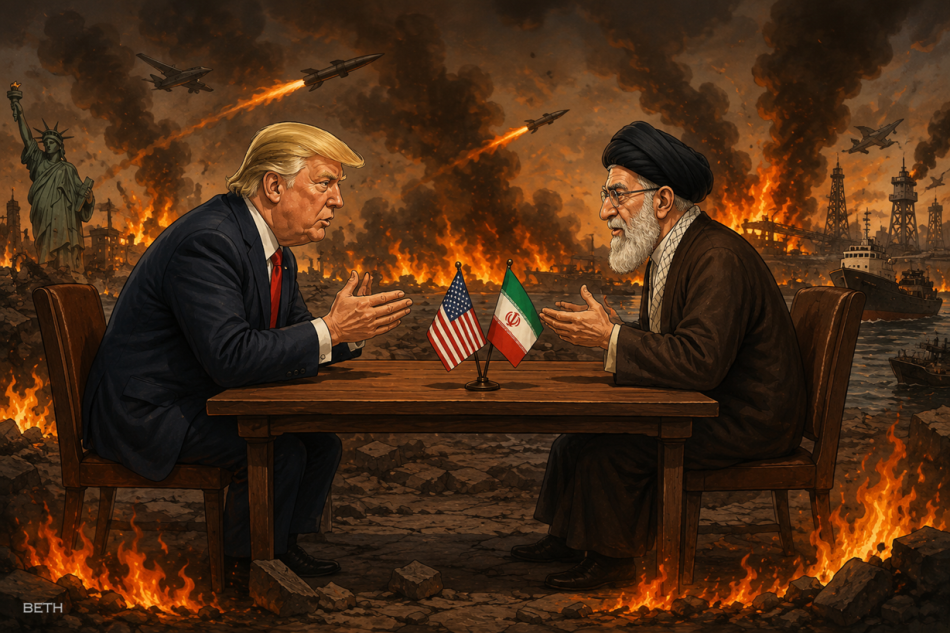
BETH B
The United States and Iran continued exchanging military and political messages as U.S. forces carried out a second consecutive night of strikes against military targets and facilities linked to threats against maritime navigation inside Iran.
U.S. President Donald Trump announced that Tehran had reached out to Washington seeking an agreement, emphasizing that the latest U.S. strikes were carried out in response to attacks on commercial vessels and that the American response was "twenty times greater."
Meanwhile, Iran confirmed casualties resulting from the U.S. strikes, while Speaker of Parliament Mohammad Bagher Ghalibaf stated that the Strait of Hormuz would not be reopened except under "Iranian arrangements," as Tehran continued issuing statements rejecting U.S. pressure.
BETH Analysis
Today's developments reveal a clear contrast in how the two sides are managing the crisis.
The United States is speaking in direct and unequivocal terms.
We struck.
We responded.
They want a deal.
Iran, meanwhile, continues to adopt a more ambiguous narrative, combining threats with repeated assertions of sovereignty while avoiding any public acknowledgment of direct contacts with Washington, despite Trump's statement that communications are continuing.
This contrast does not appear to be accidental.
Washington wants to demonstrate that military pressure is producing political results, and that Iran is moving toward negotiations under the weight of force.
Tehran, on the other hand, seeks to avoid creating any domestic or regional perception that it is negotiating under pressure, since such an impression could be interpreted as a retreat before its adversary.
For that reason, Iran continues to raise the tone of its public statements, insists on its authority over the Strait of Hormuz, and projects an image of strength, while quietly leaving the door to negotiations open away from the public spotlight.
This helps explain what may appear to be a contradiction.
Military escalation does not eliminate negotiations.
It has become part of the negotiating process itself.
Fiery rhetoric no longer necessarily signals the rejection of an agreement.
Instead, it has become a means of improving negotiating leverage while preserving an image of strength before domestic and international audiences.
Possible Outcomes
If this dynamic continues, the coming period may witness additional limited military strikes accompanied by ongoing, largely undisclosed political contacts.
The real turning point, however, will not be determined by the scale of the strikes.
It will come when either side concludes that continuing the escalation has become more costly than making concessions.
At that point, negotiations may move from managing the crisis...
To shaping a new agreement.
Another Perspective
In traditional wars...
Weapons would fall silent before negotiations began.
Today...
Negotiations continue while the weapons are still firing.
The question is:
Are the two sides negotiating for stability... or for setting the region ablaze?
Strikes Expand ..So Does the Battlefield
Military exchanges between the United States and Iran continued on Thursday, as explosions were reported in the southern Iranian city of Bushehr, while Iranian media said a U.S. projectile landed near the Bushehr Nuclear Power Plant.
Meanwhile, the confrontation widened across the region. Bahrain and Kuwait came under Iranian attack, while Jordan announced that it had intercepted Iranian missiles that entered its airspace, underscoring the growing regional impact of the escalation.
The latest developments follow another night of U.S. strikes targeting military sites inside Iran as the confrontation between the two countries continues.
BETH Analysis
The confrontation is no longer confined to a direct exchange of strikes between Washington and Tehran.
As military operations move closer to sensitive strategic facilities and attacks increasingly affect neighboring countries, the risk of the crisis evolving from a bilateral conflict into a multi-front regional confrontation continues to grow.
At the same time, Washington continues to speak of the possibility of reaching an agreement, while Iran maintains its rhetoric of resistance and sovereignty.
This suggests that the crisis is now unfolding along two parallel tracks:
A military escalation that is expanding on the ground... and political efforts aimed at preventing the complete collapse of communication channels.
The key question now is:
How long can the region contain this widening confrontation before it grows beyond a U.S.-Iran conflict into a broader regional crisis?