



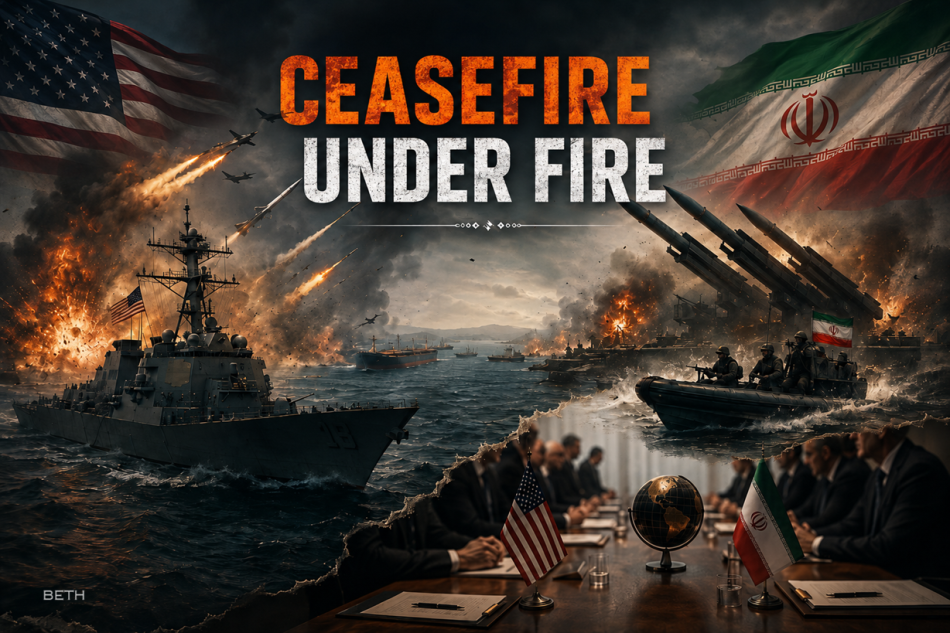
Day 126 🇺🇸⚔️🇮🇷: Ceasefire Under Fire
BETH B
News Brief
The U.S.-Iran confrontation entered a more complex phase after U.S. Central Command announced a new wave of strikes targeting more than 80 sites inside Iran, including air defense systems, command-and-control networks, coastal radar installations, anti-ship missile platforms, and dozens of Islamic Revolutionary Guard Corps fast boats. The strikes came in response to recent attacks on commercial vessels transiting the Strait of Hormuz.
In response, Iran's Islamic Revolutionary Guard Corps announced strikes against 85 U.S. military sites in Bahrain and Kuwait, describing the attacks as retaliation for what it called Washington's violation of the ceasefire agreement, further expanding the confrontation across the Gulf.
The escalation coincided with U.S. Defense Secretary Pete Hegseth's first official visit to Israel, where he is holding talks on the evolving military situation and broader regional security issues.
On the economic front, the U.S. Treasury revoked the temporary license that had allowed Iranian oil exports, describing Iran's actions in the Strait of Hormuz as "completely unacceptable," effectively restoring full economic pressure on Tehran.
Meanwhile, Iran's Foreign Ministry accused the United States of violating the Memorandum of Understanding that ended the war, arguing that the latest U.S. strikes, the cancellation of the oil-export license, and what it described as Washington's violation of the agreed arrangements in the Strait of Hormuz have significantly undermined the effectiveness of the temporary agreement.
Despite the escalating confrontation, Washington reaffirmed its commitment to continuing negotiations with Tehran, emphasizing that military operations are intended to strengthen diplomatic leverage rather than replace the political process.
BETH Analysis
War and diplomacy are no longer moving in opposite directions.
They are advancing together.
The latest developments reveal that the conflict has expanded beyond the battlefield.
Economic pressure has now become an integral part of the military campaign.
By revoking Iran's temporary oil-export license, Washington has demonstrated that its strategy extends beyond military operations to include coordinated economic and political pressure.
At the same time, Tehran has responded with more than military retaliation.
It has begun reframing the confrontation in legal and diplomatic terms.
Rather than limiting its accusations to military aggression, Iran now argues that Washington itself has violated the Memorandum of Understanding, seeking to shift the dispute from the battlefield to the arena of international legitimacy.
This marks an important shift.
The dispute is no longer confined to Iran's nuclear program, nor solely to the future of the Strait of Hormuz.
It has evolved into a broader question:
Who will ultimately be held responsible for the collapse of the agreement?
That question may prove more consequential than the outcome of the latest military exchanges.
The United States continues to project a clear message:
Freedom of navigation is non-negotiable, and economic pressure will intensify whenever international shipping is threatened.
Iran presents an equally clear counterargument:
No agreement can remain credible while military strikes continue, economic sanctions are tightened, and previously agreed arrangements are disregarded.
The confrontation has therefore moved beyond the traditional choice between war and peace.
It is now a contest between two competing interpretations of the ceasefire itself.
Both governments insist they remain committed to negotiations.
Yet each accuses the other of being the first to violate the very framework that keeps those negotiations alive.
This makes the next phase particularly delicate.
If military operations are now being used to strengthen negotiating positions, then economic sanctions, legal legitimacy, and control of the political narrative may ultimately become more decisive than missiles in shaping any final agreement.
Another Perspective
Agreements do not always collapse when missiles are launched.
Sometimes they collapse when each side begins writing its own version of the agreement.
The moment both parties disagree on what the ceasefire actually means, every military strike, every economic sanction, and every political statement becomes an attempt to redefine reality before rewriting the agreement itself.
That is when conflicts enter their most dangerous phase:
When war becomes a negotiator... and negotiations become an extension of war.
Trump from Ankara: Memorandum of Understanding Is Over .. We May Strike Iran Tonight
U.S. President Donald Trump, speaking from the Turkish capital, Ankara, declared that the Memorandum of Understanding with Iran is "over," adding that he no longer wishes to engage with Tehran and describing its leaders as "sick" and "a waste of time."
Trump also said that the United States could launch new strikes against Iran "tonight," signaling the possibility of further military escalation following renewed U.S. operations against Iranian targets after attacks on commercial vessels in the Strait of Hormuz.
BETH Analysis
President Donald Trump's remarks in Ankara mark a clear shift in Washington's political rhetoric toward Iran.
By declaring the Memorandum of Understanding effectively over, while simultaneously raising the possibility of military action within hours, Trump is sending a direct message that the previous framework governing U.S.-Iran relations no longer applies, and that Washington is prepared to enter a new phase should it determine that its interests or the security of international shipping are under threat.
The statement also reflects an effort to redefine the rules of deterrence.
Trump did not simply announce the end of the agreement. He coupled it with unusually sharp language toward the Iranian leadership, signaling an intention to maximize political and psychological pressure alongside ongoing military and economic measures.
The fact that these remarks were delivered from Ankara also carries political significance.
They come at a time of intensified regional diplomacy and military activity, underscoring that the Iranian file is no longer being managed solely as a bilateral dispute between Washington and Tehran, but as part of a broader regional security architecture.
The key question now is:
Does this statement pave the way for a limited military operation designed to reinforce deterrence and strengthen Washington's negotiating position?
Or does it mark the end of the temporary understanding and the beginning of a new phase in which pressure through force becomes the primary driver of future negotiations?
Another Perspective
In politics...
Words can sometimes have a greater impact than missiles.
Presidential statements are not issued merely to describe reality.
They are intended to shape a new one, sending carefully calculated messages to both allies and adversaries.
Perhaps the most significant part of Trump's statement was not his declaration that the Memorandum of Understanding had ended.
It was his determination to make clear that the political phase it represented has also come to an end.
When Trump Says “War”,, Does He Really Mean War?
Later the same day, U.S. President Donald Trump stated that the United States would not return to war, only hours after declaring the Memorandum of Understanding with Iran effectively over and warning that Washington could launch military strikes against Tehran.
The apparent contrast between the two statements has raised questions over whether the U.S. administration is redefining what it means by "war," or whether it is employing a familiar strategy of political and negotiating pressure.
BETH Analysis
Did Trump contradict himself?
Perhaps the more important question is:
Does Trump mean something different by "war" than by a military strike?
At first glance, his remarks may appear contradictory.
Yet they may instead reflect a clear distinction between full-scale war and the limited use of military force.
When Trump declared the Memorandum of Understanding over, expressed his distrust of Iran, and warned of possible military action, he was raising the level of pressure to its highest point.
When he later said that the United States would not return to war, he may have been signaling that Washington has no intention of entering a prolonged conflict or a war of attrition, even if it chooses to use force to achieve specific objectives.
From this perspective, the U.S. administration may not view limited military strikes as "war" in the traditional sense.
Rather, they may be seen as instruments to reshape deterrence, alter the balance of negotiations, or prevent a broader regional conflict.
This is where Trump's intended message becomes clearer.
Force is not the objective... it is the instrument.
War is not the preferred option.
Yet, in his view, the limited use of force may be the means to prevent a larger war—or to establish stronger leverage for the next round of negotiations.
Seen in this light, the two statements may not be contradictory at all.
Instead, they may represent two phases of a single strategy:
Maximum pressure... while keeping the door to a political settlement open.
Another Perspective
In politics, words are not always used in the way the public understands them.
For a political leader, "war" may mean a prolonged, large-scale military conflict.
A military strike, on the other hand, may simply be regarded as a limited instrument for achieving a political objective.
The real question, therefore, is not:
Did Trump change his position?
But rather:
How does Trump define war... and how does he want others to interpret his use of force?
Is the Memorandum of Understanding Being Tested .. or Beginning to Collapse?
The U.S.-Iran Memorandum of Understanding is now facing its most serious test since it was signed.
Military strikes have resumed.
Sanctions have intensified.
Political rhetoric has reached new highs after President Trump declared the Memorandum of Understanding over, only to later state that the United States does not want to return to war.
The central issue is therefore no longer whether the memorandum still exists.
It is whether it can contain the current escalation and prevent military strikes from evolving into a broader confrontation.
If it withstands this phase, it may prove that it was designed to endure periods of crisis.
If it fails...
What is unfolding today may well mark the beginning of its end.