


Real Estate Builds Economies .. When Vision Becomes Bigger Than a Ministry
Monitoring & Analysis
Strategic Media Department – BETH News Agency
Supervised by: Abdullah Al-Omairah
Saudi Vision 2030 has never viewed real estate merely as a housing sector. Instead, it has treated it as one of the key drivers of the national economy, a tool for reshaping cities, diversifying sources of income, enhancing tourism, improving quality of life, and attracting investment.
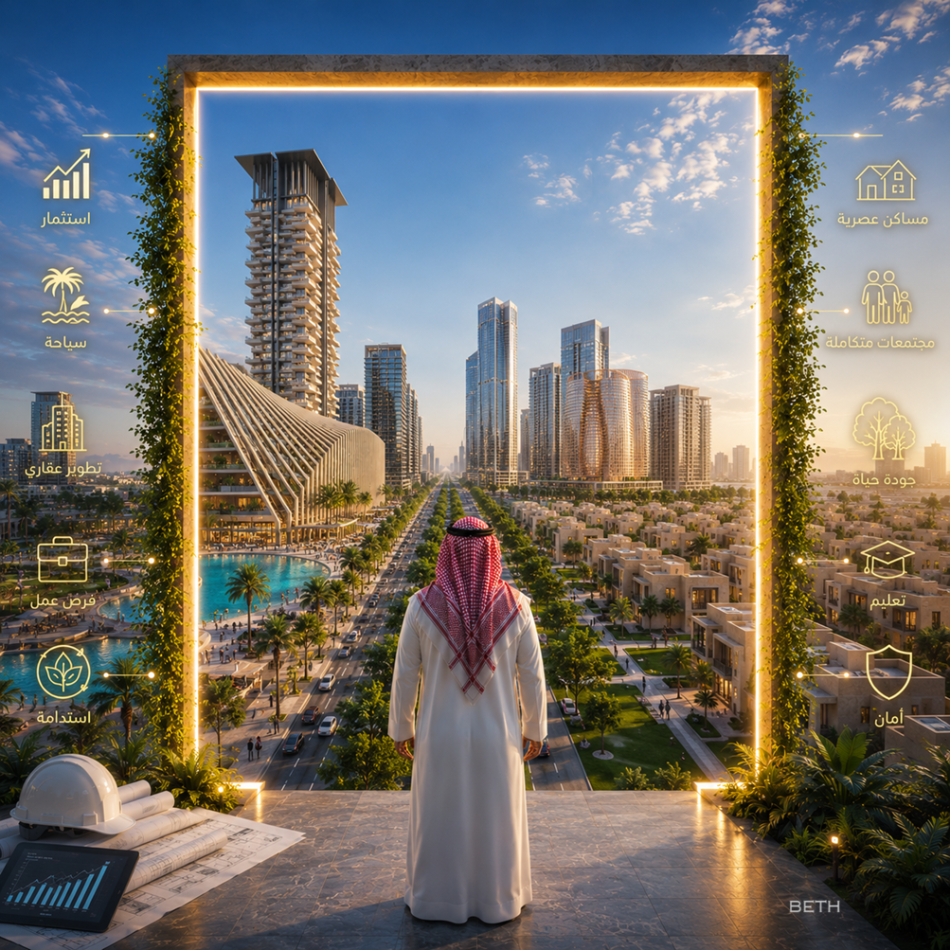
From the very beginning of the Vision, the objective was never simply to build houses. It was to create integrated economic environments in which real estate serves as the starting point for systems of production, investment, tourism, services, employment, and sustainable development.
Within this context, the Public Investment Fund (PIF) announced that its Local Real Estate Investment Division is developing more than 150 assets across all thirteen regions of Saudi Arabia. These projects integrate housing, tourism, infrastructure, and investment into a unified development framework, reflecting the expanding role of real estate in the Kingdom's economy.
The significance of this figure lies not only in the number of assets being developed, but in what it reveals about a broader shift in development philosophy. Real estate is no longer about constructing buildings. It has become a platform for generating economic value.
BETH Analysis
Perhaps one of the most distinctive features of Saudi Vision 2030 is that it does not regard real estate as the end of a project.
It sees it as the beginning of something much greater.
A building is not the objective.
A neighborhood is not the destination.
A city is not the final achievement.
The real value begins after construction is completed, when a place evolves into an environment that attracts residents, investment, businesses, tourists, universities, events, and creates employment opportunities.
The Economy of Place
Here emerges a concept that captures much of the transformation taking place across Saudi Arabia:
The Economy of Place.
The value of a project is no longer measured solely by what is built above the ground, but by the economic activity, investment, opportunities, quality of life, and long-term value that the place itself generates.
The Real Transformation
This transformation is not reflected in taller towers, larger buildings, or a greater number of housing units.
It lies in an entirely different way of thinking.
A New Development Philosophy
Under traditional development models, a real estate project effectively ended once construction was completed and units were delivered.
Under Saudi Vision 2030, construction marks only the beginning of a much longer economic cycle. It begins when a place becomes capable of attracting residents, investors, companies, universities, hospitals, events, tourists, and services, eventually forming a fully integrated economic ecosystem.
Cities are therefore no longer being built simply as urban communities.
They are being designed as platforms for economic production.
Accordingly, the success of a project is no longer measured by the number of buildings constructed.
It is measured by what the place produces after construction is complete.
This concept is no longer merely theoretical. It has become evident across Saudi Arabia's flagship national projects.
NEOM's THE LINE is not simply a new city. It integrates smart living, advanced infrastructure, high-speed mobility, innovation, and investment into a unified ecosystem designed to build a new economy rather than merely expand urban development.
The Red Sea Project follows the same philosophy. Rather than creating only a tourism destination, it is building a complete tourism economy that includes an international airport, marinas, luxury resorts, residential communities, sustainable transportation networks, and investment opportunities, transforming the project into a self-sustaining economic ecosystem.
Diriyah Gate presents another model, combining heritage, culture, housing, tourism, commerce, and quality of life, allowing history itself to become a driver of economic development rather than simply a historical landmark.
Saudi Vision 2030 is not merely building neighborhoods.
It is creating communities that thrive, endure future challenges, generate sustainable economic growth, and continue advancing national development objectives.
These projects demonstrate that Saudi Arabia's major developments are no longer centered around buildings.
They are centered around the economic function of place.
King Salman Gate in Makkah reflects the same philosophy. It extends far beyond a major urban development adjacent to the Grand Mosque by integrating housing, hospitality, retail, cultural assets, heritage preservation, and transportation into a single ecosystem designed to serve pilgrims, strengthen the local economy, and enhance both the religious and tourism experience. It reflects a development philosophy that sees place as a platform for creating value rather than simply land for construction.
When Vision Becomes Bigger Than a Ministry
At this point, the definition of real estate itself begins to change.
Real estate is no longer a sector confined to a single ministry responsible for housing policies, residential developments, and homeownership rates.
It has become a national project where economic, investment, urban planning, tourism, and development policies converge under a single vision aimed at building a diversified and sustainable economy.
As national vision expands, it becomes impossible for a single ministry to carry it alone.
Ministries execute.
Vision provides direction.
Success is therefore no longer measured by what an individual institution achieves within its own mandate.
It is measured by the extent to which it contributes to achieving the nation's strategic objectives.
This is precisely the transformation Saudi Arabia is experiencing today.
Major national initiatives are no longer managed as isolated sectors.
They are managed as integrated systems.
Accordingly, the success of a real estate project is no longer the responsibility of one entity.
It is the outcome of coordinated planning, investment, transportation, tourism, culture, economic policy, and quality of life working together under one national vision.
Have the Metrics Changed?
Here emerges an important strategic and administrative question.
An implementing agency may successfully achieve all of its operational performance indicators, while the broader strategic objective of the Vision remains unmet.
Not because implementation has failed.
But because what is measured inside an institution may differ from what is measured at the level of the state.
A ministry may successfully increase homeownership rates, deliver more housing units, or complete planned developments according to its operational targets.
Yet the Vision evaluates success using much broader criteria.
The questions are no longer:
How many projects were completed?
How many housing units were delivered?
Instead, they have become:
How much investment was created?
How many jobs were generated?
How many new economic opportunities emerged?
How many companies did the project attract?
How many visitors did it bring?
How much did it improve quality of life?
At this point, the question is no longer about the scale of achievement.
It is about the nature of its impact.
This leads to another equally important question.
If Saudi Vision 2030 has regarded real estate as a driver of the national economy from its very beginning, have all implementation mechanisms evolved accordingly?
Or are some still measuring success using the standards of an earlier era?
Do some programs still operate with a traditional "housing delivery" mindset, while the Vision is pursuing an Economy of Place in which housing becomes only one element within a broader ecosystem that integrates investment, tourism, services, infrastructure, and quality of life?
These questions are directed at no specific institution.
Nor do they diminish the significant efforts already made.
Rather, they call for a reassessment of the measurement framework itself.
Review is not a challenge to achievement.
It is a safeguard for sustaining success.
The coming phase may therefore require a comprehensive review of real estate programs, evaluating achievements, identifying shortcomings where they exist, understanding their causes, and assessing how closely outcomes align with the Vision's broader strategic objectives.
Buildings alone do not create an economy.
But a place that is intelligently designed and integrates the elements of development may generate an entire economy.
Strategic Outlook
PIF's announcement that it is developing more than 150 assets across Saudi Arabia may represent far more than a real estate portfolio.
It signals that the Kingdom has entered a new stage of development thinking, where real estate has become an instrument for generating economic growth rather than simply delivering urban products.
The real challenge over the coming years will therefore not be constructing more projects.
It will be ensuring that implementation mechanisms, performance indicators, and evaluation systems evolve with the same depth as the Vision itself.
Success is no longer measured by the number of buildings constructed.
Nor by the number of housing units delivered.
It is measured by a place's ability to generate economic activity, attract investment, create opportunities, and deliver sustainable quality of life.
Saudi Vision 2030 was clear from its very first day.
The real challenge has always been—and continues to be—ensuring that it is understood, measured, and implemented on the same scale on which it was conceived.
Closing Question
Are implementing agencies measuring their own success... while the State is measuring success by an entirely different standard?