


King Salman Gate .. When Makkah Is Built in the Language of the Vision
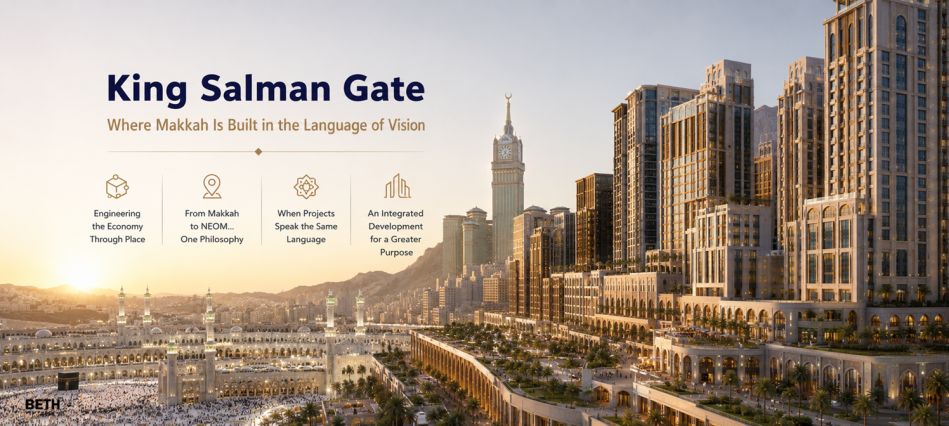
Engineering the Economy Through Place
From Makkah to NEOM... One Philosophy
When Projects Speak the Same Language
Makkah
BETH Follow-up & Analysis
Strategic Media Department – BETH News Agency
Supervised by: Abdullah Al-Omairah
BETH Brief
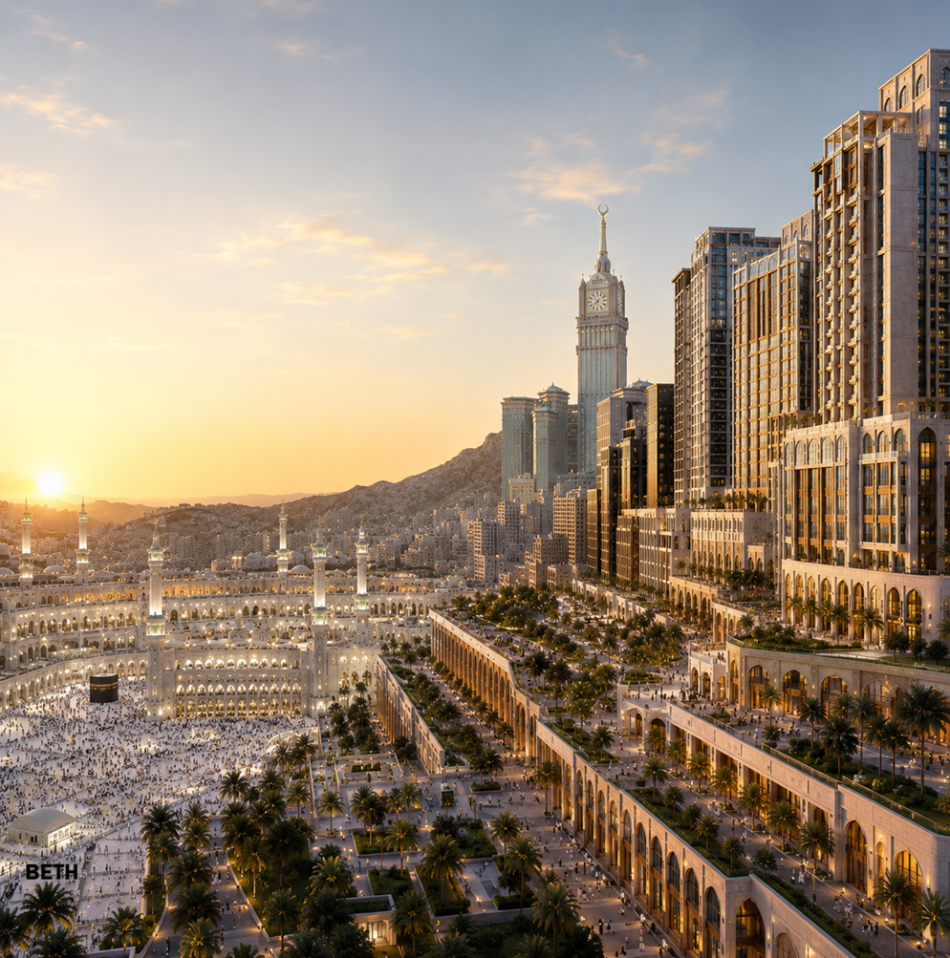
Saudi Arabia has begun implementing the King Salman Gate project in Makkah, one of the largest integrated urban developments adjacent to the Grand Mosque, with a total floor area of approximately 12 million square meters and capacity for nearly 900,000 indoor and outdoor worshippers.
The project includes around 50,000 residential units, 16,000 hotel rooms, more than 200,000 square meters of retail space, as well as cultural facilities, integrated transport hubs, and the restoration of heritage sites. It aligns with Saudi Arabia's Vision 2030 objective of welcoming 30 million Hajj and Umrah pilgrims annually.
BETH Analysis
Some may view the King Salman Gate project simply as a massive urban development serving the Grand Mosque.
Others may see it as a residential, investment, or tourism project.
Yet viewing Saudi Arabia's major developments through the lens of a single sector is no longer sufficient to understand what is taking place.
The project brings together housing, hospitality, retail, culture, heritage, transportation, and services in one integrated destination—not by coincidence, but because this is the language that Saudi Vision 2030 now speaks.
A language that does not simply build structures...
It builds economies.
Here, real estate is no longer the final product.
It becomes a platform for creating an integrated economic ecosystem.
Housing supports investment.
Transportation drives tourism.
Heritage strengthens the cultural economy.
Services enhance quality of life.
And the place itself becomes an engine of economic growth.
For this reason, King Salman Gate is not an isolated project.
Neither is NEOM.
Nor The Red Sea.
Nor Diriyah Gate.
Despite their different locations and purposes, these projects speak the same language.
A language that sees development beginning not with buildings...
But with the economy those buildings create.
Viewed from this perspective, these projects are not separate urban expansions.
They are components of one development philosophy that is redefining the relationship between place, people, investment, and quality of life.
This may well be one of the most significant transformations taking place in Saudi Arabia today.
The Kingdom is no longer merely building cities...
It is engineering the economy through place.
Strategic Outlook
At first glance, Saudi Arabia's flagship projects may appear geographically dispersed and designed for different purposes.
However, when viewed through the lens of Vision 2030, they reveal a single development philosophy.
From Makkah to NEOM...
From The Red Sea to Diriyah...
The same language is spoken.
A language that measures success not by the number of buildings constructed, the amount invested, or the number of housing units delivered...
But by a project's ability to generate economic activity, attract investment, create opportunities, and improve quality of life.
Perhaps this explains why Saudi Arabia no longer views real estate as an independent sector...
But as one of the Kingdom's most powerful instruments for building a diversified and sustainable national economy.