



Day 123 🇺🇸⚔️🇮🇷: The Funeral Truce .. and What Comes Next
BETH
Funeral ceremonies for Iran’s Supreme Leader, Ali Khamenei, entered their second day, five months after he was killed in the strike that targeted Iran on the first day of the war, while uncertainty continues to surround his son, Mojtaba Khamenei, who has yet to appear at the funeral despite being widely viewed as one of the leading figures expected to succeed his father.
Mojtaba’s absence, combined with the fact that he has not appeared publicly since the attack that killed his father, has fueled speculation about his condition, particularly following reports that he was seriously injured in the strike and has since been represented only through written statements attributed to him.
Meanwhile, a number of senior Iranian officials appeared alongside the late Supreme Leader’s coffin, including President Masoud Pezeshkian, Parliament Speaker Mohammad Bagher Ghalibaf, Quds Force Commander Esmail Qaani, as well as three of Khamenei’s sons—Masoud, Mostafa, and Meysam—in a display intended to project institutional continuity and regime stability.
The funeral ceremonies are taking place during the one-week pause announced by U.S. President Donald Trump before any further steps are taken against Iran, in what many observers describe as a temporary truce that has allowed Tehran to organize the funeral and rearrange some of its internal affairs.
At the same time, attention is turning toward an expected meeting between Trump and Israeli Prime Minister Benjamin Netanyahu after both sides agreed to meet soon in the United States to discuss Iran’s nuclear program, the future of Gaza and Lebanon, and the next phase of regional developments.
BETH Analysis
The current days may appear to be a humanitarian pause imposed by the funeral ceremonies...
In reality, however, they may represent a political truce that every party is seeking to exploit.
Iran is using the time to reorganize its internal scene and send a message that state institutions continue to function normally despite the loss of the country's highest authority.
The United States, meanwhile, is using the pause to demonstrate that its conflict is not with the Iranian people or their religious rituals, but that it has deliberately allowed a limited window before moving to the next phase of pressure or negotiations.
Israel, for its part, appears to be preparing for the post-funeral stage, with the anticipated meeting between President Donald Trump and Prime Minister Benjamin Netanyahu likely to help shape the next phase regarding Iran’s nuclear program, as well as Gaza and Lebanon.
Yet the most striking element of the Iranian scene was not who attended...
But who did not.
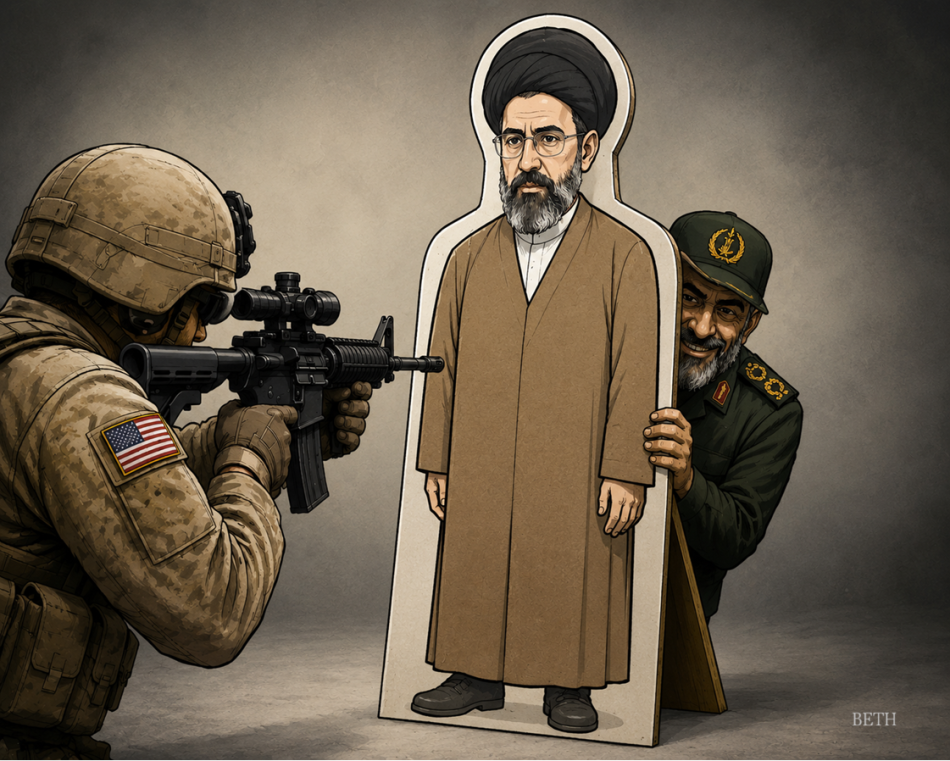
Mojtaba Khamenei, whom President Donald Trump said was seriously injured during the attack, has still not appeared publicly through the second day of the funeral ceremonies. Instead, he was represented symbolically by a cardboard cutout during the procession, a scene that has intensified speculation about his condition and prompted questions over whether his absence conceals more than the official narrative reveals.
The continued absence of Mojtaba Khamenei raises questions far beyond the fate of one individual. It opens the door to much larger questions concerning the future of the entire Iranian system, how the post-Khamenei era will be managed, and who will ultimately control the levers of power during this critical period.
The significance of this absence therefore lies not in Mojtaba himself...
But in what it represents for the future of the Iranian regime.
At moments like these, political systems seek to send unmistakable messages about stability and continuity.
When the individual most frequently associated with succession is absent, attention shifts rapidly from the fate of one man...
To the fate of the system itself.
Tehran therefore appears determined to demonstrate that state institutions remain cohesive, and that the Islamic Revolutionary Guard Corps, the presidency, and the governing institutions continue to function normally, suggesting that the regime's continuity does not depend on the public appearance of a single individual.
At the same time, however, many observers may view the continued ambiguity surrounding the succession process—and the reliance on symbolic representations of continuity—as evidence of the extraordinary sensitivity of this transition and the regime's effort to navigate one of the most critical political tests in its modern history.
The central question is therefore no longer:
Will Mojtaba Khamenei appear?
It has become:
How will the Iranian regime preserve its cohesion after the disappearance of the Supreme Leader who shaped its power structure for more than three decades?
The answer to that question may ultimately have a greater impact on the future of the war, negotiations, and the regional balance of power than many of the military statements currently dominating the headlines.
If the regime succeeds in managing the post-Khamenei transition, its policies may well continue under different leadership mechanisms.
But if internal fractures emerge, the period following the funeral could mark the beginning of a new political chapter whose consequences may extend far beyond Iran's borders.