



A Journey Inside the Mind .. th of Truth
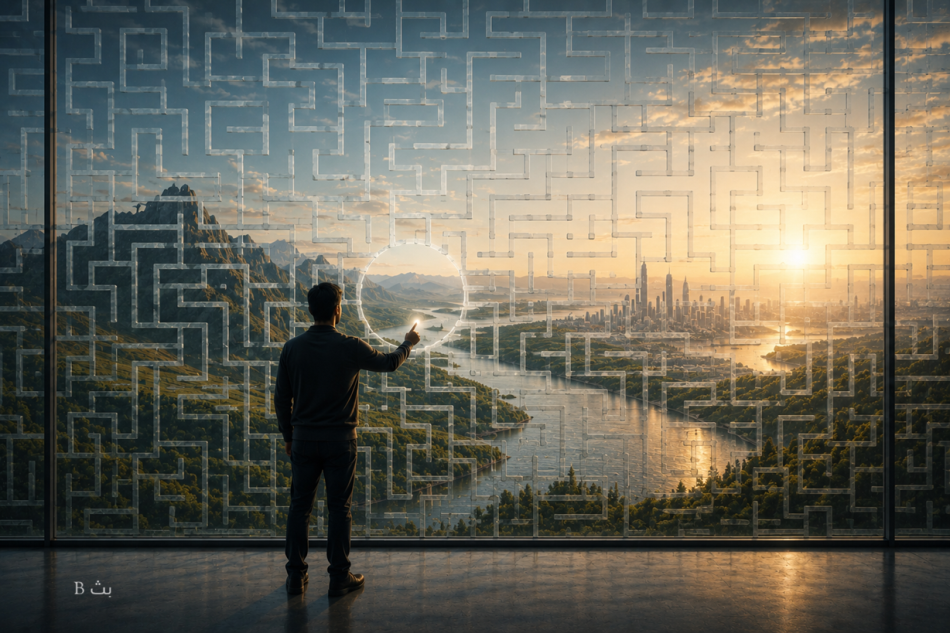
If the Truth Is Right in Front of Us, Why Don't We See It?
Research, Reading & Analysis | Strategic Media Department – BETH
Supervised by: Abdullah Al-Omirah
Truth is not always far away.
Sometimes, it is not even hidden.
It stands right before our eyes, yet we fail to see it.
Not because we lack intelligence.
Nor because information is missing.
But because the human mind does not perceive reality as it is.
It perceives reality as it interprets it.
And this is where The Labyrinth of Truth begins.
This series is not an exploration of news, politics, economics, or psychology as separate disciplines.
It is a journey into the human mind itself.
A journey that revolves around one central question, from which countless others emerge:
If the truth is right in front of us, why don't we see it?
Why do we sometimes believe what everyone repeats, even when it is wrong?
Why does the unknown frighten us more than the danger we have become accustomed to?
Why do we trust numbers more readily than people?
Why do we long for a past that may not have been exactly as we remember it?
Why does deception sometimes succeed, even when the truth has never disappeared?
These are not separate questions.
They are different faces of the same reality.
Human beings do not experience reality directly.
They experience the image their minds construct of reality.
That is why repetition can become mistaken for truth.
Why the majority can be mistaken for evidence.
Why memory can convince us that the past was better than it truly was.
Why fear can make us reject the future—not because it is worse, but because it is unfamiliar.
In economics, we may see money but fail to see the trust that moves markets.
In media, we may see the news without recognizing how it has been framed.
In politics, we may witness events without noticing the ideas driving them.
Perhaps the greatest danger we face is not what we do not know.
It is what we believe we already know.
Truth does not always disappear.
Sometimes, it is simply hidden behind the angle from which we look.
That is why The Labyrinth of Truth is not designed to provide ready-made answers.
Its purpose is to rebuild the questions.
Because when the question changes, everything that follows changes with it.
We will not stop at the event itself.
We will ask how the mind received it.
We will not stop at the news.
We will ask why some people believed it while others rejected it.
We will not stop at the numbers.
We will search for the invisible forces that give them meaning.
We will not stop at the past.
We will ask why it sometimes refuses to leave.
We will not stop at the future.
We will ask why some people fear it before they even know it.
Every idea.
Every decision.
Every opinion.
Every position.
Begins first inside the mind.
This journey will not search for truth only in the outside world.
It will search for it within the human being.
Within the way we see the world.
Interpret events.
And build our convictions.
Reality is one.
Yet minds rarely perceive it in the same way.
Two people may witness exactly the same event and leave with two completely different truths.
Not because one is lying.
But because every mind looks through its own lens.
Throughout this series, we will explore some of the most unsettling questions:
Does the majority create truth?
Or merely the feeling of truth?
Does memory preserve the past?
Or rewrite it?
Does fear protect us?
Or prevent us from seeing opportunity?
Are numbers always objective?
Or can they conceal more than they reveal?
Do we truly make our own decisions?
Or are many of those decisions formed before we become aware of them?
This series is not about politics alone.
Nor economics.
Nor media.
It is about the point where they all meet:
The human mind.
Politics begins with an idea.
Economics begins with trust.
Media begins with presentation.
Society begins with belief.
And every belief begins with the way people perceive the world.
News may tell us what happened.
Analysis may explain why it happened.
Yet there remains a deeper layer.
A layer that asks:
Why did people see the same event differently?
Why were some convinced while others remained unconvinced?
Why do certain ideas become accepted as obvious when they are not?
Why do some truths remain invisible even when they are standing before everyone?
At BETH, we believe that knowledge does not begin with reporting the news.
Nor does it end with analyzing it.
News answers one question:
What happened?
Analysis answers another:
Why did it happen?
But A Journey Inside the Mind... The Labyrinth of Truth seeks to answer a different question:
Why did we perceive it this way?
That is where depth begins.
Our goal is not to add more information to what readers already know.
Our goal is to help them see what they had never noticed, even though it had been in front of them all along.
For this reason, BETH does not limit itself to reporting and analyzing the news, important as those functions are.
It goes further.
Into observation.
Measuring impact and influence.
Anticipating transformation.
Building explanatory frameworks.
And producing journalism in all its forms—from words to photography, design, illustration, and visual storytelling.
Because we believe that news satisfies curiosity.
Ideas satisfy the mind.
Knowledge is not found at the surface of information.
It is found at its core.
Perhaps the greatest journey a human being can undertake...
is not around the world.
It is inside the mind.