


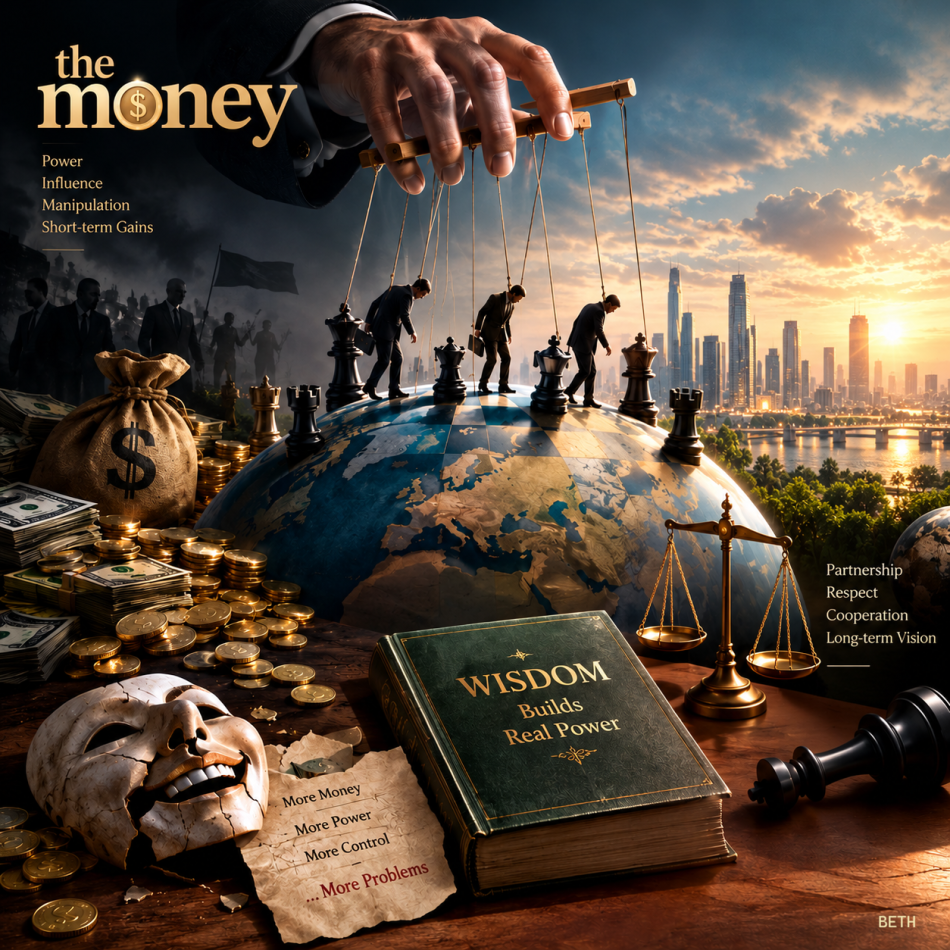
White Charisma .. Black Charisma

By Abdullah Al-Omairah
How many people have you thought possessed charisma, only to discover months—or even years—later that they were nothing more than remarkably skilled performers?
Is charisma a gift?
A skill?
Or a carefully crafted illusion?
Perhaps the question we ask far too rarely is this:
Does everyone with charisma deserve to be followed?
Few words are used today as frequently as charisma.
It dominates conversations about politics, leadership, business, media, marketing—and even everyday life.
Someone speaks with confidence, and we call it charisma.
Someone stands before an audience without hesitation, and we call it charisma.
Someone has a captivating voice, a charming smile, or a commanding presence, and once again we reach for the same word.
Yet we seldom stop to ask:
What does charisma actually mean?
A Word That Began as a Gift
The word charisma traces its origins to ancient Greek, where it meant a gift, a blessing, or a divine favor.
It was never born in business schools.
Nor in leadership seminars.
Nor in marketing manuals.
Originally, it described an extraordinary gift that people believed had been bestowed upon certain individuals.
Later, the German sociologist Max Weber introduced the concept into the study of leadership, describing a form of authority rooted not in office, wealth, or formal power, but in an individual's exceptional personal influence.
Over time, however, the word gradually lost much of its original depth.
Today, it is often used to describe little more than someone who knows how to command a camera.
The First Mistake
Our confusion is not between charisma and beauty.
It is between charisma and admiration.
You admire someone's voice.
You call it charisma.
You admire someone's elegance.
You call it charisma.
You admire someone's quick wit.
You call it charisma.
But admiration is an emotion.
Charisma is an impact.
Four Circles We Often Confuse
There are four closely related—but fundamentally different—circles.
The first is Attractiveness.
It captures attention through appearance, style, or a pleasant voice.
The second is Presence.
It is the ability to make people feel your presence, even in silence.
The third is Charisma.
It is the ability to earn trust and inspire others to listen, believe, and follow.
The fourth—and the rarest—is Influence.
This is where genuine transformation begins.
People leave the conversation with a new idea.
A broader perspective.
Or a better version of themselves.
Many possess attractiveness.
Fewer possess presence.
Even fewer possess charisma.
But true influence...
remains exceptionally rare.
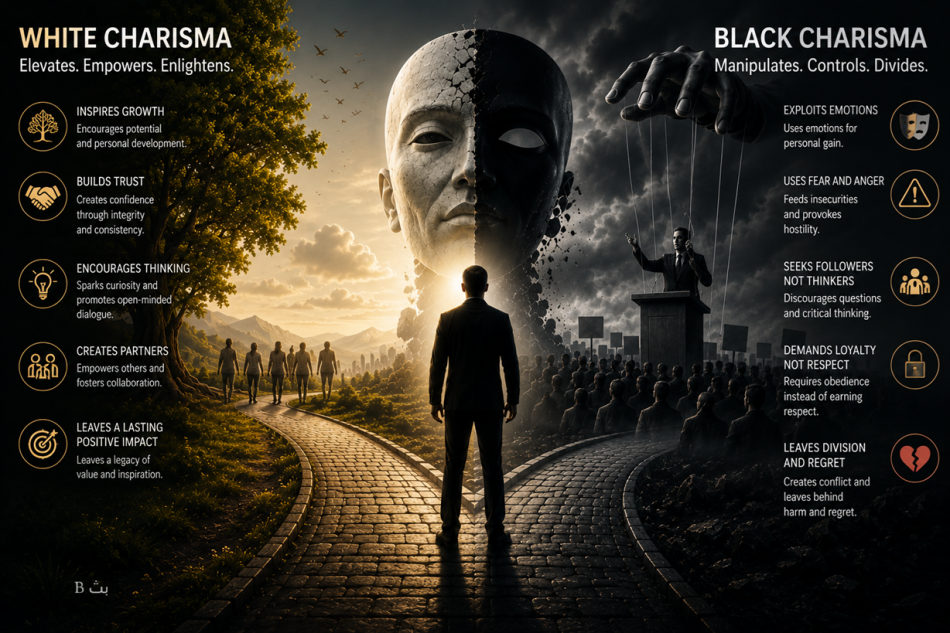
White Charisma
White charisma makes people better than they were before they met you.
When its owner speaks, your perspective expands.
When they disagree with you, they respect your mind.
When they succeed, they lift others with them.
Their presence does not consume people.
It gives them room to grow.
They do not seek followers.
They build partners.
They do not seek applause.
They awaken thought.
White charisma does not make people revolve around a person.
It inspires them to discover the best within themselves.
Black Charisma
Here begins the side we rarely discuss.
Some individuals possess extraordinary influence.
Yet they use it to build loyalty rather than awareness.
They know how to exploit fear.
How to feed anger.
How to make people applaud before they think.
That, too, is charisma.
But it is black charisma.
It does not lead people toward truth.
It leads them toward dependence.
The problem, therefore, is not charisma itself.
The problem is the direction in which it is used.
Fire can cook a meal.
It can also burn down a house.
Charisma is no different.
The Most Dangerous Leader
The most dangerous leader is not the ignorant one.
Ignorance often fails to persuade.
Black charisma, however, can convince you to defend what is wrong while believing you are defending the truth.
It can make you admire the individual...
And forget to examine the idea.
That is why not every influential leader is a good leader.
In Leadership
When an organization looks for a leader, it should not look for the finest performer.
It should look for the person who inspires belief in the mission rather than admiration for themselves.
A manager who sells their own image may create a strong first impression.
A manager who builds trust creates a lasting institution.
In Marketing
When I look for a marketing director, I am not searching for the person with the greatest power of persuasion.
I am searching for the one who genuinely believes in what they represent.
Customers may buy once because they are impressed.
They return because they trust.
Manufactured charisma may win the first sale.
Authenticity builds the brand.
Pretending, Manufacturing, and Building
These three ideas are often confused.
Pretending is performing a personality that is not your own.
Manufacturing is copying someone else's successful style, voice, gestures, and behavior.
Building, however, is something entirely different.
It is the lifelong process of developing yourself.
Expanding your knowledge.
Deepening your experience.
Refining your character.
Learning to listen before you speak.
At that point, you are no longer trying to create charisma.
You are creating a better human being.
And charisma finds you...
Rather than the other way around.
A Simple Test
If you want to discover the true color of someone's charisma, do not ask:
Do they attract attention?
Ask instead:
Do I respect them more the better I know them?
Do they explain ideas—or simply sell emotions?
Do they develop people—or merely build an audience?
Can they admit when they are wrong?
If they disappeared tomorrow, would the noise disappear...
Or would the meaning disappear?
In the end, you will discover that time is the most reliable judge of genuine charisma.
When Proverbs Say What Books Cannot
After philosophers debated the subject...
After sociologists analyzed it...
After psychologists explained it...
Popular wisdom expressed the same truth in just a few words.
An old Arabian proverb says:
"A man's true worth is proven by what he is—not by how he appears."
It is a saying that does not judge appearances.
It tests character.
It does not ask:
How does he look?
It asks:
What does he do?
Another profound Najdi proverb says:
"Shake the saddlebag."
The khirj—or saddlebag—was the traveler's leather bag that carried his provisions and belongings.
When it was shaken, only what had truly been inside would fall out.
If nothing emerged but dust and worthless scraps, its value became obvious.
That is why the proverb came to describe people whose presence is louder than their substance.
They fill gatherings with words...
But not minds with meaning.
Its opposite is a person of substance—someone whose words carry weight rather than volume.
Long before modern psychology and leadership theory, popular wisdom had already reached a timeless conclusion:
A person's value is never measured by appearance, but by what remains after they have been tested.
Conclusion
Charisma is not about walking into a room and turning every head.
It is about leaving the room...
And leaving something behind.
It is not about being admired.
It is about making people better because they knew you.
Beware of the person who makes you admire them more than the idea they represent.
White charisma inspires belief in the idea.
Black charisma demands belief in the individual.
That is where the difference begins...
Between a leader...
And a creator of followers.
Light may capture the eye.
But warmth...
Is what remains in memory.