



Hormuz Through History
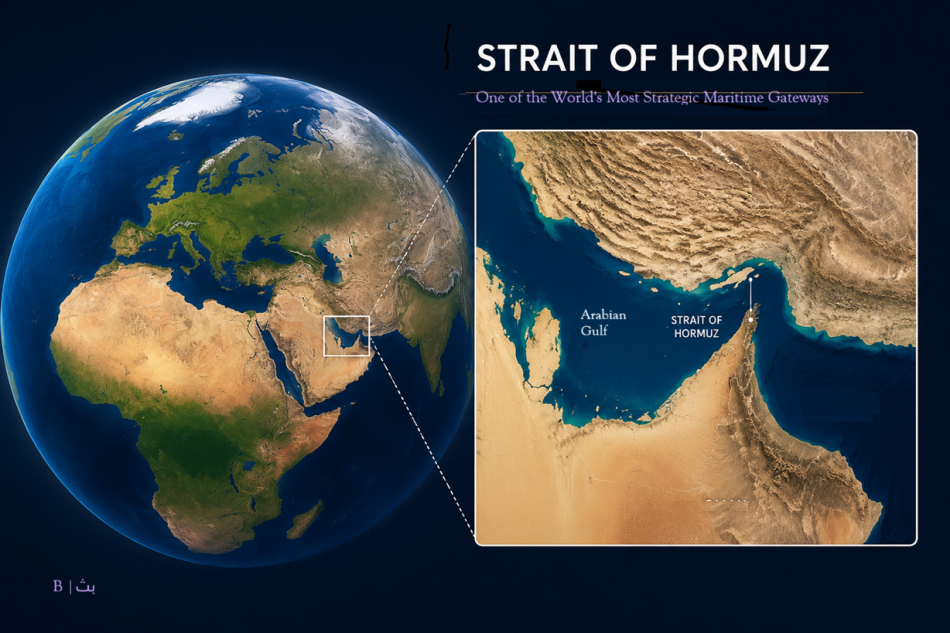
The Passage That Turned Geography into Power
Prepared and Analyzed by | Strategic Media Department – BETH Agency
Supervised by: Abdullah Al-Omairah
The Strait of Hormuz has never been merely a narrow stretch of water separating two shores.
For centuries, this small geographic passage has carried immense political, commercial, and military significance. Whoever passes through Hormuz crosses more than water—they move between the Gulf and the world, between energy and markets, between national sovereignty and international interests.
The Strait of Hormuz lies between Iran to the north and the Sultanate of Oman to the south, linking the Arabian Gulf with the Gulf of Oman and the Arabian Sea. The U.S. Energy Information Administration describes it as one of the world's most critical oil chokepoints. In 2024, approximately 20 million barrels per day of crude oil and petroleum products passed through the Strait, representing around 20% of global petroleum liquids consumption. Nearly one-fifth of the world's liquefied natural gas trade also transited Hormuz, most of it originating from Qatar.
Why Is It Called Hormuz?
This question requires precision, because the name does not have one universally accepted origin, despite what is sometimes presented in simplified historical accounts.
The most widely accepted explanation is that the Strait derived its name from Hormuz—the historic city, port, and commercial kingdom that emerged near this maritime passage. Over time, the name became associated with Hormuz Island and eventually with the Strait itself. According to the Encyclopaedia Iranica, Hormuz refers to an island, a strategic strait, and a historic port located near the passage. During the Islamic period, it was also known as "Coastal Hormuz" to distinguish it from inland settlements bearing the same name.
The origin of the word Hormuz itself remains the subject of several interpretations. The most prominent traces it to the Middle Persian form of Ahura Mazda, the supreme deity in Zoroastrianism, through forms such as Hormozd or Hormuz. Other, less common theories connect the name to local expressions or to a Greek root referring to a gulf or harbor.
From a journalistic perspective, the most accurate conclusion is this:
The Strait was named after the historical region known as Hormuz, while the origin of the name itself remains the subject of multiple historical and linguistic interpretations.
Hormuz Before Oil
Long before oil became the defining feature of Hormuz, the Strait formed part of the maritime trade route connecting the Gulf with India and East Africa.
During the Middle Ages, the Kingdom of Hormuz emerged as one of the region's leading commercial centers, linking Persia, the Arab world, India, and the Indian Ocean. Historical sources indicate that by the thirteenth century Hormuz had become a principal trading hub with India, succeeding earlier ports such as Siraf and Qais.
At that time, Hormuz owed its importance not to oil but to commerce.
Pearls, horses, spices, metals, and goods arriving from India and East Asia transformed Hormuz into a commercial crossroads rather than merely a maritime passage.
Some historians therefore described Hormuz as being far from the margins of history. Instead, it became a marketplace at the edge of the ancient world, where caravans met ships and empires met merchants.
The Portuguese and the Discovery of Hormuz's Maritime Power
The arrival of the Portuguese in the Indian Ocean and the Gulf at the beginning of the sixteenth century fundamentally changed Hormuz's strategic value.
It was no longer simply a commercial marketplace.
It became a point of maritime control.
In 1507, Afonso de Albuquerque reached Hormuz, and Portuguese influence was later consolidated on the island as part of a broader strategy to dominate the maritime trade routes linking Europe, India, and the Gulf. Studies of Portuguese activity in the Gulf describe Portugal as the first European power to exercise broad commercial, military, and diplomatic influence across the region.
From that moment onward, Hormuz evolved in international strategic thinking from a commercial port into a maritime gateway.
Controlling Hormuz no longer meant controlling an island or a rocky outcrop.
It meant controlling the gateway to the Gulf.
From a Trade Route to a Global Energy Artery
The discovery of النفط and the rise of the Gulf states as major global energy producers transformed Hormuz once again.
The Strait was no longer simply a commercial passage.
It became one of the world's principal energy arteries.
The ships crossing Hormuz transport more than Gulf exports.
They carry global energy stability, market balance, and industrial supply security for Asia and Europe.
Data from the U.S. Energy Information Administration indicate that most of the energy transported through Hormuz has no practical alternative if the Strait were closed, despite the existence of some bypass pipelines in Saudi Arabia and the United Arab Emirates. These alternative routes provide only limited capacity and cannot compensate for the full volume of energy flowing through the Strait.
Geography was no longer silent.
It had become an integral part of the global economy.
International Law: A Passage Owned by No Single State
Hormuz's sensitivity is also rooted in its legal status.
Under the United Nations Convention on the Law of the Sea, ships and aircraft enjoy the right of transit passage through international straits, ensuring continuous and expeditious navigation and overflight that cannot legally be obstructed. Coastal states are likewise required not to impede transit passage and to provide notice of known navigational hazards.
Law, however, does not eliminate politics.
Iran and the Sultanate of Oman also approach the Strait through the lenses of sovereignty, national security, and territorial waters.
Most other countries view it through the principles of international interest, freedom of navigation, and energy security.
Here lies the central dilemma:
Hormuz lies between two countries, yet it serves the entire world.
What Has Hormuz Been?
Throughout its history, Hormuz has embodied three successive identities.
It was first a marketplace connecting the Gulf with India and the Indian Ocean.
It then became a strategic maritime gateway contested by major powers.
Finally, in the modern era, it evolved into a global energy artery whose importance extends far beyond any single country or region.
These three historical phases explain why Hormuz cannot be understood merely as geography.
It is simultaneously a commercial legacy, an arena of strategic influence, and a continuing test of global power balances.
What Will Hormuz Become?
Hormuz is unlikely to lose its strategic importance anytime soon, even as renewable energy expands.
Energy sources may evolve.
Transportation technologies may change.
Alternative pipelines and ports may continue to develop.
Yet Hormuz will remain strategically significant for reasons that extend beyond oil itself.
It stands at the intersection of three critical spheres:
- Energy security.
- Maritime security.
- Regional strategic balance.
Hormuz may therefore evolve from an oil chokepoint into a global testing ground for the governance of international maritime corridors.
The future questions will no longer be limited to:
Who protects Hormuz?
They will increasingly become:
Who establishes the rules governing passage?
Who ensures that the Strait does not become an instrument of coercion?
Who participates in securing it without claiming exclusive control?
Why Has the World's View of Hormuz and the Gulf States Changed?
The recent war did not make Hormuz important.
It revealed how important it had always been.
Before the crisis, many viewed the Strait simply as another statistic in global energy reports.
Following the escalation, it became clear that Hormuz possesses the capacity to influence oil markets, maritime insurance, global supply chains, and political decision-making in Washington, Beijing, Tokyo, New Delhi, and across Europe.
Energy Information Administration data further show that 84% of the crude oil and condensates and 83% of the liquefied natural gas transported through Hormuz in 2024 were destined for Asian markets, with China, India, Japan, and South Korea representing the largest destinations.
A new understanding of the Gulf's strategic importance emerged.
The Gulf states are no longer important merely because they produce energy.
They stand at the gateway through which much of the world's energy flows.
For that reason, Gulf security is no longer simply a regional matter.
It has become an essential component of global economic security.
The Gulf: From Energy Source to Strategic Balance
The recent crisis demonstrated that the Gulf states are far more than producers of oil and gas.
They occupy the center of a global equation combining energy, investment, ports, logistics, maritime security, and diplomacy.
When Hormuz is shaken, the consequences extend far beyond oil tankers.
Markets react.
Insurance premiums rise.
Military planning changes.
Central banks reassess risk.
Industrial supply chains across Asia and Europe are disrupted.
This has fundamentally reshaped the world's perception of the Gulf.
The region is no longer viewed merely as a source of natural resources.
It has become a center of international strategic balance.
Hormuz After the Recent War
Following the recent conflict, the central question is no longer whether Hormuz can be closed.
Instead, it has become:
What price will the world pay if Hormuz becomes a permanent instrument of geopolitical pressure?
This explains the growing discussions surrounding navigation management, the respective roles of Iran, Oman, and the Gulf states, the application of international law, the future of the American military presence, and possible new regional security arrangements.
In this sense, Hormuz has returned to its historical essence.
It is not merely a place through which ships pass.
It is where power itself is tested.
BETH Conclusion
Hormuz is more than a name on a map.
It represents a long history of commerce, maritime dominance, energy, and international strategic balance.
The cargo crossing the Strait has changed.
The powers watching over it have changed.
Yet its essential function has remained remarkably constant.
Whoever passes through Hormuz passes into the heart of the global economy.
For that reason, the future of the Strait will not be determined by military force alone, international law alone, or geography alone.
It will depend upon a delicate balance between sovereignty, international interests, and the role of the Gulf states in safeguarding regional security without allowing these maritime corridors to become instruments of political pressure.
Hormuz was once a marketplace.
Then it became a gateway.
Today, it has become a mirror reflecting the world's dependence on the Arabian Gulf.