



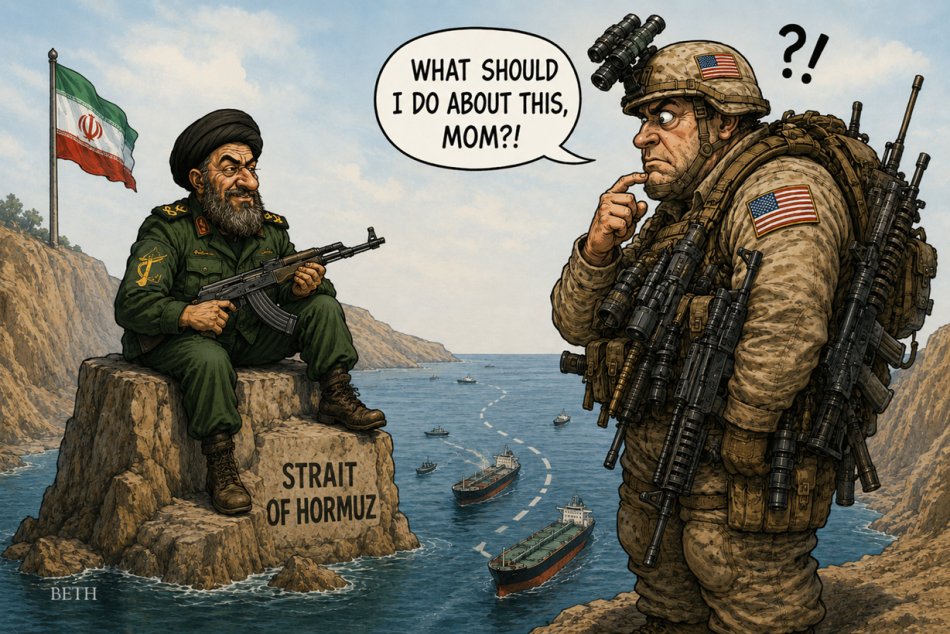
Day 118 🇺🇸⚔️🇮🇷: Strait Conflict and the Question of Decisive Resolution
Prepared and Analyzed by | Strategic Media Department – BETH Agency
Supervised by: Abdullah Al-Omairah
After several days of reciprocal strikes, both sides returned to a ceasefire and resumed negotiations in Doha, while the most sensitive issue remained unresolved: the Strait of Hormuz.
This raises the central question:
If the United States possesses clear military superiority, why has the Strait of Hormuz issue not been decisively resolved?
Strait of Hormuz: More Than a Waterway
At first glance, the dispute appears to be about a strategic maritime passage.
In reality, however, it revolves around a much larger question:
Who sets the rules of the international order when national sovereignty intersects with global interests?
The United States seeks to guarantee freedom of navigation as a global interest.
Iran seeks to ensure that its geography remains a strategic factor that cannot be ignored.
Meanwhile, the countries of the region and the wider international community are looking for a formula that guarantees security and preserves the uninterrupted flow of trade and energy without allowing the Strait to become a permanent instrument of pressure.
What is taking place in Hormuz, therefore, is not merely a struggle over a waterway, but a test of politics' ability to manage geography.
Why Has the Issue Not Been Resolved Militarily?
Some may ask:
If the United States enjoys overwhelming military superiority, why has it not eliminated the Iranian threat in the Strait through a decisive strike?
The answer lies in the fact that the nature of conflict in Hormuz differs fundamentally from conventional warfare.
The Strait is not dependent on a single military base that can simply be destroyed. Rather, it stretches along a long coastline protected by multiple capabilities, including fast attack boats, coastal missile systems, unmanned aerial vehicles, naval mines, and forces capable of constant maneuver and redeployment.
Consequently, weakening Iran's military capabilities does not necessarily eliminate its ability to disrupt or threaten maritime traffic intermittently.
On the other hand, while the United States can protect a significant portion of maritime traffic, it cannot guarantee the safety of every vessel at every moment without broader political and security arrangements.
The challenge is therefore not purely military. It is a combination of geography, deterrence, international law, and political and economic cost calculations.
A large-scale military operation might further degrade Iran's capabilities, but it could also expand the conflict, disrupt global energy supplies, and destabilize the world economy.
For this reason, both sides appear to be using military power primarily to strengthen their negotiating positions rather than to seek a final military resolution.
Why Has Washington Not Settled the Issue?
Because military victory does not necessarily achieve political objectives.
Military force can destroy targets, but it cannot always build the political reality desired after military operations have ended.
This is not an American dilemma alone; it has confronted most major powers throughout history.
Military success does not automatically secure political goals, just as silencing the guns does not eliminate the causes of conflict.
One unwritten principle of international relations therefore remains:
Winning a war is easier than winning the peace.
Military victory does not necessarily equal political victory.
Why Does Iran Continue to Hold Onto the Strait?
For Tehran, the Strait of Hormuz is far more than a maritime passage.
It is one of its most valuable strategic assets.
The greater the Strait's importance to the global economy, the greater the value of this bargaining card.
Iran therefore appears to be shifting from the equation of the ability to close the Strait to participation in managing it.
This represents an important evolution in the nature of its objectives.
Can Iran Manage the Strait Alone?
In practical terms, this appears unlikely.
The Strait serves global commerce, carries vessels from dozens of countries, and its navigation is governed by international law and broad international economic interests.
Any future arrangement, if successful, will therefore require regional and international consensus rather than unilateral decisions by any single party.
What Does International Law Say?
The Strait of Hormuz is one of the world's most important international straits.
Accordingly, most countries rely on the principle of transit passage, which is intended to ensure uninterrupted international navigation.
Iran, by contrast, bases its position on considerations of sovereignty, national security, and the management of waters within its geographical jurisdiction.
This is where law and politics intersect.
What Are the Likely Tactics?
If negotiations continue, the coming period is likely to witness a combination of diplomatic and security measures rather than outright military resolution.
Possible developments include:
- Continued freedom of navigation under temporary security arrangements.
- Technical negotiations regarding shipping routes and safety procedures.
- A greater role for the Gulf states and the Sultanate of Oman in future arrangements.
- Continued reciprocal political and military pressure without escalation into full-scale conflict.
- Using the Strait of Hormuz as leverage in broader regional and international negotiations.
Where Could the Situation Lead?
Three principal scenarios appear most likely.
First: Maintaining the current situation, with navigation continuing while political and legal disputes remain unresolved.
Second: Reaching a new agreement regulating navigation and security coordination with regional and international participation.
Third: The collapse of negotiations and renewed escalation—an outcome that would impose the highest costs on all parties and therefore appears to be the least attractive option at present.
Yet the real turning point may emerge from where neither side expects it. History has often brought conflicts to an end through developments that were never part of the calculations of the warring parties.
BETH Conclusion
The dispute over the Strait of Hormuz may appear to concern a maritime passage.
In reality, it revolves around a broader question:
How should geography be managed when competing claims of sovereignty intersect with global interests?
The United States possesses military capabilities capable of protecting navigation, yet it cannot by itself impose a lasting political reality.
Iran believes it possesses important geographical leverage, yet it also cannot unilaterally impose new rules governing international navigation.
The outcome therefore is unlikely to be determined by military power alone or by politics alone, but rather by a complex balance involving power, geography, international law, and global economic interests.
The Strait of Hormuz may ultimately illustrate a broader reality that characterizes many conflicts of the twenty-first century:
Military power can open the door to negotiations, but it is not sufficient by itself to build a stable political order or a lasting peace.
BETH's Next Question
If military power alone is no longer sufficient to resolve the conflicts of the twenty-first century, then two larger questions naturally emerge:
Why does the United States so often fail to achieve lasting political victory despite its overwhelming military superiority?
For decades, Iranian officials and prominent figures within the ruling establishment have spoken of restoring Persia's historical role and expanding Iran's influence beyond its geographical borders. Why has this declared ambition not been transformed into a stable strategic reality?
Perhaps the answer begins by redefining what victory itself truly means. Wars are not measured by what is destroyed on the battlefield, but by what is ultimately achieved at the negotiating table, in strategic outcomes, and after the guns fall silent.