

Peace and Normalization
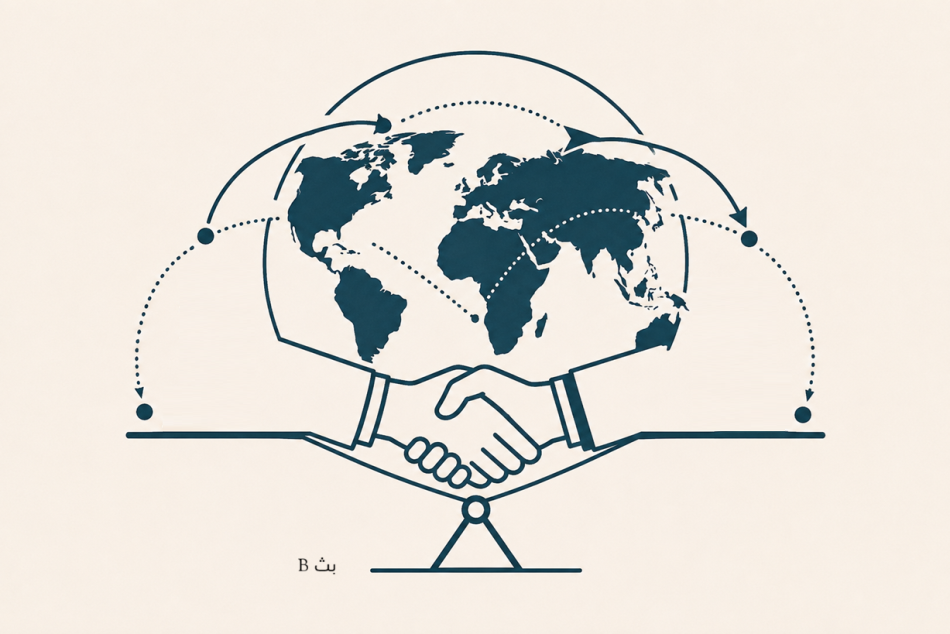
Why Are Two Different Concepts So Often Confused?
Prepared and Analyzed by | Strategic Media Department – BETH Agency
Supervised by: Abdullah Al-Omairah
In Arab public discourse, the terms peace and normalization are often used as though they carry the same meaning.
However, in political science and international relations, they are two distinct concepts, each with its own objectives, mechanisms, and outcomes.
The confusion between them may be one of the reasons why misunderstandings persist—not only among governments and societies, but also within media and academic discussions.
Peace Is Not Love
In international law and relations between states, peace does not mean the disappearance of disagreements or a change in convictions.
Rather, at its core, it means shifting from managing conflict through force to managing it through politics, law, and negotiation.
Two countries may sign a peace agreement while continuing to disagree profoundly over history, borders, identity, or national interests.
Peace, therefore, does not require complete agreement. Its primary purpose is to prevent war as a means of resolving disputes.
Yet peace does not mean the end of conflict.
Armed confrontation may cease while political, economic, technological, and media competition continues for decades.
International relations do not eliminate conflicting interests; they simply move competition from the battlefield to politics, economics, diplomacy, or influence.
Peace, therefore, does not erase disagreements. It changes the way they are managed.
Normalization
Normalization is a different concept.
It is less about ending war than about transforming the relationship between states into a normal one.
It usually includes diplomatic relations, trade, investment, tourism, scientific and cultural cooperation, and, in some cases, security cooperation.
Normalization can therefore be viewed as a stage distinct from peace rather than a synonym for it.
Does Peace Mean Surrender?
Not necessarily.
Throughout history, many countries have signed peace agreements after long wars without eliminating their disagreements or bringing their political positions closer together.
Likewise, many states continue to disagree politically or ideologically while choosing not to use war as a means of managing those differences.
In international relations, peace is fundamentally about managing conflict—not changing convictions.
Does Normalization Mean Endorsement?
Not necessarily.
Normal relations between states do not imply political or moral agreement.
Many countries maintain diplomatic and economic relations with states whose positions differ on foreign policy, international law, human rights, or regional conflicts.
Establishing relations does not necessarily mean adopting the other party's views.
Testing the Concept Within the Arab World
Before discussing Arab-Israeli relations, the Arab world may first need to ask itself an important question:
What is the nature of relations among Arab states themselves?
Are they peace?
Normalization?
Or do they represent a different model altogether?
The reality suggests that most Arab states are not engaged in open warfare with one another. Yet their relationships do not always reach the level of deep strategic partnerships.
In many cases, relations fluctuate between cooperation and distance, temporary coordination and political disagreement, depending on regional developments, rather than being built upon lasting institutions or long-term shared interests.
In other words, the challenge is not always the absence of peace, but rather the limited level of trust, weak institutional integration, and the failure to transform common interests into sustainable frameworks of cooperation.
Some Arab relationships can therefore be described as stable without integration, or functional rather than truly strategic partnerships.
This observation goes beyond the Palestinian issue itself.
If relations among countries sharing language, history, culture, geography, and economic interests still experience periodic fluctuations, then the question extends beyond peace and normalization.
It becomes a broader question:
Is the problem really about terminology, or about the region's ability to build sustainable strategic relationships, regardless of the other party?
The real challenge may not lie in signing agreements, but in building lasting foundations for cooperation that are resilient to changes in governments, crises, and political disagreements.
Why Do Different Societies Understand These Concepts Differently?
The confusion between peace and normalization is not unique to the Arab world.
Every society interprets these concepts through its own history, conflicts, political discourse, media narratives, and collective memory.
The reasons, however, differ from one society to another.
In the Arab World
The confusion is rooted in historical, political, and cultural factors.
In the Arab public consciousness, peace treaties have often been associated with the beginning of normal relations, making the two concepts appear inseparable.
Political and media discourse has also frequently used the terms interchangeably despite their distinct meanings in international relations.
As a result, many people have come to regard peace as synonymous with normalization, or normalization as synonymous with concession, even though international relations clearly distinguish between the two.
In Israel
A significant part of public debate focuses on security, regional recognition, and integration into the Middle East.
Accordingly, peace is often viewed as a means of achieving security and stability, while normalization is seen as evidence of broader political, economic, and cultural acceptance within the region.
For many Israelis, peace and normalization are therefore viewed as complementary stages rather than separate concepts.
In Iran
The understanding of these concepts has been shaped by the political discourse that has prevailed since 1979, linking Iran's regional relationships to ideological and political considerations that go beyond conventional interstate disputes.
Consequently, normalization is widely presented within official discourse as both a political and moral transformation, while peace is often interpreted through the lens of regional power balances.
At the same time, alternative perspectives do exist within Iranian academic and political circles, although they are less visible in official discourse.
In the West
Political and academic discourse across many Western countries tends to distinguish more clearly between peace and normalization.
Peace is generally defined as ending conflict or managing disputes through peaceful means, whereas normalization is viewed as the subsequent process of rebuilding diplomatic, economic, and social relations.
Nevertheless, Western positions often differ regarding the timing and conditions of normalization, particularly when issues of security, international law, or human rights are involved.
This raises one of the most enduring questions in international politics:
Are the principles of security, international law, and human rights applied equally in every case, or are they sometimes influenced by power, national interests, and political alliances?
This debate extends well beyond the Middle East and remains central to broader discussions about the consistency of the international order.
Every Side Has Its Own Calculations
In any prolonged conflict, each party pursues its national interests according to its own priorities.
For some states, security comes first.
For others, economic development, historical grievances, or achieving a comprehensive political settlement take precedence.
Consequently, positions on peace and normalization are shaped primarily by national interests rather than political slogans alone.
Between Rhetoric and Reality
In many international conflicts, public rhetoric does not fully reflect underlying national interests.
Public discourse often emphasizes principles and symbols, while political decisions are generally driven by considerations of security, economics, stability, and regional balance.
This pattern is not unique to any particular region. It has appeared repeatedly in international experiences where armed conflict eventually gave way to negotiation and evolving forms of interstate relations.
What Has Changed?
Over recent decades, the world has become more interconnected.
Economics, technology, supply chains, energy, maritime security, and artificial intelligence have all increased the cost of prolonged conflict for many countries.
Yet political and humanitarian issues continue to shape both governmental policies and public opinion.
For this reason, efforts continue to search for formulas capable of balancing security, rights, stability, and development.
The Question of the Future
Do states pursue peace because they genuinely believe in peace as a value?
Or because the cost of war has become greater than the cost of negotiation?
Reality may well contain elements of both, as principles and interests often intersect in different proportions from one case to another.
The Question Worth Asking
Perhaps the real question is no longer:
Is peace better than normalization?
Rather:
Can lasting peace be achieved without addressing the root causes of conflict?
And conversely:
Can those root causes ever be addressed if war remains the only language between the parties?
Conclusion
Perhaps one of the greatest misconceptions in many public debates is treating peace and normalization as though they were the same concept.
International relations demonstrate that they are two different stages serving two different functions.
They may coexist, or they may exist independently, depending on the nature of each conflict and the interests of its parties.
Understanding this distinction does not require adopting a political position or granting legitimacy to one side over another.
It simply provides a more accurate framework for understanding how states think and how international relations function.
Peace answers one question: How do wars stop?
Normalization answers another: How are relations managed afterward?