



Day 115 🇺🇸⚔️🇮🇷: After the War
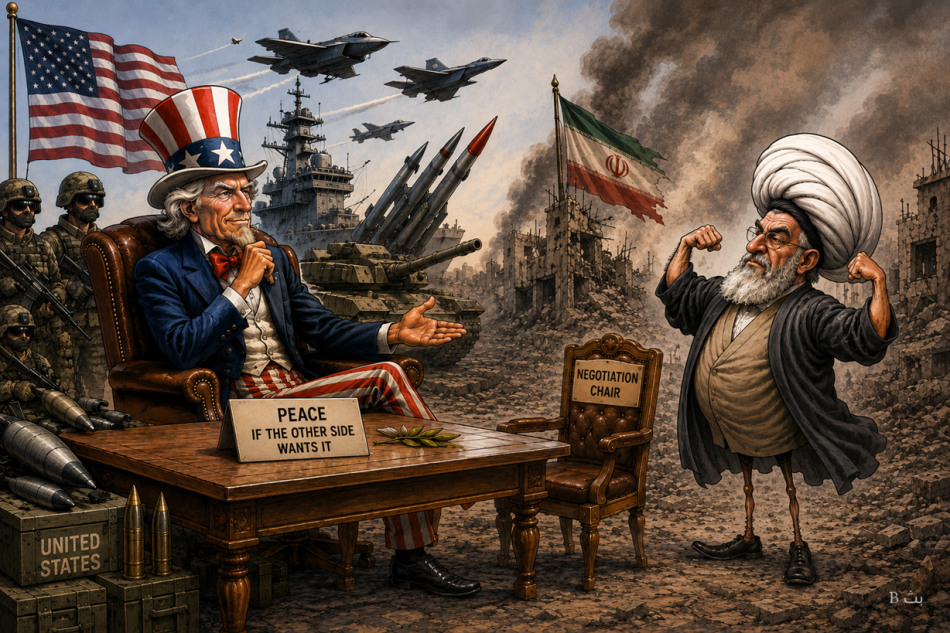
Iran Clings to Influence as Washington Shapes the Next Phase
BETH | B
Iran accused NATO of complicity in what it described as the "unlawful war of aggression" waged by the United States and Israel against the country.
Meanwhile, Iran's Islamic Revolutionary Guard Corps (IRGC) warned that no new shipping route through the Strait of Hormuz should be announced without coordination with Iran, insisting that safe passage is only possible through routes approved by Iranian authorities. The warning came after Oman announced a temporary maritime corridor for vessels transiting the strait.
In Washington, reports revealed a heated confrontation between President Donald Trump and Republican Senator Bill Cassidy over the administration's handling of the conflict with Iran and the level of information shared with Congress. Cassidy later received a security briefing at the White House from Vice President J.D. Vance and Special Envoy Steve Witkoff.
Separately, U.S. Secretary of State Marco Rubio met with the foreign ministers of the Gulf Cooperation Council (GCC) in Manama, reaffirming that the United States seeks a real agreement with Iran. He stressed that the Strait of Hormuz is an international waterway, describing any attempt to impose fees or restrictions on navigation as unacceptable, while reiterating that Iran will never be allowed to acquire a nuclear weapon.
Rubio also expressed appreciation for America's Gulf partners, highlighting cooperation not only in security but also in economic development, and reaffirmed Washington's commitment to a peace that guarantees stability and prosperity for the region and the world.
BETH Analysis
The central question is no longer:
Who won the war?
It is now:
Who will define the rules of the post-war era?
Iran appears determined to preserve its remaining leverage, particularly through the Strait of Hormuz, long regarded as one of its most important strategic assets.
At the same time, Washington's messaging has shifted from military confrontation toward establishing a new regional framework.
By describing the Strait of Hormuz as an international waterway, the United States is sending more than a legal message. It is signaling that freedom of navigation is no longer a bargaining chip but a fundamental principle of regional security.
Meanwhile, political tensions inside Washington illustrate that managing the aftermath of war can be as challenging as conducting the war itself, especially as lawmakers demand greater transparency regarding objectives, outcomes, and long-term strategy.
Rubio's meeting with GCC foreign ministers also reflects a broader U.S. effort to reinforce partnerships built not only on security cooperation but increasingly on economic integration, recognizing that lasting regional stability depends on both.
The question is no longer:
Will there be another war?
It is:
Will the region move toward a comprehensive agreement with Iran—or enter a prolonged period of managed rivalry under a new set of regional rules?
Rubio to Gulf Leaders: Our Alliance Faced a Tough Test—And Passed It with Flying Colors
Perhaps U.S. Secretary of State Marco Rubio best captured the entire regional landscape when he declared:
"Our alliance faced a tough test, but it passed it with flying colors."
This was far more than a message of appreciation to America's Gulf partners.
It was a political assessment of how Washington views the outcome of the recent phase.
The test was not purely military.
It was a test of an alliance built on:
- Military strength.
- Economic power.
- Energy security.
- Global supply chains.
- Regional stability.
- And the wisdom to manage crises.
What stands out is that Rubio did not emphasize military victory as much as he emphasized the resilience and cohesion of the alliance.
In today's world, the strength of alliances is no longer measured solely by the size of their armed forces.
It is measured by their ability to protect the global economy, safeguard the uninterrupted flow of trade, preserve market stability, and prevent regional crises from escalating into worldwide disruption.
For that reason, Washington's message appears to be focused not only on what happened during the conflict...
but on the regional order it seeks to consolidate in the post-war period.
The question is no longer:
Who won the confrontation?
It is:
Which alliance will prove more capable of delivering stability to the region—and to the world?
U.S. Responds After Hormuz Incident
The U.S. Central Command (CENTCOM) announced airstrikes on targets inside Iran, including missile depots, drone storage facilities, and coastal radar stations, in response to a drone attack on the Singapore-flagged cargo vessel MV Ever Lovely in the Strait of Hormuz.
CENTCOM stated that the attack on the civilian vessel constituted a violation of the ceasefire and freedom of navigation, adding that U.S. forces will continue safeguarding commercial shipping and monitoring Iran's compliance with existing agreements.
BETH Analysis
The U.S. response underscores that freedom of navigation in the Strait of Hormuz has become a clear red line for Washington.
The message is no longer directed at Iran alone...
It is aimed at all regional actors, signaling that any attack on international shipping routes will trigger a direct response as part of enforcing the post-war security framework and protecting global trade.