



Saudi Arabia to Shanghai 🇸🇦🇨🇳
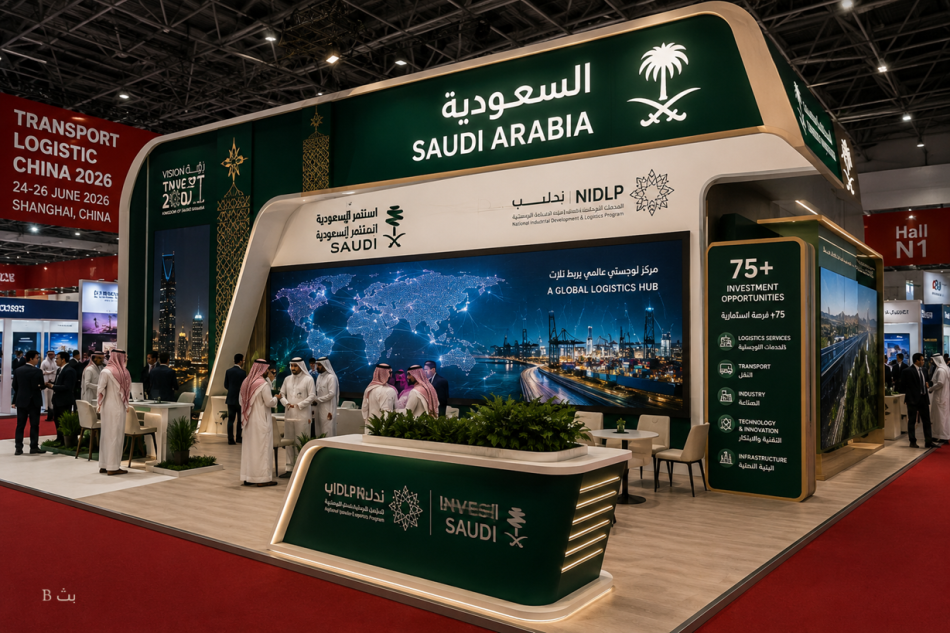
NIDLP Showcases More Than 75 Investment Opportunities at Asia’s Largest Logistics Gathering
Shanghai | BETH | B
Saudi Arabia’s National Industrial Development and Logistics Program (NIDLP), in cooperation with Invest Saudi, is participating in Transport Logistic China 2026, held in Shanghai from June 24 to 26, with the participation of 25 national entities representing the Kingdom’s transport, logistics, and investment ecosystem.
The Saudi pavilion highlights the Kingdom’s ongoing transformation in infrastructure and logistics services, alongside more than 75 high-value investment opportunities and a range of strategic projects supporting the goals of Saudi Vision 2030 and strengthening the Kingdom’s position as a global logistics hub connecting three continents.
The pavilion also showcases innovation and advanced technologies, while offering a cultural experience reflecting Saudi identity and national industries, as part of efforts to strengthen the Kingdom’s international presence and build new partnerships with global investors and companies.
Transport Logistic China is regarded as one of the world’s leading exhibitions dedicated to transportation, logistics, and supply chains, bringing together investors, decision-makers, experts, and major international companies.
BETH Analysis
Saudi Arabia’s participation in Shanghai represents more than attendance at a specialized exhibition. It reflects a new phase in how the Kingdom presents itself to the world.
Global competition is no longer defined solely by ports, roads, or warehouses. Increasingly, it revolves around the ability to build an integrated ecosystem that combines:
- Infrastructure.
- Advanced technologies.
- Supply chains.
- An attractive investment environment.
- And connectivity between markets and continents.
Notably, Saudi Arabia is not promoting a single project or sector. Rather, it is presenting itself as an integrated economic and logistics platform, supported by more than 75 investment opportunities and a unified message across participating national entities.
As global trade patterns continue to evolve and supply chains are being reshaped, future competition may not be between the countries that produce the most, but between those that are best positioned to connect the world with the world.
The question is no longer:
Who owns the largest port?
But rather:
Who can become the most influential node in global trade flows?