



Day 113 🇺🇸⚔️🇮🇷 .. Negotiations Crawl Forward
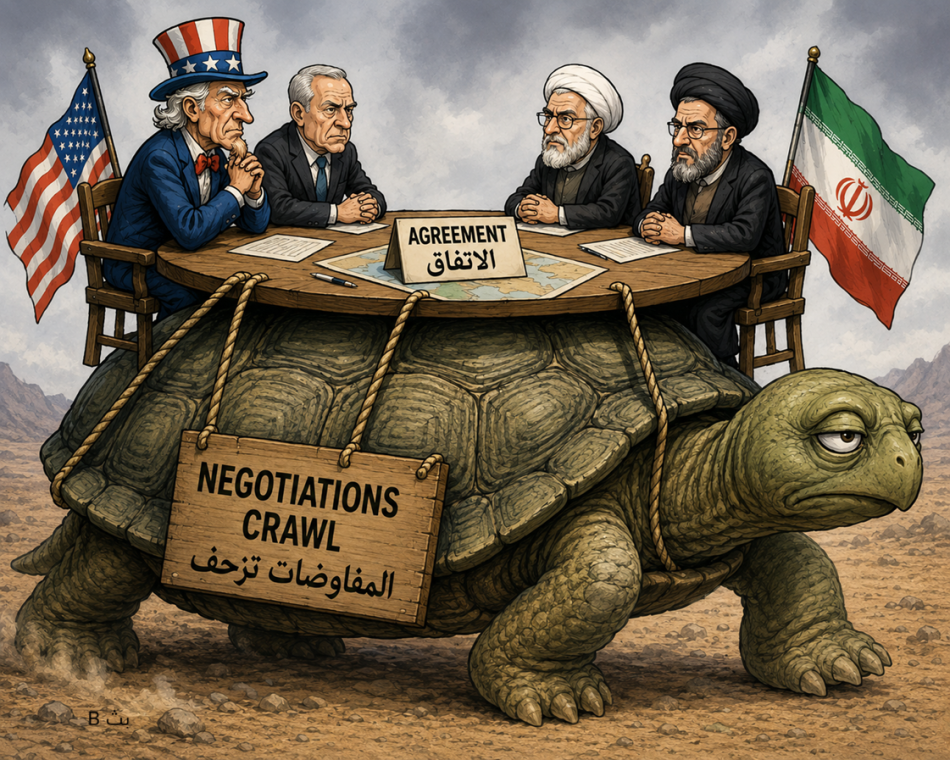
U.S. Vice President J.D. Vance has returned to Washington, while President Donald Trump has reiterated his warnings to Iran should negotiations fail to produce an agreement. Meanwhile, the Iranian president has arrived in Islamabad, as Tehran continues to emphasize its red lines.
Between statements coming from Washington and those issued in Tehran, negotiations appear to be moving slowly—advancing, stalling, and then moving again without ever leaving the same circle.
A pattern of ebb and flow, expansion and contraction, Iranian maneuvering, and American firmness resembling a delicate balance: neither a complete rupture nor a complete concession.
After J.D. Vance announced that Iran had agreed to allow International Atomic Energy Agency inspectors to return to its nuclear facilities, Iran's Foreign Ministry quickly denied the claim, stating that it has no intention of allowing inspectors to visit nuclear sites targeted during the conflict.
Tehran also stressed that any released frozen assets would be under Iran's full control and that its missile and defense capabilities are not open for negotiations.
At the same time, Israeli Prime Minister Benjamin Netanyahu stated that Israel had dealt a severe blow to Iran and its regional proxies, while emphasizing that the war is not over.
BETH Analysis
The question is no longer:
Will negotiations continue?
The larger question is:
Who is betting more on time?
Some analysts argue that Iran only responds to military pressure and that the current pattern of advances and retreats merely provides Tehran with more room to maneuver and buy time.
Others believe that strategic patience, combined with sustained economic, military, and political pressure, could eventually push Iran toward a gradual settlement.
What is unfolding so far suggests that neither side is seeking a full-scale confrontation, nor are they pursuing a rapid agreement.
Washington appears determined to maintain pressure without closing the door to diplomacy, while Tehran seeks to preserve as many leverage cards as possible without entering an open conflict.
Israel, meanwhile, is sending a different message:
The war is not over.
The situation increasingly resembles a prolonged tug of war, with each side carefully testing the other's endurance while trying to demonstrate superior patience.
Perhaps the real question is not:
Who will win?
But rather:
Who can endure time the longest?
Because many major conflicts are not decided by the loudest side, but by the one that refuses to tire first.
Not Slow Negotiations
Some may argue that major negotiations naturally move slowly, and that complexity imposes a gradual pace that cannot be rushed.
But what is unfolding appears to be more than simply slow diplomacy.
The picture increasingly resembles endless wrangling, political maneuvering, and arguments without tangible results; contradictory statements, denials of announcements made only hours earlier, and a gap between words and actions. Progress advances slightly, then stalls, only to return to square one.
The issue, therefore, is not merely the speed of the negotiations, but the absence of agreement even on what is actually taking place.
When there is no consensus on a statement, reaching consensus on major issues becomes even more difficult.
What we are witnessing looks less like a clear negotiating process and more like an intermittent crawl — a prolonged exchange of arguments rather than talks approaching their conclusion.