



Day 112 🇺🇸⚔️🇮🇷 .. The Stretched Negotiations
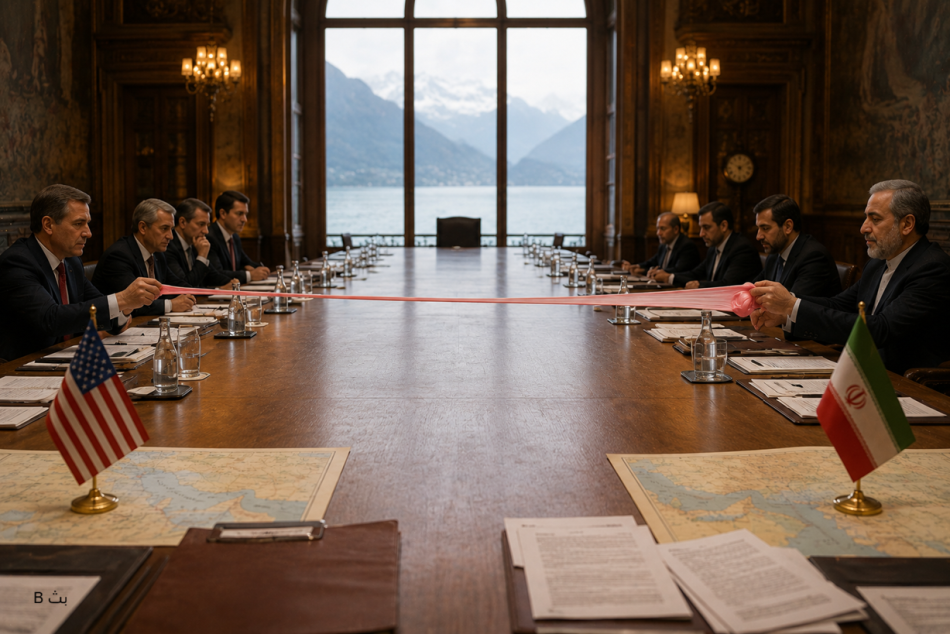
Progress Advances… While Resolution Is Delayed
Prepared and Analyzed by
Strategic Media Department – BETH | B
Supervised by Abdullah Al-Omairah
After 112 days of war, the United States and Iran appear to have achieved enough to avoid collapse—but not enough to reach the finish line.
The 18-hour negotiations in Bürgenstock, Switzerland, ended with optimistic statements from Washington, a brief message from Tehran, and the departure of the Iranian delegation back to Iran, while technical teams remained in Switzerland.
That alone reveals the nature of the current phase:
Politicians return to their capitals.
The real details are left to the experts.
What Did the First Round Achieve?
According to U.S. Vice President J.D. Vance, progress was made on the nuclear file, and technical foundations were established for a security agreement, with technical discussions set to continue in the coming weeks.
He also announced that Iran had agreed to receive inspectors from the International Atomic Energy Agency, that the Strait of Hormuz remains open, and that progress had been made toward a final agreement.
Meanwhile, the mediators—Qatar, Pakistan, and Switzerland—announced a 60-day roadmap, along with a mechanism aimed at ending hostilities in Lebanon and a communication channel to help ensure safe commercial navigation through the Strait of Hormuz.
Why Do the Negotiations Seem “Stretched”?
Because none of the parties wants failure.
But neither do they want a rushed conclusion.
Washington wants a durable agreement, not a quick deal that collapses weeks later.
Iran wants relief from pressure, but without appearing to have made major concessions.
And the mediators understand that success is measured not by the speed of signing, but by the durability of the outcome.
Why Did Qalibaf Return?
The return of the Iranian delegation to Tehran, while technical discussions continue, suggests that major political issues require internal consultations.
Decision-making in Iran does not rest solely with the negotiating team.
It passes through a complex network of institutions and calculations involving the state, the Revolutionary Guard, the Supreme Leader, and various political circles.
Some negotiations do not end inside the room.
They begin afterward.
Why Does Washington Appear More Comfortable?
Because it believes time is working in its favor.
Inspectors are returning.
Talks are continuing.
Hormuz remains open.
And tensions in Lebanon are moving toward de-escalation.
From Washington’s perspective, delaying an agreement is preferable to watching it collapse.
The Stretched Negotiations
Prolonging the process may not be a sign of failure.
It may be deliberate.
The more detailed the issues become, the greater the need for time.
And the closer the negotiations move toward sensitive files, the greater the need for gradualism and careful pacing.
What is taking shape may not be a rapid peace.
But a slow peace.
Day 112
After a long night of negotiations, the question is no longer:
Did the round succeed?
But rather:
Have the negotiations entered a new phase?
The most likely answer is:
Yes.
The talks have moved from preventing an explosion…
To managing the details.
But as diplomats often say, details are where the landmines are hidden.
And so, the coming days may not bring dramatic surprises.
Instead, they may bring something quieter—and more difficult:
The Stretched Negotiations.
Some wars end with a single blow.
But some agreements…
Are born slowly.
Statement
The mediators, Qatar and Pakistan, announced the conclusion of the first round of U.S.-Iran talks in Bürgenstock, Switzerland, confirming that “constructive progress” had been achieved and that a roadmap had been agreed upon with the aim of reaching a final agreement within 60 days.
The joint statement included:
- Agreement to establish a high-level committee to oversee the political dimension of the negotiations.
- Creation of specialized working groups for the nuclear file, sanctions, and dispute-resolution mechanisms.
- Continuation of technical talks throughout the week in Bürgenstock.
- Establishment of a communication channel to ensure the security of commercial navigation in the Strait of Hormuz.
- Agreement on a special mechanism to monitor the cessation of military operations in Lebanon, with Lebanon participating and the mediators facilitating the process.
- Reaffirmation of Washington and Tehran’s commitment to pursuing diplomatic and peaceful solutions.
BETH Analysis | B
The statement does not reveal a final agreement as much as it reveals an agreement on the mechanism for searching for one.
The first round did not end the differences, but it succeeded in preventing a collapse and moved the file from the stage of escalation and confrontation to that of committees, technical teams, and detailed discussions.
In other words:
The agreement has not been born yet, but the parties have agreed on how to search for it.
Therefore, what is taking place now appears closer to engineering a long road than approaching the finish line.
Trump’s Warning Messages
At the same time that the mediators announced progress in the U.S.-Iran negotiations, posts by U.S. President Donald Trump on Truth Social triggered reactions in Tehran after he renewed his warning against any return to escalation, stressing that the United States would respond “with greater force” if navigation through the Strait of Hormuz were threatened, or if Iran’s allies continued their activities in Lebanon.
Trump’s remarks came while the talks in Switzerland were making progress, prompting some observers to question the contrast between the president’s threatening rhetoric and the calmer tone adopted by the negotiating team led by Vice President J.D. Vance.
BETH Analysis | B
Trump’s messages do not appear aimed at undermining the negotiations as much as they are intended to remind the Iranians that dialogue does not mean the absence of pressure tools.
In the American school of statecraft, diplomacy and deterrence often move together.
Thus, while Trump’s posts may sound loud and confrontational, technical teams continue quietly to build the details.
In other words:
While experts negotiate inside the rooms, Trump continues negotiating in his own way outside them.