



The War We Do Not See
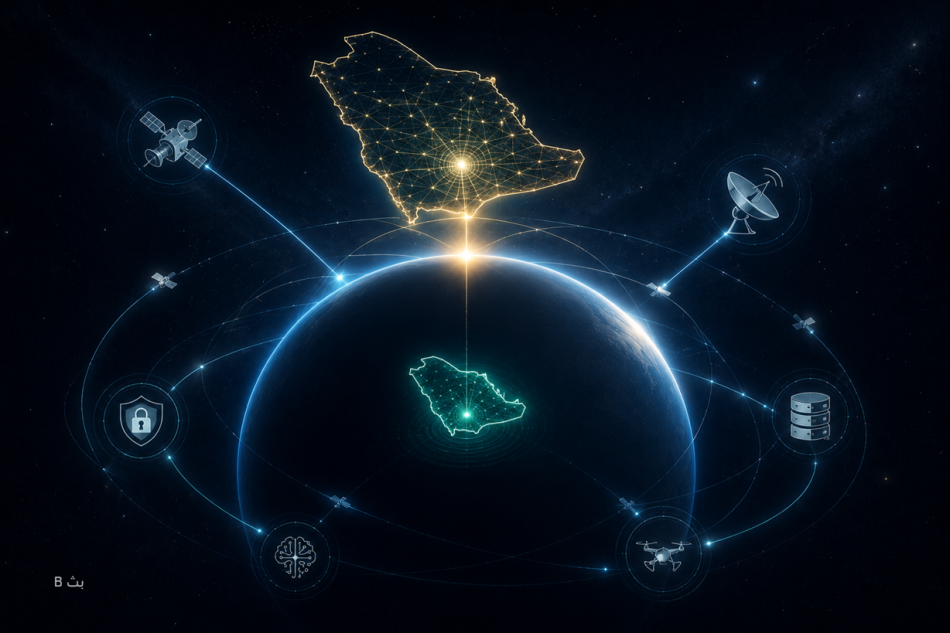
From Earth to Space… Where Does Saudi Arabia Stand in the Equation?
Prepared and Analyzed by
Strategic Media Department – BETH | B
Supervised by Abdullah Al-Omairah
In the wars of the past, the world watched armies move across the ground.
In modern warfare, attention shifted to aircraft, missiles, and naval fleets.
Today, however, there is another kind of war—one that many people cannot see.
A war that begins on Earth but does not end at the edge of the sky.
Space is no longer merely a scientific field or a symbol of imagination and progress.
It has become part of the equation of power, security, deterrence, and economics.
Why Has Space Become a Battlefield?
Because modern armies do not move alone.
They move with satellites.
Communications systems.
Data.
Images.
Navigation systems.
Artificial intelligence.
Drones.
And precision-guided missiles.
Those who can see from above, control communications, and analyze data can know more, move faster, and strike with greater precision.
That is why disabling a satellite, disrupting communications, or interfering with navigation systems may today be more dangerous than destroying a tank.
War Is No Longer Limited to the Battlefield
Modern wars do not always begin with gunfire.
They may begin with jamming.
Cyber intrusions.
Data disruption.
Communication outages.
Image manipulation.
Or navigation interference.
As a result, armies no longer fight only on land, at sea, and in the air.
They also fight in space.
Cyberspace.
Data.
And algorithms.
Cybersecurity: The Invisible Line of Defense
In modern warfare, missiles and aircraft alone are no longer enough.
Attacks may begin from a computer screen, malicious code, the penetration of critical networks, or the disruption of systems controlling energy, communications, and essential infrastructure.
That is why cybersecurity has become an integral component of national security and one of the arenas of power invisible to the naked eye.
In this context, Saudi Arabia has ranked first globally in the Global Cybersecurity Index for the third consecutive year, an achievement that reflects the scale of investments, legislation, and national capabilities developed by the Kingdom in recent years.
In the war we do not see, protecting data and networks is no less important than protecting borders.
Security is no longer measured solely by the number of aircraft and missiles a country possesses, but also by its ability to secure its digital domain, protect its infrastructure, and maintain the flow of information and communications in a world where data itself has become part of the equation of power and deterrence.
As global competition shifts toward space, artificial intelligence, and digital systems, cybersecurity is emerging as one of the first lines of defense in the battle of the future.
Countries that lose control of their networks may find themselves losing wars that never began on the ground.
Where Does Saudi Arabia Stand?
Saudi Arabia is not entering this equation for the sake of symbolism or prestige.
It is doing so as part of a strategic transformation.
Riyadh understands that national power in the coming decades will not be measured solely by the size of armies, but by the ability to master technology, localize industries, protect data, and develop national talent.
That is why the Kingdom is advancing on several fronts.
In space, through the Saudi Space Agency and the Human Spaceflight Program, which launched its first mission in 2023 with Rayyanah Barnawi and Ali Al-Qarni aboard the International Space Station.
In defense manufacturing, through the goal of localizing more than 50 percent of military spending by 2030, a target pursued by Saudi Arabian Military Industries (SAMI) in building the Kingdom’s defense industrial base.
And in artificial intelligence and data, through the National Strategy for Data and AI, which seeks to maximize the role of data and AI in digital and economic transformation.
The Saudi Equation
The question is not:
Has Saudi Arabia reached space?
Rather:
Is Saudi Arabia building an ecosystem that makes it present in both the space and terrestrial equations?
Space without industry is not enough.
Industry without data is not enough.
Data without cybersecurity is not enough.
And security without national minds cannot endure.
That is where the importance of Saudi Arabia’s transformation lies.
The Kingdom is not seeking merely an image in space.
It is seeking a place in the next equation of power.
A New Definition of Power
In the twentieth century, great powers were defined by factories, ships, and aircraft.
In the twenty-first century, great powers will be defined by networks, satellites, data, artificial intelligence, and the ability to connect Earth with space.
With its geographic position, resources, technological investments, and industrial transformation, Saudi Arabia does not view space as a scientific luxury.
It sees it as part of its future security and future economy.
Those who protect energy must see farther.
Those who secure maritime routes must communicate faster.
Those who build defense industries require more precise data.
And those who seek advanced economies need space, technology, and artificial intelligence.
Conclusion
The war we do not see is not far away.
It is above us.
Around us.
Inside our devices.
Within our data.
And among the satellites that observe, connect, guide, and analyze.
Therefore, the question is no longer:
Who possesses the weapons?
But rather:
Who possesses the system that enables weapons to see, communicate, and think?
And here Saudi Arabia is moving toward a larger equation:
To be a power on Earth.
Present in space.
And capable of protecting the future before it arrives.
For the war we do not see is not a war in the traditional sense.
It is a long race toward science, technology, and stability.
And in that race, victory may not belong to those who possess the strongest weapons—
But to those who possess the farthest vision.