



Negotiation Scenario
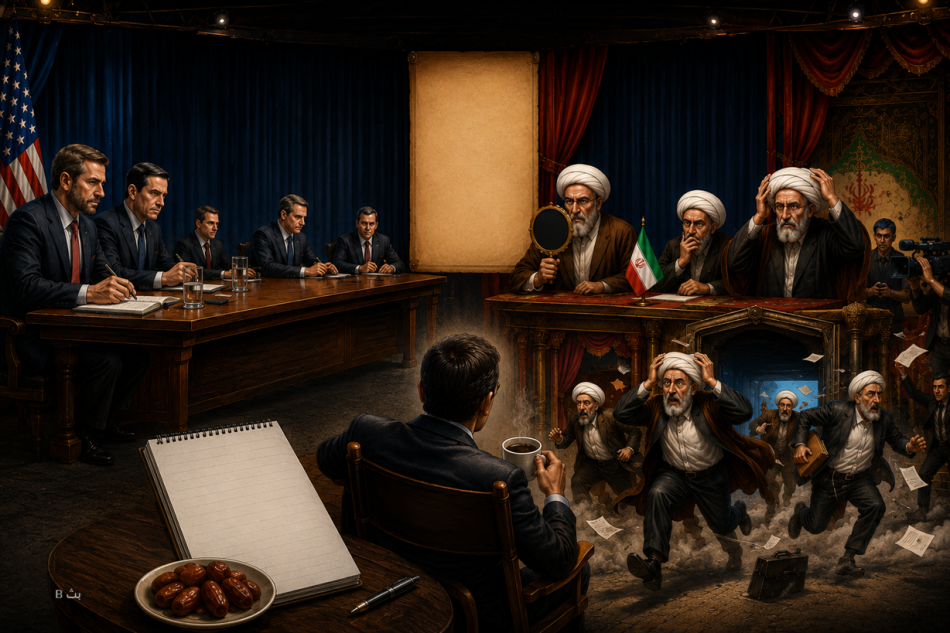
The following image is neither a leak from inside the Swiss fortress nor an official record of what is taking place behind closed doors.
Rather, it is a satirical attempt to read the future and anticipate what may happen, based on the behavior of the parties, the nature of their rhetoric, and the long-standing relationship between the state and the revolution, and between politics and slogans.
Perhaps this scenario is the closest to reality.
And if events unfold differently, then let the image remain nothing more than a satirical cartoon.
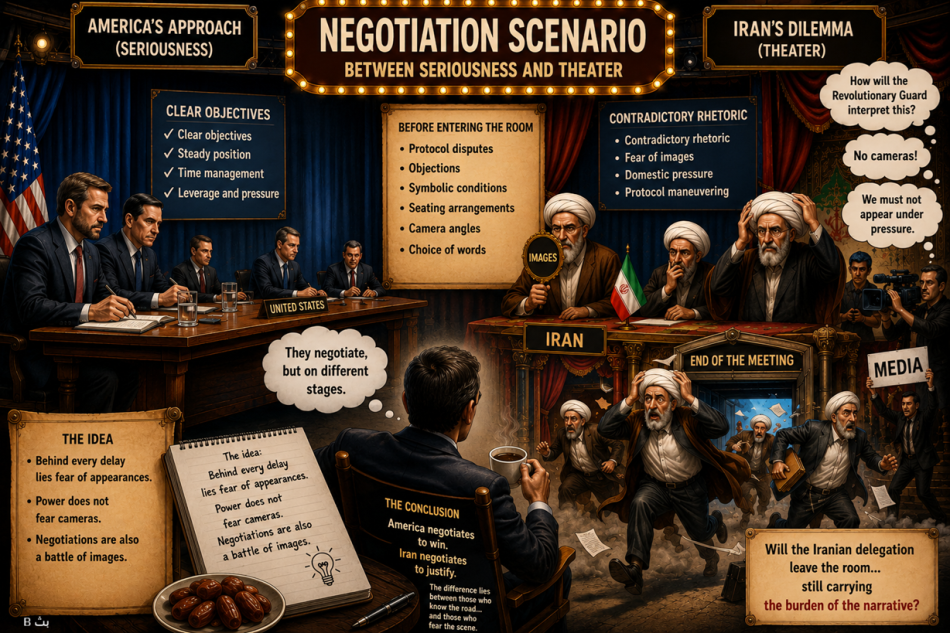
Who Will Enter the Room .. and Who Will Enter History?
Prepared and Analyzed by
Strategic Media Department – BETH | B
Supervised by Abdullah Al-Omairah
In conventional wars, the question is:
Who possesses the missiles?
But in wars of negotiation, the question is different:
Who possesses the ability to adapt to reality?
These negotiations are not merely about uranium or sanctions.
They revolve around a much larger question:
Who has the courage to move from the language of revolution to the logic of the state?
America Negotiates from a Position of Strength
Washington does not view sitting at the table as a concession.
It views it as an extension of power.
Interests are the objective.
Methods may change.
That is why America does not fear cameras.
Nor does it regard agreements as defeat.
The Iranian Dilemma
The issue is not negotiation itself.
It is the narrative upon which the regime's legitimacy was built.
Every image, every compromise, and every agreement requires justification before the domestic audience, the Revolutionary Guard, and generations raised on the language of revolution and confrontation.
And here lies the dilemma:
How do you secure the benefits of an agreement…
without appearing to have retreated?
Why Might Delay Be Part of the Scenario?
For some factions, time is not an enemy.
It is a tool.
That is why we may witness:
- Protocol disputes.
- Refusal of joint photographs.
- Tough rhetoric.
- Revolutionary language in the media.
- Greater flexibility behind closed doors.
Between Washington's Anvil and Tehran's Hammer
Some Iranian negotiators appear to be sitting not only across from the American delegation, but also between the anvil of American pressure and the hammer of internal calculations imposed by the clerical establishment and the Revolutionary Guard.
Expanding the talks and bringing in additional mediators may add political momentum.
But it may also increase complexity.
Because more players do not necessarily mean that a solution is closer.
Conclusion
Perhaps the Iranian delegation will not leave the room running while gathering their turbans.
And perhaps that image will remain merely a humorous scene.
But what is certain is that some wars end when everyone realizes that slogans alone are not enough.
And that states are not governed by proclaimed dignity alone.
But by interests.
By economics.
And by the ability to adapt.
Therefore, the real question is not:
Who will win this round?
But rather:
Who will enter the future with the mindset of a state… and who will remain the guardian of yesterday's narrative?
The Plate of Dates
What Was It Doing at the Negotiating Table?
Dates may have no direct connection to negotiations.
But some ideas do not emerge from behind closed doors.
They emerge from a cup of coffee…
A plate of dates…
And a man who watches the world…
And smiles.