


Day 111 🇺🇸⚔️🇮🇷 .. The War of Negotiations
Between U.S.-Iranian secrecy and Hormuz messages… who is driving the game?
Prepared and Analyzed by
Strategic Media Department – BETH | B
Supervised by Abdullah Al-Omairah
After 111 days of war, battles are no longer fought only with missiles.
The new front has become the negotiating table.
But these are not quiet negotiations. They represent another kind of war, where secrecy mixes with military signaling, and diplomacy blends with pressure and displays of power.
Why all this secrecy?
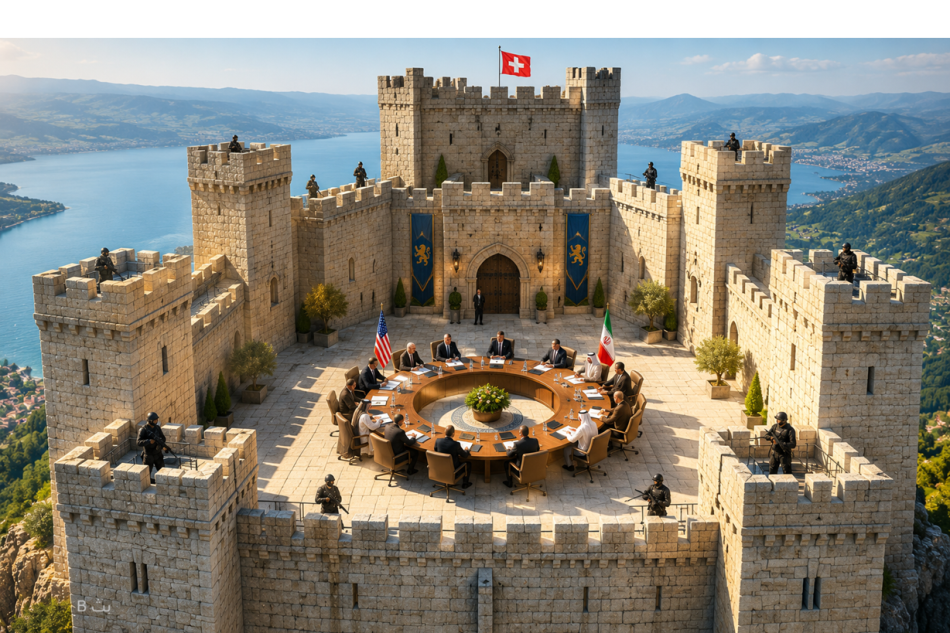
Although the broad framework of the U.S.-Iran memorandum is known, Swiss authorities have emphasized strict confidentiality.
The reason is not merely security.
Secrecy itself is part of the negotiations.
General principles can be made public.
But sensitive details—such as:
- Uranium enrichment levels.
- Verification mechanisms.
- The role of regional proxies.
- American guarantees.
- Israeli red lines.
- Sanctions and how they might be lifted.
These issues require confidentiality to prevent every sentence from becoming a political or media battle.
Therefore, secrecy does not necessarily imply hidden agreements. Rather, it reflects the sensitivity of this stage and the desire to shield negotiations from external pressure before final understandings are reached.
Why are Vance and Qalibaf leading the talks?
The presence of J.D. Vance and Mohammad Bagher Qalibaf carries important implications.
They do not merely represent traditional diplomacy.
They represent political and security decision-making circles.
This suggests that negotiations have moved beyond exploratory contacts and entered a phase focused on larger and more sensitive arrangements.
Why did the Revolutionary Guard announce the closure of Hormuz?
The Revolutionary Guard's declaration regarding the Strait of Hormuz, coinciding with Israeli strikes in Lebanon, was less a legal announcement than a political message.
Iran's message was clear:
If our interests or our regional assets come under severe pressure, we possess tools capable of threatening the global economy.
But the American response was swift:
Iran does not control the Strait.
Navigation continues.
Oil flows uninterrupted.
And U.S. forces remain committed to enforcing the agreement.
What does the American response mean?
Washington's response carried three messages:
First:
Rejecting any notion that Iran can impose a new reality in Hormuz.
Second:
Reassuring global markets and preventing panic in energy markets.
Third:
Reaffirming that the United States still holds the keys to maritime security in the Gulf.
In other words:
The Revolutionary Guard said:
"We can escalate."
Washington replied:
"And we can prevent it."
Has the war of negotiations begun?
Yes.
What is happening today is neither full peace nor all-out war.
It is a war of negotiations.
Each side is trying to improve its position before a final agreement emerges.
Iran is using:
- Regional influence.
- Proxy networks.
- Hormuz.
- Time.
The United States is using:
- Sanctions.
- Military power.
- Economic leverage.
- Political pressure.
Israel is using:
- Active fronts.
- Preventive strikes.
- Pressure on Washington.
Meanwhile, the Gulf states are seeking to preserve stability and prevent old threats from returning under the cover of a new agreement.
Are we witnessing an internal Iranian struggle?
Possibly.
Statements by the Revolutionary Guard may also reflect an internal battle.
While the Iranian state negotiates, the military establishment does not want to appear as if it has abandoned the language of strength.
Some statements may therefore be aimed more at domestic audiences than at foreign ones.
Day 111 Reflection
After 111 days…
The war is no longer confined to the battlefield.
It has moved to the negotiating table.
The guns may fall silent.
But the struggle over the terms of peace…
May prove even fiercer than the war itself.
And so the real question is no longer:
Will the negotiations succeed?
But rather:
Who will succeed in imposing their own definition of peace?
Because some wars end with agreements.
But some agreements…
Become the beginning of new wars.
Before the Meeting Begins
Why Is the Iranian Delegation Afraid of Cameras?
As Switzerland prepares to host a new round of U.S.-Iran negotiations, political maneuvering continues to accompany the process.
Reports indicate that the Iranian delegation refused to enter the meeting hall before the media had left and insisted on avoiding any photographs with the American delegation—a move that may appear minor on the surface, but carries deeper implications.
What Is the Iranian Delegation Afraid Of?
Most likely, the issue is not the cameras themselves.
Iranian politics has long been accustomed to dealing with the media.
The issue is the image.
Because, in politics, an image is not merely an image.
It is a message.
Inside Iran, some circles do not want to appear as the side that came to Switzerland seeking an agreement at any cost, or as the side that sat down under American pressure.
Such images could be interpreted domestically as concessions.
Within the Revolutionary Guard, they could be viewed as signs of weakness.
And so, cameras themselves become part of the battle.
What Are the Iranians Thinking About?
Tehran is most likely focused on three things.
First:
Preserving the image of supposed strength before the domestic audience.
The Iranian regime does not want to appear as though it has suddenly shifted from the language of confrontation to the language of negotiation.
Second:
Maintaining the balance between the Iranian state and the Revolutionary Guard.
Iranian negotiators know that every image and every statement may be subject to sensitive interpretations at home.
Third:
Securing the greatest possible gains without appearing as the side seeking salvation.
Why Is Washington Not Afraid of Cameras?
Because the United States views the image differently.
Washington wants to present itself as the side taking the initiative.
It sees sitting at the table not as a concession, but as part of managing power.
In Iran, however, images are subject to far more complicated calculations because politics is intertwined with ideology, the state with military institutions, and external affairs with domestic considerations.
Is It Merely Protocol?
Perhaps.
But small details often reveal larger contradictions.
A side confident in its image does not worry much about camera lenses.
A side fighting an internal battle alongside an external one calculates even the angle of the camera.
Before the Negotiations Begin
The battle over image has already begun.
And before the two sides negotiate the terms,
they have begun negotiating the scene itself.
Why Do Some Circles Within the Iranian Regime Feel That Negotiations Mean Submission, While Americans See Them as Part of Managing Power and Advancing Interests?
The difference does not lie in the table itself.
It lies in political culture.
The United States has built much of its influence through negotiations, deal-making, and the management of interests.
The Iranian regime, by contrast, has built much of its legitimacy on the language of revolution, confrontation, and resistance, causing some factions to view negotiations as a concession that must be justified rather than as a normal instrument of statecraft.
Thus, Washington enters negotiations viewing them as an extension of power.
While some circles in Iran enter them fearing that they may be interpreted as an admission of weakness.
And so, the most difficult battle may not be over the terms themselves,
but over image,
identity,
and narrative.