



Day 110 🇺🇸⚔️🇮🇷 | Has the Document Succeeded?
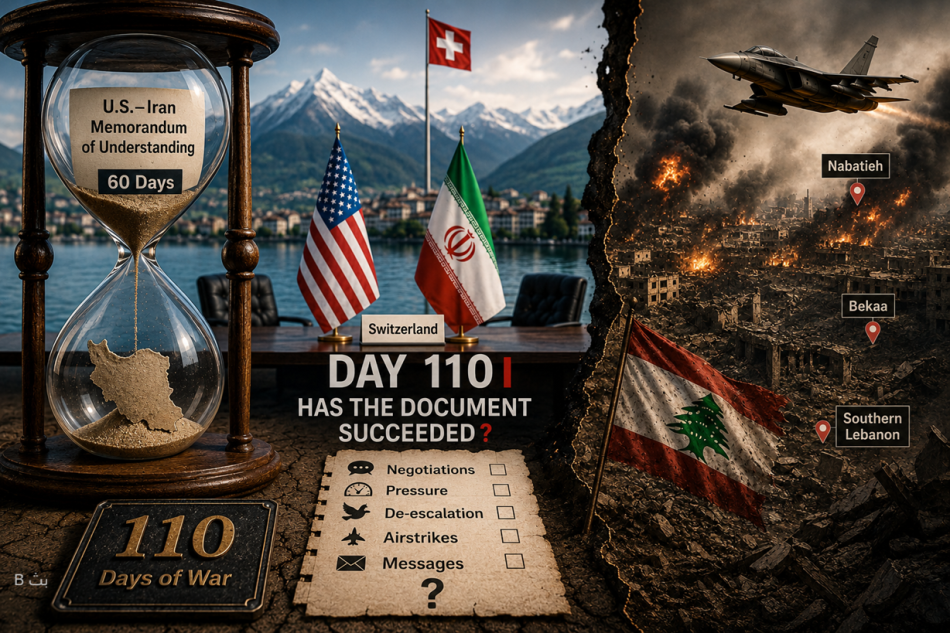
Between Trump’s Optimism and Lebanon’s Fires… The Memorandum Faces Its Test
Prepared and Analyzed by
Strategic Media Department – BETH | B
Supervised by Abdullah Al-Omairah
After 110 days of war, the question is no longer:
Was the Memorandum of Understanding signed?
That chapter is over.
The real question now is:
Has the memorandum begun to succeed?
So far, the answer appears far more complicated.
Trump… Optimistic
U.S. President Donald Trump expressed confidence that all outstanding issues could be resolved within sixty days, emphasizing that there would be no need to resume military operations if negotiations succeed.
At the same time, however, he kept the pressure option on the table, warning that failure would lead to measures “that the Iranians will not like.”
In other words, the stick still stands beside the document.
Switzerland… Delayed, Not Canceled
Despite the uncertainty surrounding the technical talks between Washington and Tehran, diplomatic efforts have not stopped.
The visit of Pakistan’s interior minister to Tehran, along with reports that Iranian Foreign Minister Abbas Araghchi may travel to Switzerland, indicate that channels of communication remain open and that postponement does not mean collapse.
Both sides understand that the cost of returning to war may be greater than the cost of negotiation.
Lebanon… The Front That Refuses Calm
Southern Lebanon presents a different picture.
Only hours after the ceasefire between Israel and Hezbollah was announced, Israeli airstrikes resumed over Nabatieh and the Bekaa region, leaving casualties, including a Lebanese soldier.
Here lies one of the most complex challenges of the post-war phase:
Agreements are signed by states.
But fires often continue to burn on secondary fronts.
Therefore, the success of the U.S.-Iran memorandum cannot be measured solely by what happens in Switzerland.
It must also be measured by developments in Lebanon, Iraq, and the Gulf.
Has the Document Succeeded?
It is too early to speak of success.
And it is equally too early to speak of failure.
What is certain, however, is that the document has entered its real test.
The most difficult phase does not begin with the signing.
It begins afterward.
When broad principles meet practical details.
And when political intentions collide with realities on the ground.
Further Analysis
Washington and Tehran appear to be managing the conflict more than ending it.
Israel appears to be managing the fronts more than closing them.
Regional proxies are seeking to preserve their cards rather than surrender them.
As a result, the region does not seem to be heading toward complete peace.
Nor toward full-scale war.
Instead, it appears to be entering a long intermediate phase, where:
Negotiations…
Pressure…
De-escalation…
Limited strikes…
And exchanged messages…
all coexist.
Day 110 Reflection
After 110 days,
the issue is no longer the signing of the document.
The real challenge is whether it can withstand the fires still burning around it.
States have signed.
But the battlefield is still testing intentions.
And so…
the count continues.
Day 110.