



World Cup .. When Spirit Triumphs Over Stars
Why Genius Alone Is Not Enough
Prepared and Analyzed by
Strategic Media Department – BETH | B
Supervised by Abdullah Al-Omairah
In the World Cup, no player wins alone.
A star may score a decisive goal or change the course of a match, but he cannot carry an entire national team to the finish line unless there is a system behind him that believes in the team before the individual.
This raises the bigger question:
What makes one national team look like a family, while another appears to be merely a group of players torn apart by jealousy and sensitivities, each pursuing his own interests more than the team's?
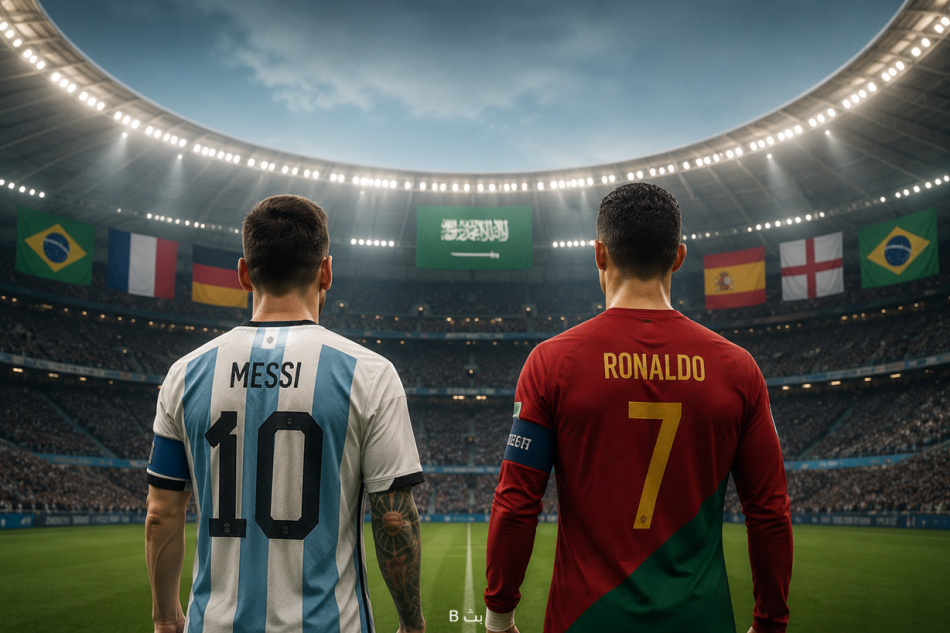
Messi .. When the Star Became Part of the Collective
Lionel Messi succeeded with Argentina because the team never became "Messi's team"; it remained Argentina.
Messi was the leader and symbol, but the rest of the players never felt they were merely assistants.
They fought with him, not simply for him.
That is where the brilliance lies.
The Argentine team did not make the star bigger than the group; it made the group stronger because of the star.
Thus emerged spirit, harmony, and the willingness to sacrifice.
Ronaldo and Portugal .. When Team Spirit Declines
Cristiano Ronaldo is one of the greatest players in history.
But the issue was never his talent.
The more difficult question was:
Was Portugal playing like one family?
Or as a group of stars, each with his own calculations?
Talent alone is not enough.
Great national teams do not lose only because of a lack of skill.
They lose because of inflated egos, sensitivities, jealousy, cliques, and hidden battles for stardom.
Eventually, any crack inside the dressing room becomes a crack on the pitch.
Salah and Liverpool .. The System Before the Star
Mohamed Salah did not change between Liverpool and the Egyptian national team.
The environment changed.
At Liverpool, he found a stable structure, clear roles, a collective culture, and a coach who knew how to unite everyone toward a common goal.
With the national team, circumstances are different.
This confirms an important truth:
Stars do not create systems.
Systems allow stars to shine.
Real Madrid .. The Dressing Room Is More Dangerous Than the Pitch
In recent years, Real Madrid's problem has not been a lack of talent.
The stars are there.
The resources are there.
But the core problem has increasingly become the dressing room.
A player seeks money.
Then achieves wealth.
Then pursues personal glory.
Competition becomes internal rivalry.
Rivalry becomes jealousy.
Jealousy becomes fragmentation.
And defeat begins before the match itself.
That is why turning to a strong and disciplined figure such as Portuguese coach José Mourinho would not primarily be about solving tactical issues, but about rebuilding team spirit and placing the club above individual interests.
Many major clubs resort to strong personalities in such circumstances—not only to solve tactical problems, but also to rebuild unity, eliminate excessive selfishness, and place the club above names and stars.
Great coaches do not organize lines alone.
They reorganize minds and souls as well.
Europe, Asia and Africa… The Difference Is Not Talent
Many national teams in Asia, Africa, and the Arab world do not suffer from a lack of talent.
They suffer from the absence of a system.
Europe enjoys:
Stability.
Clear roles.
Discipline.
Team culture.
And placing the national team above clubs and individuals.
In many other environments, however, there are:
Personal relationships.
Sensitivities.
Administrative weakness.
Club influence.
Destructive fanaticism.
Cliques.
And the pursuit of individual glory.
As a result, unity disappears.
And so do results.
Naturalization and Professionalism… Tools Alone Are Not Enough
National teams cannot succeed simply through naturalization.
Naturalization itself is not the problem.
But it requires wise selection, a clear football vision, and a national identity capable of integrating players into one project.
Money alone does not create success.
Success comes from management, structure, and instilling loyalty to the shirt before names.
Playing abroad also plays a major role in developing players and exposing the true differences between them.
Some players appear as stars in domestic leagues, only to discover that football at higher competitive levels demands more than talent.
It requires mental speed, discipline, and collective work.
More important than naturalization and professionalism, however, is developing the system itself and broadening the national horizon, so that the national team becomes a common project rather than merely a gathering of players.
Success does not come from changing names alone.
It comes from changing the culture governing the team.
Sports Media… Manufacturing Illusions or Building Awareness?
The problem does not stop with players, coaches, or administrators.
Sports media itself is part of the system.
When competition turns into fanaticism, when journalism becomes club propaganda, and when fans become rival tribes, it becomes easy to create illusions larger than reality.
Some local media label players as "legends," only for international tournaments to reveal the gap between image and reality.
The problem is not always with the player.
It is often with the system that exaggerated his image.
Sports media is not merely a carrier of matches.
It is a creator of sporting culture.
Therefore, reforming media discourse and freeing it from fanaticism is as important as academies and coaching development.
If you want to know the level of journalism in a country, look at its sports journalism.
If you want to know the level of minds, look at how people deal with sports.
And if you want to know the level of systems, observe their behavior and results when tested on the international stage.
Sport is not merely a game.
It is a mirror of awareness, discipline, tolerance, and one of the faces of a nation's soft power.
Football reveals not only sporting systems, but many other systems as well.
Saudi Arabia… Returning to the Spirit of 1984
Saudi Arabia does not lack talent.
Like many national teams, however, it constantly needs to recalibrate its compass.
Great teams are built not only on talent.
But on spirit.
In Saudi memory, the 1984 generation remains unique.
Players belonged to different clubs.
But once they wore the green jersey, their primary loyalty became the national team.
The nation was greater than the club.
The team brought together the best players from various clubs, yet the green shirt united them.
Saudi Arabia came before all other affiliations.
The collective came before the individual.
Therefore, any new project for the Saudi national team requires more than technical preparation.
It requires a mental reset that restores one principle:
Saudi Arabia First.
The World Cup Reveals More Than Skills
The World Cup does not reveal only the quality of players.
It reveals something deeper.
It reveals personalities.
Relationships.
And the willingness of each player to sacrifice for the other.
Many championships are not lost because of a lack of talent.
But because of an excess of ego.
Conclusion
Messi did not shine merely because he was Argentina's best player.
He shone because Argentina defeated individualism and transformed stars into a collective.
Ronaldo's influence has not diminished.
But even the greatest players cannot build a team alone.
If Portugal's relative decline can be explained, it has less to do with Ronaldo and more with slow collective performance, weakened team spirit, and poor management of critical moments on and off the field.
National teams do not always lose because of a lack of talent.
Sometimes, they lose because of an excess of individualism.
Ultimately, the World Cup does not crown the biggest names.
It crowns the teams capable of turning eleven players into one heart.
Stars may win matches.
But collective spirit creates champions.
Sports history does not always remember the most talented teams.
It remembers the teams that turned stars into a family.
Because, in the end, the World Cup is played with feet…
But it is decided by hearts.