
Between Versailles and Tehran… Messages
Does the Place of Signing Carry Political Messages?
Prepared and Analyzed by
Strategic Media Department – BETH | B
Supervised by Abdullah Al-Omairah
When major agreements are signed, words are not the only message.
The place is also a message.
The image is a message.
The background is a message.
And sometimes, the details surrounding the paper are no less important than the paper itself.
In the U.S.-Iran memorandum of understanding, the scene seemed to tell two different stories.
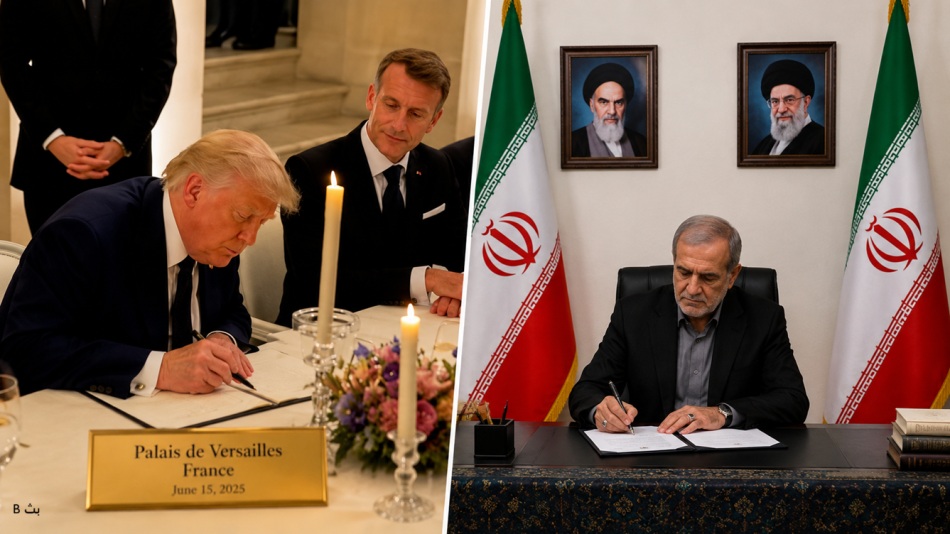
U.S. President Donald Trump chose to sign from France.
Meanwhile, Iranian President Masoud Pezeshkian signed from his office in Tehran, surrounded by two Iranian flags, with portraits of the leaders of the system hanging above him.
Was that merely a procedural detail?
Or did each image carry its own message?
Why France?
The choice of the Palace of Versailles may simply have been a procedural matter linked to the U.S. presidential visit schedule.
It may also have reflected the international nature of the memorandum.
But historical memory finds it difficult to ignore that France was also the last stop from which the founder of the current Iranian system departed for Tehran on February 1, 1979, after residing in the Yvelines region, from where a new chapter in the history of Iran and the region began.
It is also striking that the memorandum was signed from France, and from roughly the same region associated with the beginning of the current Iranian system.
Is this merely a geographical coincidence?
Or does history sometimes enjoy rearranging its scenes in ways that are not devoid of symbolism?
What Did Pezeshkian Want to Say?
In contrast, the Iranian president did not appear in a neutral venue.
He appeared in his office, surrounded by two Iranian flags, with portraits of the leaders of the system above him.
Was the message directed toward the Iranian domestic audience?
Did he seek to emphasize that the signing represented not merely a president or a government, but the system itself?
Or is the scene simply the standard setting of Iranian institutions?
What If the System Changes?
If agreements are concluded between states rather than regimes, do the meanings of such images change when regimes change?
Did Pezeshkian intend to link the agreement to the legitimacy of the current system?
Or do international documents remain greater than individuals, images, and symbols?
Politics Does Not Speak Through Words Alone
In politics, texts are not the only things that are read.
Images are read.
Places are read.
Symbols are read.
But danger begins when interpretation turns into certainty.
Good journalism does not live on doubt.
Nor does it seek to eliminate doubt.
Rather, it uses doubt to reach a better understanding.
The choice of France may simply be a coincidence.
And Pezeshkian’s background may be nothing more than a routine protocol setting.
But the question itself is legitimate.
In 1979, the founder of the current Iranian system departed from France to Tehran, beginning a new chapter in the history of the region.
Nearly half a century later, an American president chose to sign a memorandum of understanding with Iran from France as well, while the Iranian president made sure to appear before the world within the framework of the symbols upon which the system was founded.
It may be merely a coincidence.
Or it may be more than that.
But one thing is certain:
Politics does not move alone.
Memory moves with it.
And the question is not:
What was signed?
But rather:
Why did each side choose to be seen in the way it appeared?