



Labyrinth of Truth | Chapter Two
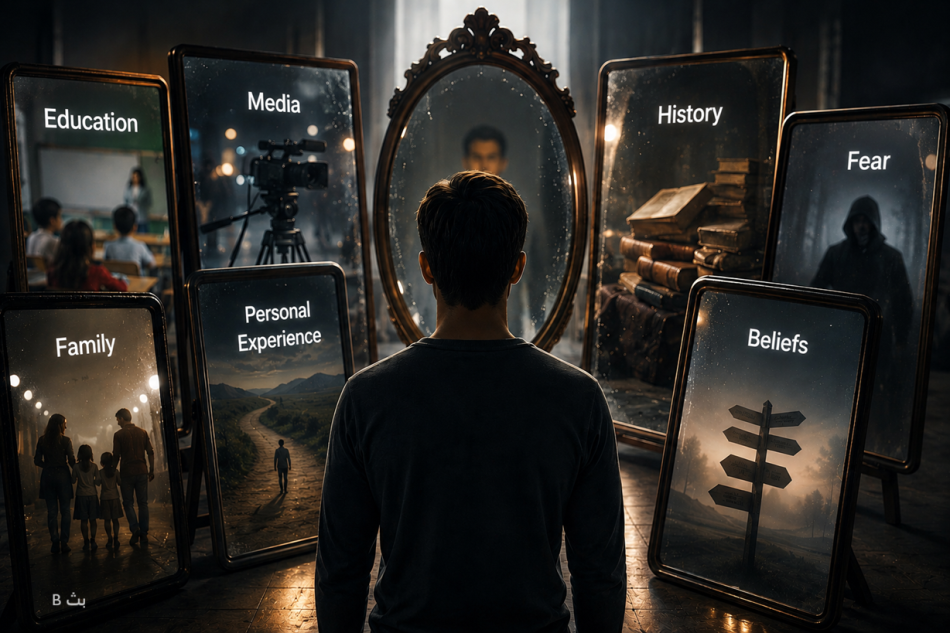
Who Placed the Mirror?
Prepared and Analyzed by
Strategic Media Department – BETH | B
Supervised by Abdullah Al-Omairah
When a person stands in front of a mirror, he believes he sees himself.
And that is true.
But not entirely.
A mirror does not lie.
Yet it shows only one angle.
It does not carry sound.
It cannot reveal what lies behind the face.
Nor can it tell us what is happening inside the mind.
And still...
We trust it.
And that is where the story begins.
For the question is not:
What do we see?
But rather:
Who placed the mirror in the first place?
Every society is surrounded by many mirrors.
Some are called:
Media.
Others:
Education.
Others:
History.
Others:
Family.
Others:
Personal experience.
And others:
Fear.
Each reflects something.
But none reflects everything.
That is why human beings do not live directly within reality.
They live within accumulated images of reality.
Images they have formed themselves.
Images they have inherited.
And images that were created for them without their noticing.
Imagine two children looking at the same scene.
One sees opportunity.
The other sees danger.
The scene has not changed.
But the mirror through which each sees it is different.
That is why the greatest battles in history have not always been fought over land.
They have often been fought over mirrors.
Who places them?
Who creates them?
And who determines the angle of reflection?
Politicians understand this.
Journalists understand this.
Advertisers understand this.
And so do those who manufacture rumors.
Human beings rarely act because of truth alone.
They act because of the image they hold of truth.
That is why people may fear what deserves no fear.
Trust what deserves caution.
Fight for ideas they have never examined.
Reject people they have never known.
And applaud decisions they have never understood.
Not because the mind is absent.
But because the mirror stood closer than the window.
And here comes a more disturbing question:
Do we see the world as it is?
Or as it is reflected by the mirrors surrounding us?
In Labyrinth of Truth...
We do not break mirrors.
Nor do we ask people to stop looking into them.
Mirrors are necessary.
But danger begins when we forget that they are mirrors.
And mistake them for the whole world.
The Second Truth
The problem is not that we view the world through a mirror.
The problem is forgetting that the mirror exists.
Labyrinth of Truth
It is not merely an attempt to explain the world around us...
But an attempt to understand how we see it.
In the second chapter, the question shifts to the instrument of perception itself:
If truth is seen through a mirror… who placed the mirror?
And so, Chapter Three — “The Compass” — becomes the natural way out of the labyrinth, rather than merely the conclusion of the series.