



LIGO: When Humanity Began Listening to the Universe
By Dr. Ahmad Shaalan, Representative of Lebanon to the International Astronomical Union
BETH | B
For centuries, humanity explored the universe through light. Telescopes observing visible light, radio waves, infrared radiation, X-rays, and gamma rays formed the foundation of modern astronomy. But a new chapter began when scientists succeeded in detecting gravitational waves, opening an entirely different way to understand the cosmos.
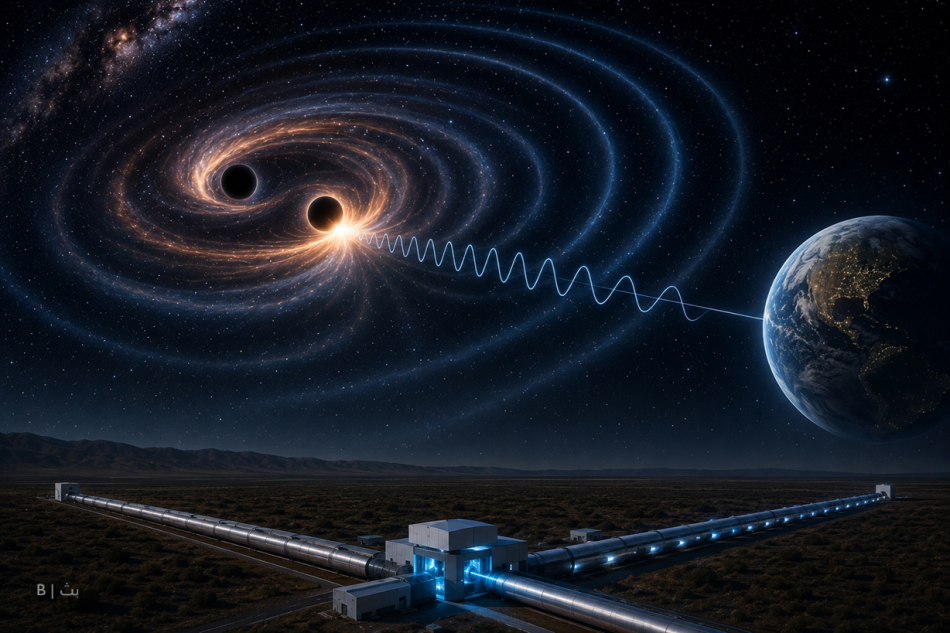
In this study, Dr. Ahmad Shaalan explains how the Laser Interferometer Gravitational-Wave Observatory (LIGO) made history by detecting gravitational waves for the first time in 2015. The signal originated from the merger of two black holes nearly 1.3 billion light-years away, confirming a prediction made by Albert Einstein a century earlier.
Unlike conventional telescopes, LIGO does not observe light. Instead, it detects tiny distortions in space-time caused by massive cosmic events. This achievement provided scientists with a new tool to study black holes, neutron stars, supernovae, and some of the most violent phenomena in the universe.
Researchers describe this discovery as the beginning of a new era in astronomy. If traditional telescopes allowed humanity to see the universe, gravitational-wave observatories have enabled it to listen to the echoes of cosmic events occurring billions of years ago.
The discovery also demonstrates how revolutionary scientific ideas can precede technology by decades. Einstein predicted gravitational waves in 1916, yet nearly a century passed before scientists acquired the instruments capable of detecting them.
As technology continues to advance, many researchers believe that future generations of gravitational-wave observatories will reveal even deeper secrets about the birth of the universe, the nature of black holes, and questions that science has yet to answer.
If humanity learned how to see the universe, and then learned how to listen to it… what will it learn next?
Source: Arab Thought Foundation – Article by Dr. Ahmad Shaalan, Representative of Lebanon to the International Astronomical Union | Edited and presented by BETH | B