



"AlUla Beacon" .. A New Saudi Window to the Universe
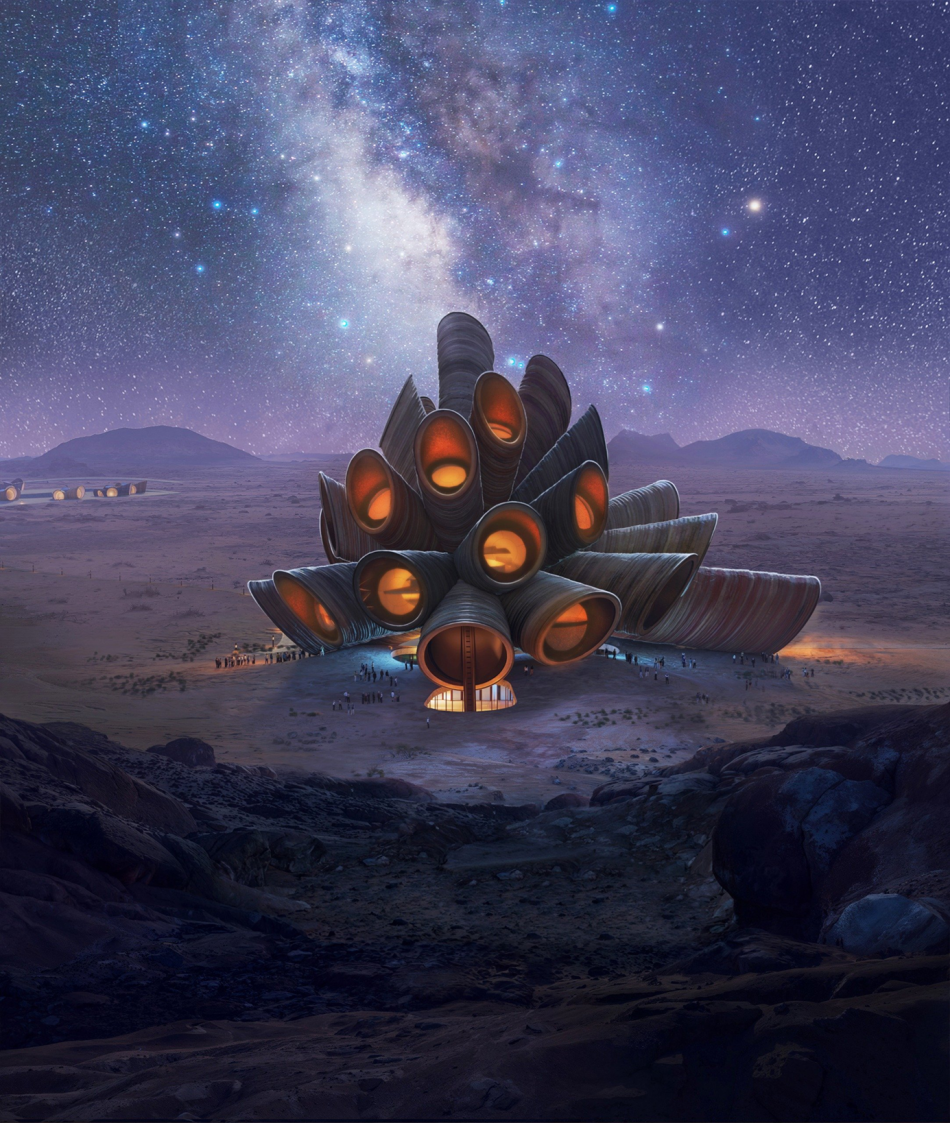
Advanced Observatory with Some of the World's Largest Telescopes
A Project Combining Scientific Research, Astro-Tourism, and Environmental Sustainability
AlUla | بث | B
The Board of Directors of the Royal Commission for AlUla has approved the design of "AlUla Beacon," an integrated project featuring an advanced astronomical observatory and a research and visitor center, creating a new scientific and cultural landmark aimed at promoting astronomical discoveries and sustainable tourism.
Located more than 70 kilometers north of AlUla, the site was selected for its exceptionally low light pollution and clear skies, between Harrat Uwayrid Reserve and Gharameel, making it an ideal environment for observing stars and celestial bodies.
The project includes a main telescope with a four-meter aperture, in addition to two telescopes with two-meter apertures, placing AlUla Beacon among the world's largest astronomical observatories. It will also feature observation platforms, interactive exhibitions, research facilities, and exhibition halls.
The Royal Commission for AlUla will work alongside the Saudi Space Agency, King Abdulaziz City for Science and Technology (KACST), and SETI Institute to develop the project into a hub for innovation, scientific research, and astro-tourism.
The design incorporates locally sourced sandstone and has been carefully adapted to the surrounding terrain and natural environment. It also includes strict outdoor lighting regulations to preserve dark skies, ecological balance, and wildlife habitats.
BETH Analysis
AlUla Beacon is more than a new astronomical observatory. It reflects an expansion in Saudi Arabia's development vision—from investing in the earth to investing in the sky.
Many countries possess observatories, but the global trend is increasingly focused on integrating scientific research, tourism, education, and environmental sustainability into a single ecosystem. This is precisely the model AlUla seeks to create.
The project also highlights a broader Saudi ambition to strengthen its presence in advanced sciences and space-related sectors while supporting the knowledge economy and diversifying tourism offerings.
Notably, the site's selection was based not only on its natural beauty, but also on scientific criteria related to light pollution and sky clarity, signaling a shift from building a traditional tourist attraction toward creating a fully integrated scientific environment.
At a time when nations are competing to explore space, AlUla Beacon seeks to connect history with the future. AlUla, once associated with stars and ancient caravan routes, is preparing to welcome scientists, researchers, and astronomy enthusiasts from around the world.
And the question raised by the project goes beyond AlUla itself:
Could Saudi Arabia become a more influential player in astronomy and space sciences in the years ahead, just as it has emerged as a major force in energy, tourism, and sports?