



Limits of Power
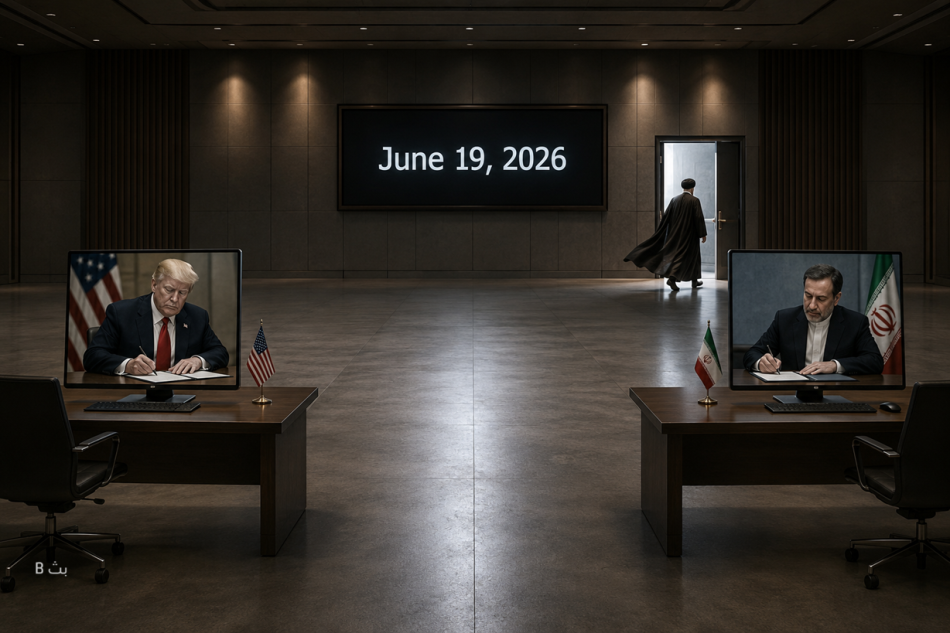
How Did the United States and Iran Stop a War Neither Side Could Decisively Win?
Prepared and Analyzed by | Strategic Media Department – BETH Agency
Supervision: Abdullah Al-Omairah
The U.S.-Iran agreement was not, at its core, a declaration of total victory by one side over the other.
Nor was it an Iranian surrender to Trump.
And it was not a complete American retreat before Tehran.
What emerged was something far more complex:
An agreement born from the limits of power, not from the presence of trust.
Trump did not obtain everything he had demanded at the beginning of the confrontation.
Iran, meanwhile, did not emerge as though it had imposed all of its conditions.
Both sides told their respective audiences that they had achieved enough.
Yet the deeper reality is that both reached a point where they realized that continuing the war could become more costly than signing a gray agreement.
Why Did Both Sides Agree Now?
This is the most important question.
Not:
Who won?
Nor:
Who lost?
But:
Why now?
Because the timing of an agreement often reveals more than its written provisions.
The United States concluded that the war could become prolonged and that military pressure alone could not guarantee the dismantling of every complex issue: the nuclear program, ballistic missiles, regional influence, and the behavior of the Iranian regime.
Iran, on the other hand, concluded that continued confrontation carried growing costs—economic, military, political, and potentially domestic.
It was at this point that the two sides met at the intersection of necessity.
Not because trust had emerged.
But because danger had grown.
What Did Trump Give Iran?
One question cannot be ignored:
What did Trump offer in order for Iran to agree?
It is clear that Washington did not secure a complete resolution of the most critical issues.
Iran's nuclear program was not definitively closed.
The fate of its stockpile of highly enriched uranium remains unresolved.
Ballistic missiles remain a deferred issue.
Regional influence has not been dismantled.
So what actually happened?
The most likely explanation is that Trump accepted postponing several major issues in exchange for ending the war and opening a new phase of negotiations.
This means the agreement was not a final settlement.
It was a transitional arrangement.
A transition from war to testing.
From confrontation to monitoring.
From fire to negotiations conducted under pressure.
What Did Iran Give Trump?
Iran did not give Trump everything he wanted.
But it did provide what he needed politically at this moment:
An agreement.
An end to the war.
The reopening of the Strait of Hormuz.
Calmer markets.
And the image of a president who stopped a war before it evolved into a prolonged and costly conflict.
These are not insignificant gains in American political calculations.
Especially when the war had already begun generating economic and domestic pressures.
Yet they do not amount to a complete victory, because the core dispute remains unresolved.
Has the Nuclear Crisis Ended?
No.
The nuclear crisis has not ended.
It has been postponed.
And there is a crucial difference between:
Stopping a war.
And:
Resolving the reasons for the war.
The current agreement succeeded in halting escalation.
But it has not yet proven capable of eliminating the roots of the crisis.
The nuclear issue, ballistic missiles, regional influence, and Iran's broader regional behavior all remain subject to future testing.
For this reason, the sixty days that follow may prove more important than the day of signing itself.
No Complete Victory, No Complete Defeat
It would be a mistake to interpret this agreement solely through the lens of victory and defeat.
Some wars do not end with a white flag.
They end when both sides conclude that the cost of victory exceeds the cost of compromise.
That appears to be what happened here.
Trump did not fully subdue Iran.
Iran did not break Trump's will.
Both stepped back from their maximum demands.
Both obtained enough to justify the agreement to their domestic audiences.
But both also entered a more difficult phase:
The phase of proving commitment.
The Gray Agreement
This agreement is gray because it offers no final answer.
It does not declare the crisis over.
Nor does it predict the return of war.
It neither fully opens the door to trust nor completely closes the door to doubt.
It stops the shooting, but it does not extinguish every source of future conflict.
It calms markets, but it does not reassure politics.
It creates an opportunity, but it guarantees nothing.
For that reason, the real question after signing will not be:
Was an agreement reached?
But:
Can the agreement survive?
BETH Assessment
What happened is not the end of the story.
It is the beginning of a new chapter.
If Iran demonstrates clear compliance, accepts meaningful verification mechanisms, and begins addressing the postponed issues through practical solutions, the gray agreement could evolve into a broader settlement.
If, however, ambiguity continues, interpretations diverge, and postponed issues return to deadlock, the agreement may become nothing more than a prolonged truce before another test.
The conclusion closest to reality is this:
Trump did not subdue Iran.
Iran did not defeat Trump.
Both discovered the limits of their power.
And from those limits, the agreement was born.
The war did not end because it was decisively won.
It stopped because continuing it became too costly for everyone involved.
And herein lies the truth that official statements rarely acknowledge:
The agreement was not born from trust.
It was born from fear of the alternative.
Why Didn't Trump Decisively End the Confrontation?
Many observers may ask:
How did Trump appear compelled to accept a gray agreement despite the overwhelming military superiority of the United States?
The answer is that the challenge was never the ability to strike.
It was the ability to control what would follow the strike.
The United States possesses overwhelming military power and was capable of inflicting significant damage on Iran.
But military power alone is insufficient when the objective is political and strategic rather than purely military.
War is not merely about firing weapons.
It is about managing what comes afterward.
And that is where the limits of American power became visible.
Trump could have escalated further.
But he could not guarantee that the conflict would not become a prolonged war of attrition, trigger major disruptions in global energy markets, spread through the Strait of Hormuz, Lebanon, and other regional fronts, or generate political and economic pressures inside the United States itself.
How Did Iran Dare to Resist?
Iran did not confront the United States because it was stronger.
It confronted Washington because it understood the limits of what Washington wanted.
Tehran recognized that the United States did not want an open-ended war with no clear conclusion.
As a result, Iran relied on three primary tools:
Time
Betting on prolonging negotiations and delaying decisive outcomes until circumstances changed.
Cost
Raising the price of confrontation through potential disruptions to energy markets, global trade, and maritime navigation.
Ambiguity
Keeping major issues unresolved, offering partial concessions, and postponing the most sensitive questions to later stages.
Power Is Not Always Measured by Weapons
Iran did not obtain some of what it wanted because it won militarily.
Nor did Trump move toward an agreement because he was defeated.
The more accurate reality is that each side exercised a different form of power.
Trump's power lay in the ability to strike.
Iran's power lay in the ability to complicate what followed the strike.
The United States possesses the world's strongest military.
But Iran has decades of experience turning confrontations into complex, prolonged, and politically costly struggles.
From that reality, the gray agreement emerged.
Not because either side achieved total victory.
But because both realized that complete victory could be more expensive than temporary compromise.
Perhaps this is one of the most important lessons revealed by the crisis:
In politics, power does not always belong to the side with the largest arsenal. Sometimes it belongs to the side that makes the use of that arsenal more costly and more complicated.
How Did the World Read the Gray Agreement?
Even before the formal signing, and before the full details became known, different audiences began interpreting the agreement through different lenses.
As a result, one agreement produced multiple narratives.
The American Public
Within the United States, reactions quickly diverged.
Trump's supporters viewed him as a leader who combined force with diplomacy and succeeded in ending the war without becoming trapped in a prolonged conflict.
His critics argued that several objectives announced at the outset remained unresolved and that the most sensitive issues had merely been postponed.
For some Americans, the agreement represents success.
For others, it is simply an untested truce.
The Iranian Public
The picture inside Iran is equally complex.
Supporters of the system argue that Tehran withstood immense pressure, preserved the regime, and avoided the surrender conditions once discussed at the start of the crisis.
Others believe that economic and military pressure forced Iran to accept an understanding it would not have considered only months earlier.
Yet many Iranians are less focused on political language than on practical results.
Europeans
Europe largely welcomed the agreement with relief.
The primary European concern was never which side won politically.
It was preventing another regional explosion and protecting the global economy and energy markets.
From this perspective, the agreement represents an opportunity to reduce tensions and return the issue to a diplomatic path.
Israel
Israel may be the most cautious observer of all.
In Tel Aviv, the central question is not whether the war has stopped.
It is whether the agreement will actually prevent Iran from advancing its nuclear and missile capabilities.
For that reason, Israel appears committed to a strategy of waiting and watching, while remaining skeptical about the unresolved issues.
The Gulf: A Different Calculation
In the Gulf states, the agreement is not judged primarily through the lens of political victory or defeat.
It is measured by the losses that can be avoided.
Disruptions to maritime trade, rising insurance and shipping costs, economic uncertainty, and direct security threats have made stability a priority that outweighs symbolic victories.
For this reason, Gulf capitals tend to view the agreement as an opportunity to reduce risks rather than as a triumph for either side.
The Arab World
Across the broader Arab world, perspectives vary according to geography and priorities.
Yet a common theme remains:
Support for any step that reduces the likelihood of war and escalation.
After decades of conflict, stability, development, and economic growth often rank above the logic of open confrontation.
The Rest of the World
For much of the world, the questions are simpler:
Will risks decline?
Will energy markets stabilize?
Will maritime traffic normalize?
Will the likelihood of military confrontation decrease?
For many countries, the success of the agreement is measured not by who won, but by whether it prevents another crisis capable of destabilizing the global economy.
Conclusion
At this stage, there is no single agreement in the eyes of the world.
There are multiple agreements.
Some see victory.
Others see compromise.
Still others see an opportunity to pause and breathe.
The final judgment has not yet been rendered.
The world rarely judges agreements on the day they are signed.
It judges them after they have been tested by time.
And perhaps the question being asked everywhere, in different forms, is this:
Has a viable peace been born? Or merely a truce awaiting its next test?
Perhaps this war did not reveal who was stronger.
Perhaps it revealed that power itself has limits.
And that the most dangerous moment in any conflict is not when the shooting begins.
It is when all sides realize that the cost of victory has become greater than the cost of stepping back.
So was this agreement the end of a war?
Or the first mutual acknowledgment of the limits of power?
Questions After the Agreement
Despite the announcement of the agreement, three key questions continue to be raised:
Did Washington and Tehran really need all this time to reach such an understanding?
Perhaps the challenge was not drafting the agreement itself, but reaching a point where both sides concluded that continuing the confrontation had become more costly than reaching an understanding.
Why are there conflicting statements regarding the signing date and format?
Because major agreements are managed not only politically, but also through media narratives, with each side seeking to present the event to its audience in a way that supports its own version of the story.
Why were the missile issue and regional proxy networks left unresolved?
Because they represent the most complex and sensitive core of the dispute. It appears that both sides chose to stop the war first and postpone the most difficult issues to a later stage.
The agreement may have answered one question: How does a war stop?
But it has not yet answered the more important one: How are the causes of war resolved?