



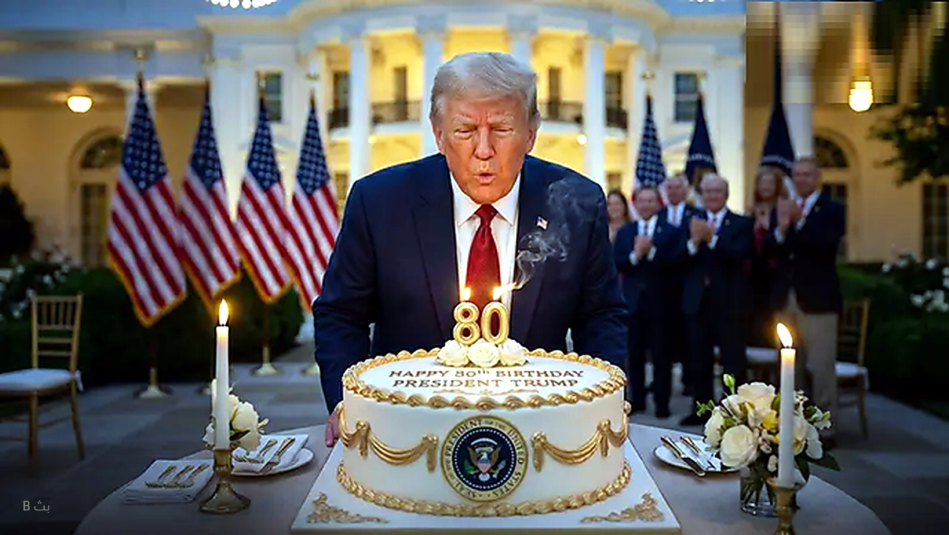
Day 105 🇺🇸⚔️🇮🇷: A Gray Agreement Under the Glow of Trump's 80th Candle
B بث
The United States and Iran announced that they had reached a framework agreement, or memorandum of understanding, paving the way for an end to the war that had lasted for months, with a formal in-person signing scheduled for June 19.
The announcement was marked by differing timelines. U.S. President Donald Trump stated that the agreement had been concluded on Sunday, coinciding with the celebration of his 80th birthday, while Tehran chose to announce it several hours later.
Observers believe Trump was keen to have the agreement recorded as both a political and personal achievement on his birthday, while Iran showed little enthusiasm for that timing and opted to delay its announcement until after midnight.
Thus, the agreement was effectively born with two different timelines: one agreement, but each side presented it to its audience in its own way.
At the same time, shipping companies are awaiting the completion of mine-clearing operations and the full restoration of navigation through the Strait of Hormuz, while global markets continue to monitor the agreement's implications and its potential impact on energy prices.
Despite the announcement, several key issues remain postponed to future rounds of negotiations, including Iran's nuclear program, its stockpile of highly enriched uranium, its ballistic missile program, and its relationships with regional allies.
What Does This Mean?
Wars often end either with a clear outcome or a comprehensive settlement.
What has emerged here appears closer to halting a major confrontation without fully resolving the issues that ignited it in the first place.
The two sides reached an agreement sufficient to stop the war.
But not necessarily one sufficient to eliminate its underlying causes.
For that reason, the current picture looks more like a political de-escalation than a final settlement.
What Deserves Attention?
The most sensitive issues remain unresolved.
The core subjects at the heart of the crisis:
- The nuclear program.
- Highly enriched uranium.
- Ballistic missiles.
- Regional influence.
All remain subject to further negotiations in the coming phase.
This means the agreement succeeded in stopping escalation.
But it has not yet succeeded in removing all sources of disagreement.
Who Won?
The question being asked today in Washington and Tehran is not:
Was an agreement reached?
But rather:
Who got what they wanted?
In the United States, Trump's supporters will argue that he ended the war and opened the door to lower tensions and greater market stability.
His critics, however, will point out that several objectives announced at the beginning of the crisis remain unresolved.
In Iran, some will argue that the system preserved its continuity and avoided more difficult scenarios.
Others will contend that economic and military pressure forced Tehran to accept an understanding it would not have considered months earlier.
The Sixty-Day Window
The most important number today may not be June 19.
It may be the sixty days that follow.
During that period, the real answers to the postponed questions will emerge:
Will the agreement evolve into a broader settlement?
Or will it become a temporary truce?
Can the parties overcome the most difficult issues?
Or will disagreements return to the forefront?
BETH Assessment
Current indicators suggest that both sides have reached what could be described as:
An Agreement of Necessity.
An agreement that stopped the war.
Reduced pressure.
And gave all parties an opportunity to reassess their calculations.
Yet it has not resolved the issues that created the crisis in the first place.
Therefore, the most important question today may not be:
Has the war ended?
But rather:
Has the process of resolving the crisis truly begun?
Some agreements are black or white.
This one, however, appears—for now—to be a Gray Agreement: one that stopped the fighting while leaving many questions unanswered.
Strategic Media Department | BETH Agency