



Dahis and Al-Ghabra
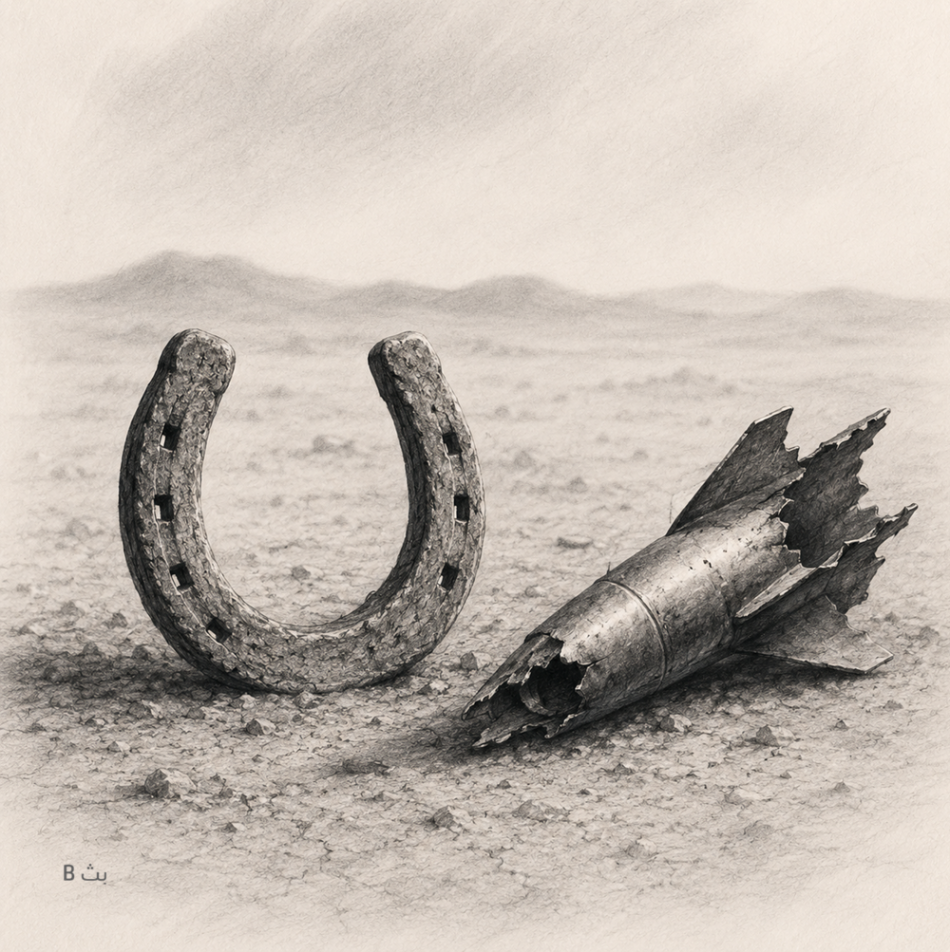
The War That Refuses to End
✍ Abdullah Al-Omairah
For thousands of years, humanity has believed that the latest war would be the last war.
Yet history smiles every time—and proves otherwise.
One of the most famous wars in Arab history still offers a lesson that remains relevant today: The War of Dahis and Al-Ghabra.
The war began over a horse race between two horses, Dahis and Al-Ghabra. What appeared to be a limited dispute soon escalated when accusations, suspicions, and the refusal to accept the outcome ignited a conflict that lasted for years between the tribes of Abs and Dhubyan.
The issue was never truly about a horse race.
It became a matter of honor, revenge, and prestige.
As time passed, many forgot how the conflict had started, yet the war itself continued.
In the end, the war concluded through reconciliation, exhaustion, and the realization that both sides had lost far more than they had been fighting for.
Here lies the enduring lesson:
Sometimes wars continue not because their original causes still exist, but because ending them becomes more difficult than sustaining them.
What Did the Desert Teach the Arabs?
For centuries, Arabs lived in a harsh environment.
The desert rarely allowed repeated mistakes.
Water was scarce.
Distances were vast.
Survival required patience, wisdom, and the ability to anticipate danger before it appeared.
As a result, Arabs developed qualities closely linked to survival:
Patience.
Endurance.
Generosity in times of hardship.
Respect for commitments.
And the ability to adapt to crises.
Arab tribes understood that war might sometimes be necessary, but they also understood that a conflict without an end in sight could exhaust everyone involved.
This is why Arab heritage contains as many stories of reconciliation as it does stories of courage.
Islam and the Building of Civilization
When Islam emerged, it did not present itself as a project to coerce people or erase identities.
Rather, it brought a system of values, ethics, and social organization.
Its civilization spread through trade, knowledge, language, scholarship, and human interaction as much as it spread through political power.
As a result, Islamic civilization left a lasting legacy in science, medicine, astronomy, mathematics, philosophy, architecture, and language, making a significant contribution to human civilization.
What Do Wars Do to Societies?
Throughout history, wars have been fought for different reasons.
Some were fought in defense of territory.
Some were struggles for influence.
Others sought control of resources, trade routes, or balances of power.
Yet the recurring outcome has been remarkably similar:
The longer wars last, the greater the cost for everyone.
Conversely, human experience shows that long periods of stability allow societies to integrate economically, culturally, and scientifically.
Human beings are naturally more inclined to build than to destroy.
And more inclined to cooperate than to fight when provided with a stable and secure environment.
The War That Refuses to End
From here, the discussion returns to our present day.
After more than one hundred days of confrontation between the United States and Iran, with Israel playing a central role in the conflict, the region appears trapped in a cycle that resembles Dahis and Al-Ghabra in a modern form.
Everyone claims to seek security.
Everyone says they are defending their interests.
Yet the fire continues to burn.
Escalation continues.
Negotiations resume and then stall.
It is as if the war itself has become part of the landscape.
What Does America Want?
Washington says it seeks to prevent Iran from acquiring capabilities that could threaten regional stability, American interests, and its allies.
It also seeks to protect its strategic influence and its network of interests stretching from the Gulf to the Eastern Mediterranean.
What Does Israel Want?
Israel says it seeks to eliminate what it views as an existential threat, preserve its military and security superiority, and prevent any regional power from acquiring capabilities that could alter the balance of deterrence.
What Does Iran Want? And What Does Its People Want?
The Iranian regime appears focused first and foremost on survival, preserving its regional influence, and maintaining the instruments of power it considers essential to its security and continuity.
The Iranian people, however, like people everywhere, are generally more concerned with economic stability, improved living standards, broader employment opportunities, and greater openness to the world.
This raises one of the most important questions in the region:
Do the priorities of the regime align with the priorities of society?
Or is the gap between what the state wants and what its citizens want part of a conflict that does not always appear on television screens?
What Do the Arabs Want?
Across their different countries and political systems, Arabs appear to share a common aspiration: stability, development, and avoiding prolonged conflicts that drain resources, delay economic progress, and increase uncertainty.
Different Structures... Different Concerns
It is interesting to note that the United States, Israel, and Iran—despite their significant differences—share one characteristic.
Each consists of multiple ethnic, cultural, religious, or social components and continually faces the challenge of managing this diversity while preserving national cohesion and political continuity.
This reality may influence how these states view security, identity, and threats, making internal unity an enduring strategic consideration.
The Arab world, despite differences among its states and societies, possesses broad common foundations: a shared language, interconnected history, a closely related cultural heritage, and deep religious and social ties.
This raises an important question:
Does the internal composition of states influence how they see the world, perceive threats, and make decisions during times of crisis?
Deep Roots
As for civilization, I will not recount its long history, nor will I engage in comparisons among nations and peoples.
I will leave readers to explore history for themselves.
Yet a few numbers are worth reflecting upon.
Scientists estimate that modern humans first appeared approximately 300,000 years ago.
Organized civilizations emerged only a few thousand years ago.
Archaeological studies indicate that Al-Maqar Civilization in the Arabian Peninsula dates back to around 9000 BCE—roughly 11,000 years ago.
By comparison, the first major Persian civilization known to history, the Achaemenid Empire, emerged around 550 BCE.
That is approximately 2,376 years ago.
The purpose of this comparison is neither to elevate one people above another nor to diminish any civilization, for every nation has contributed to human history.
Rather, it is an invitation to reflect on how civilizational depth influences collective consciousness and patterns of thought.
Long-term settlement on the land and the accumulation of experience across thousands of years leave their mark on culture, self-perception, patience, resilience, and decision-making.
This is why, when some politicians speak of destroying an entire civilization, they are often speaking the language of politics rather than the language of history.
Civilizations are not measured by missiles.
Nor are they erased by declarations.
They endure as long as their influence remains alive in people, memory, and culture.
The Lesson That Never Ages
History does not provide ready-made solutions.
But it does offer free lessons.
It teaches us that courage is not always found in starting wars.
That strength is not always found in prolonging them.
And that true wisdom sometimes lies in the ability to end conflicts before the parties involved forget why they began in the first place.
Just as Dahis and Al-Ghabra eventually ended after years of bloodshed and exhaustion, one question remains present in every age:
Do human beings learn from history?
Or will history continue repeating its lessons until someone is willing to listen?
Can the very nature of these states be part of the explanation for their behavior?
"History does not provide ready-made solutions... but it does offer free lessons."